 Indietro
Thermal Properties of Matter: Energy, Temperature, and the Ideal Gas Law
Guida di studio - Note intelligenti
 Appunti personalizzati basati sui tuoi materiali, ampliati con definizioni chiave, esempi e contesto.
Thermal Properties of Matter
Energy and Temperature
Thermal physics explores the relationship between energy, temperature, and the microscopic behavior of matter. In gases, temperature is directly related to the average kinetic energy of the molecules.
Internal Energy (E): The total energy contained within a system, primarily due to the kinetic energy of its molecules in an ideal gas.
Temperature (T): A measure of the average kinetic energy per molecule in a substance.
Relationship: For an ideal gas, the internal energy is given by: where N is the number of molecules, m is the mass of a molecule, v is the average speed, and k_B is Boltzmann's constant.
Key Point: Temperature is proportional to the average kinetic energy of the molecules.
Example: In a gas at thermal equilibrium, not all molecules move at the same speed; there is a distribution of molecular speeds.
Pressure in Gases
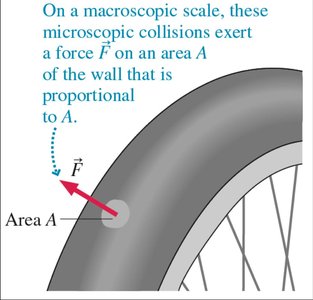
Pressure arises from the collective force exerted by gas molecules colliding with the walls of their container. It is defined as force per unit area.
Definition: , where F is the force exerted perpendicular to area A.
Unit: 1 Pascal (Pa) = 1 Newton per square meter (N/m2).
Microscopic Origin: On a macroscopic scale, pressure results from countless microscopic collisions of molecules with the container walls.
The Ideal Gas Law
The ideal gas law relates the pressure, volume, temperature, and number of particles in a gas. It is a fundamental equation of state for ideal gases.
Equation (Molecular Form):
Equation (Mole Form):
Variables:
p: Pressure
V: Volume
N: Number of molecules
n: Number of moles
k_B: Boltzmann's constant
R: Universal gas constant
T: Temperature (in Kelvin)
Why Two Forms? The molecular form uses the number of molecules and Boltzmann's constant, while the mole form uses the number of moles and the universal gas constant. Both describe the same physical law.
Units of pV: Joules (J), which are units of energy.
Behavior of Gases: Conceptual Questions
Expansion Without Friction: When a partition is removed quickly (without friction), the internal energy of the gas remains the same because no work is done and no heat is exchanged.
Expansion With Friction: If the partition moves with friction, some internal energy is converted to heat, increasing the internal energy of the gas.
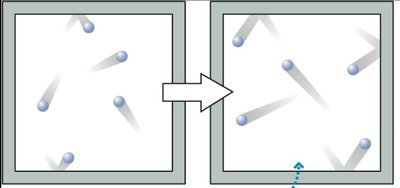
Pressure Change After Expansion: When the gas expands into a larger volume, its pressure decreases if temperature remains constant.
Effect of Temperature Increase: Increasing the temperature of a gas (at constant volume) increases its pressure.
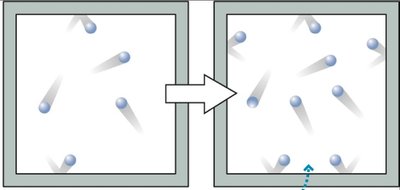
Effect of Increasing Number of Molecules: Adding more molecules (at constant volume and temperature) increases the pressure.
Exceptions to the Ideal Gas Law
The ideal gas law assumes non-interacting, point-like particles. Real gases deviate from this behavior under certain conditions:
High Pressure/Low Temperature: Intermolecular forces and finite molecular size become significant.
Polarity: Polar molecules interact more strongly, causing deviations from ideal behavior.
Extensive vs. Intensive Properties
Physical properties are classified based on how they scale with system size:
Extensive Properties: Depend on the amount of substance (e.g., internal energy, volume). Doubling the system doubles these quantities.
Intensive Properties: Independent of system size (e.g., temperature, pressure). Doubling the system does not change these quantities.
Property | Extensive/Intensive | Behavior When System is Doubled |
|---|---|---|
Internal Energy (E) | Extensive | Doubles |
Volume (V) | Extensive | Doubles |
Temperature (T) | Intensive | Unchanged |
Pressure (p) | Intensive | Unchanged |
Applications and Additional Context
Biological Systems: Pressure within organisms can vary; some areas (e.g., blood vessels) are under relatively constant pressure.
Space Environments: There is no atmospheric pressure in space. Astronauts rely on pressurized suits and spacecraft to maintain proper cardiovascular and respiratory function.
Additional info: The above notes expand on the brief lecture points to provide a self-contained summary suitable for exam preparation in a calculus-based physics course.
