 Indietro
Thermodynamics: Brayton Cycle, State Tables, and Entropy
Guida di studio - Note intelligenti
 Appunti personalizzati basati sui tuoi materiali, ampliati con definizioni chiave, esempi e contesto.
Brayton Cycle and Thermodynamic Processes
Overview of the Brayton Cycle
The Brayton cycle is a fundamental thermodynamic cycle used in gas turbine engines, such as those found in jet aircraft and power plants. It consists of four main processes: compression, heat addition, expansion, and heat rejection.
Compression: Air is compressed, increasing its pressure and temperature.
Heat Addition: Fuel is combusted, adding heat at constant pressure.
Expansion: The high-pressure, high-temperature gas expands through a turbine, producing work.
Heat Rejection: The gas releases heat at constant pressure, returning to its initial state.
Adiabatic Processes: Compression and expansion are typically modeled as adiabatic (no heat transfer).
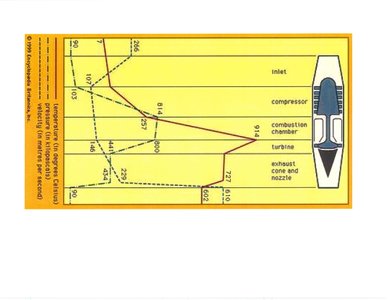
Example: Jet engines operate on the Brayton cycle, converting chemical energy from fuel into mechanical work and thrust. 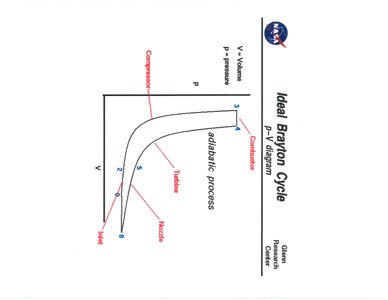
Thermodynamic State and Process Tables
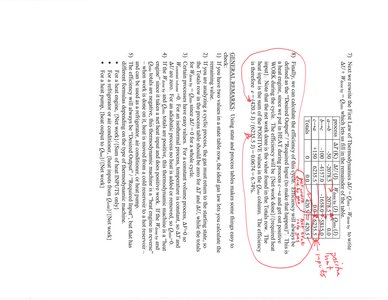
State and process tables are used to track the properties of a working fluid (such as air) at various points in a thermodynamic cycle. These tables typically include pressure, temperature, enthalpy, entropy, and other relevant properties.
State Table: Lists the properties of the fluid at each key point in the cycle (e.g., after compression, after heat addition).
Process Table: Describes the changes in properties during each process (e.g., from state 1 to state 2).
Application: Used to calculate work, heat transfer, and efficiency for each stage of the cycle.
Example: Calculating the enthalpy and entropy changes for air as it passes through a compressor and turbine.
State | Pressure (kPa) | Temperature (K) | Enthalpy (kJ/kg) | Entropy (kJ/kg·K) |
|---|---|---|---|---|
1 | 100 | 300 | 300 | 1.7 |
2 | 500 | 500 | 500 | 1.6 |
3 | 500 | 1500 | 1500 | 2.0 |
4 | 100 | 800 | 800 | 1.8 |
Additional info: Table values are representative; actual values depend on specific cycle parameters. 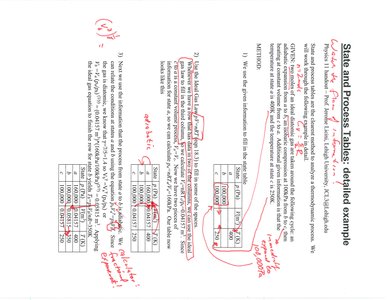
Entropy in Thermodynamic Cycles
Definition and Calculation of Entropy
Entropy is a measure of disorder or randomness in a system and is a key concept in the second law of thermodynamics. In thermodynamic cycles, entropy changes are used to analyze the efficiency and irreversibility of processes.
Formula for Entropy Change: For a reversible process, the change in entropy is given by:
For Ideal Gases: The entropy change can be calculated using: or
Application: Entropy calculations help determine the feasibility and efficiency of thermodynamic cycles.
Example: Calculating the entropy change for air during adiabatic compression in a Brayton cycle. 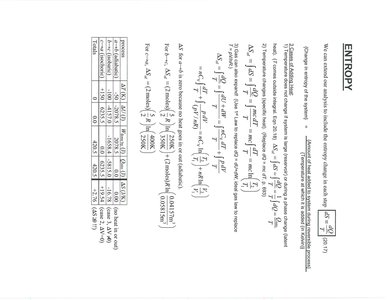
Thermodynamic Diagrams
p-v and T-s Diagrams
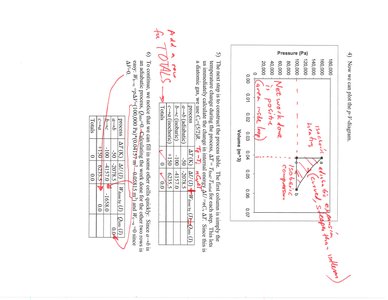
Thermodynamic diagrams, such as pressure-volume (p-v) and temperature-entropy (T-s) diagrams, visually represent the states and processes in a cycle.
p-v Diagram: Shows the relationship between pressure and volume during each process.
T-s Diagram: Illustrates temperature and entropy changes, useful for analyzing heat transfer and irreversibility.
Cycle Representation: Each process is shown as a curve or line connecting states; adiabatic and isothermal processes have characteristic shapes.
Example: The Brayton cycle is often depicted on a p-v diagram to show compression, heat addition, expansion, and heat rejection.
Summary of Key Concepts
Brayton Cycle: Fundamental for gas turbines; consists of compression, heat addition, expansion, and heat rejection.
State and Process Tables: Essential for tracking thermodynamic properties and calculating work and heat transfer.
Entropy: Central to the second law of thermodynamics; used to analyze efficiency and irreversibility.
Thermodynamic Diagrams: p-v and T-s diagrams provide visual understanding of cycles and processes.
Additional info: These notes cover topics relevant to Ch 17–20 (Temperature and Heat, Thermal Properties of Matter, First and Second Laws of Thermodynamics) and Ch 44 (Particle Physics and Cosmology, as related to energy cycles) in a Physics with Calculus course.
