 Indietro
Two-Dimensional Kinematics: Motion, Projectile Motion, and Applications
Guida di studio - Note intelligenti
 Appunti personalizzati basati sui tuoi materiali, ampliati con definizioni chiave, esempi e contesto.
Two-Dimensional Kinematics
Motion in Two Dimensions
Two-dimensional kinematics studies the motion of objects in a plane, where both the x (horizontal) and y (vertical) components must be considered. The equations of motion for constant acceleration are applied separately to each direction.
Position Equations:
Horizontal:
Vertical:
Velocity Equations:
Horizontal:
Vertical:
Constant Velocity: If , the object moves with constant velocity.
Component Analysis: Always resolve vectors into x and y components before applying equations.
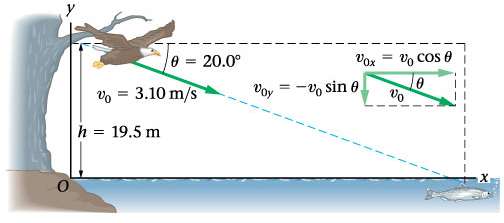
Example: Eagle Descending Toward Water
An eagle descends from a perch 19.5 m above water, maintaining a constant speed of 3.10 m/s at an angle 20.0˚ below the horizontal. The motion is analyzed by resolving the velocity into components and applying the kinematic equations.
Velocity Components:
Time to Reach Water: ; solve for when .
Horizontal Distance:
Displacement:
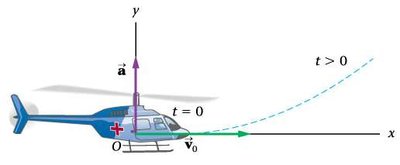
Example: Helicopter with Vertical Acceleration
A helicopter moves horizontally at 11 m/s and then accelerates vertically at 0.96 m/s2. The motion is analyzed using the kinematic equations for each direction.
Horizontal Motion: , so
Vertical Motion: , so
Velocity Components:
(constant)
Magnitude and Direction: ,
Displacement:
Projectile Motion
Definition and Equations
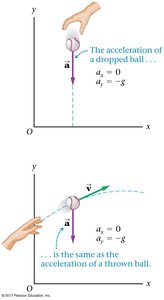
Projectile motion describes the path of an object launched into the air, moving under the influence of gravity alone. The horizontal acceleration is zero (), while the vertical acceleration is (downward).
Horizontal Equations:
Vertical Equations:
Vector Components: Always resolve initial velocity into and before solving.
Example: Projectile Launched at an Angle
A projectile is launched from the origin at 20.0 m/s at 35.0˚ above the horizontal. The position and velocity at various times are found by resolving the initial velocity and applying the kinematic equations.
Initial Velocity Components:
Position at s:
Position at s:
Position at s:
Velocity at s:
Velocity at s:
Maximum Height: At ,
Time to Maximum Height:
Times at Half Maximum Height: and (two answers because the projectile passes this height twice: once ascending, once descending)
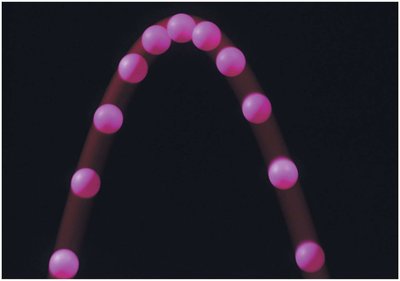
Example: The stroboscopic photo above shows the parabolic trajectory of a projectile, illustrating the change in vertical velocity and constant horizontal velocity.
Additional info: The equations and examples provided are fundamental for solving any two-dimensional kinematics or projectile motion problem in introductory physics with calculus.
