 Indietro
Two-Dimensional Kinematics: Projectile Motion and Applications
Guida di studio - Note intelligenti
 Appunti personalizzati basati sui tuoi materiali, ampliati con definizioni chiave, esempi e contesto.
Two-Dimensional Kinematics
Projectile Motion: Concepts and Problem Solving
Projectile motion is a classic example of two-dimensional kinematics, where an object moves under the influence of gravity alone after being projected. The motion can be analyzed by separating it into horizontal (x) and vertical (y) components, each governed by its own kinematic equations.
Horizontal motion: Constant velocity, since there is no horizontal acceleration ().
Vertical motion: Constant acceleration due to gravity ().
Trajectory: The path followed by a projectile is a parabola.
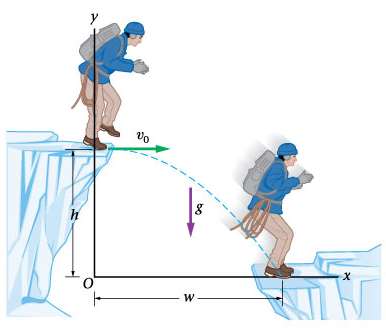
Example: Mountain Climber Crossing a Crevasse
This example illustrates how to apply the equations of projectile motion to solve for unknowns such as minimum speed, velocity at landing, and displacement.
Given: Vertical drop , horizontal distance , initial vertical velocity .
Find: (a) Minimum speed to cross, (b) velocity before landing, (c) displacement, (d) position and velocity at intermediate points.
Key Equations:
Vertical position:
Horizontal position:
Vertical velocity:
Horizontal velocity: (constant)
Solution Steps:
Time to cross: Set (landing level), solve for :
Minimum speed:
Velocity before landing:
(constant)
In unit vector notation:
Displacement:
Intermediate positions:
At , ,
Position vector:
Velocity at above lower level:
(negative sign: moving downward)
Velocity vector:
Magnitude:
Direction: below horizontal
Example: Football Kickoff
Projectile motion with an initial angle above the horizontal. The ball lands at the same vertical level as it was kicked.
Given: Range , launch angle
Find: (a) Initial speed, (b) time in air
Key Steps:
Resolve initial velocity: , w
Use and with at landing
Solve for and :
Result: ,
Example: Golf Ball Landing on a Higher Green
Projectile motion where the landing point is above the launch point.
Given: , ,
Find: (a) Height of green, (b) horizontal distance, (c) just before landing
Key Steps:
Resolve initial velocity: ,
Vertical position at landing:
Horizontal distance:
Vertical velocity:
Results: , ,
Projectile Motion: Characteristics and Terminology
Projectile motion exhibits several important characteristics and terminology:
Range: The horizontal distance traveled before landing.
Launch Angle: The angle above the horizontal at which the projectile is launched.
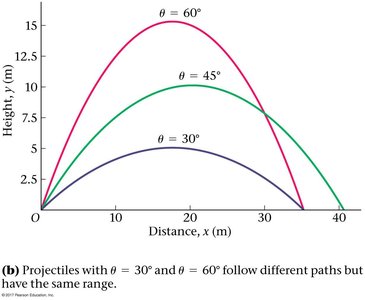
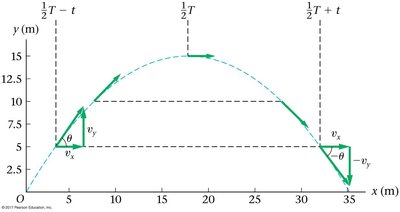
Symmetry: At a given height, the speed is the same on the way up as on the way down; the angle above the horizontal on the way up equals the angle below on the way down.
Parabolic Trajectory: The path of a projectile is a parabola.
Summary Table: Key Equations for Projectile Motion
Quantity | Equation | Description |
|---|---|---|
Horizontal position | Constant velocity in x-direction | |
Vertical position | Accelerated motion in y-direction | |
Horizontal velocity | Remains constant | |
Vertical velocity | Changes due to gravity | |
Range (level ground) | Maximum horizontal distance | |
Maximum height | Peak vertical position |
Additional info: The symmetry of projectile motion means that for complementary launch angles (e.g., and ), the range is the same if the initial speed is unchanged. The velocity vector at any point can be found by combining the horizontal and vertical components using the Pythagorean theorem and trigonometry.
