 Indietro
Vectors and Coordinate Systems: Foundations and Applications
Guida di studio - Note intelligenti
 Appunti personalizzati basati sui tuoi materiali, ampliati con definizioni chiave, esempi e contesto.
Vectors and Coordinate Systems
Introduction to Vectors
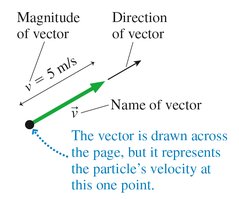
In physics, many quantities require both a magnitude and a direction for a complete description. These quantities are called vectors. Understanding vectors is essential for analyzing motion and forces in two and three dimensions.
Scalar: A quantity with only magnitude (e.g., mass, temperature).
Vector: A quantity with both magnitude and direction (e.g., displacement, velocity, force).
Notation: Vectors are typically denoted with an arrow above the symbol, such as .
Properties of Vectors
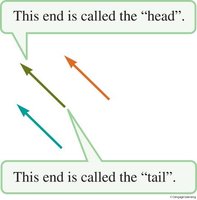
Vectors are represented graphically as arrows. The length of the arrow indicates the magnitude, and the direction of the arrow shows the direction of the vector. The starting point is called the tail, and the endpoint is the head.
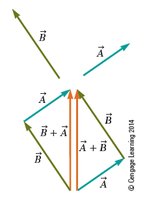
Equality: Two vectors are equal if they have the same magnitude and direction, regardless of their initial position.
Negative Vectors: Multiplying a vector by -1 reverses its direction.
Vector Addition and Subtraction
Graphical Methods
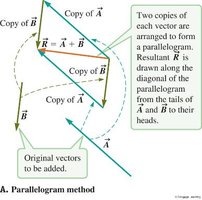
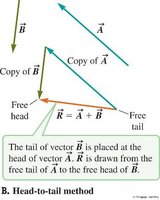
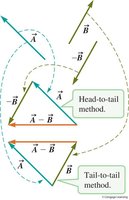
Vectors can be added or subtracted using graphical techniques. The two main methods are the parallelogram method and the head-to-tail method.
Parallelogram Method: Place the tails of both vectors together, complete the parallelogram, and the diagonal represents the resultant vector.
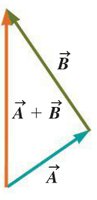
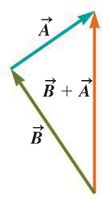
Head-to-Tail Method: Place the tail of the second vector at the head of the first. The resultant vector is drawn from the tail of the first to the head of the second.
Commutativity and Associativity
Vector addition is both commutative and associative:
Commutative:
Associative:
Vector Subtraction
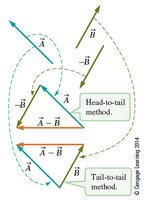
To subtract vectors, add the negative of the vector:
The negative of a vector has the same magnitude but opposite direction.
Displacement, Velocity, and Acceleration Vectors
Displacement
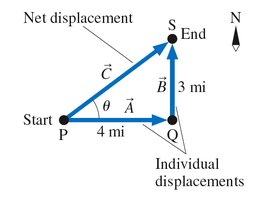
Displacement is a vector that points from an object's initial position to its final position. It is independent of the path taken.
Notation:
Velocity and Acceleration
Velocity is the rate of change of displacement, and acceleration is the rate of change of velocity. Both are vectors.
Average velocity:
Average acceleration:
Vector Components and Unit Vectors
Decomposing Vectors
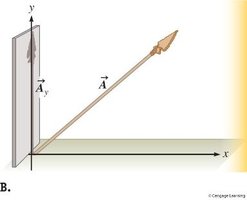
Any vector in a plane can be decomposed into components along the x- and y-axes. This process is called resolving a vector.
x-component:
y-component:
Signs must be assigned based on the vector's direction relative to the axes.
Unit Vectors
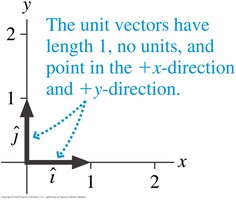
Unit vectors are vectors of length 1 that indicate direction along the coordinate axes. In Cartesian coordinates:
points in the +x direction
points in the +y direction
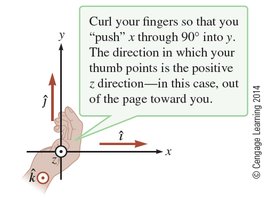
points in the +z direction (for 3D)
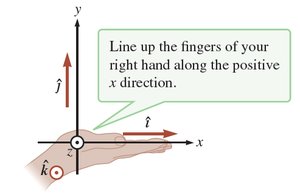
Right-Handed Coordinate Systems
Physics commonly uses right-handed coordinate systems. The orientation of the axes follows the right-hand rule, which is important for vector cross products and three-dimensional analysis.
Algebraic Vector Operations
Adding and Subtracting Components
Vectors can be added or subtracted algebraically by combining their components:
If and , then:
The magnitude of is
The direction is
Coordinate Systems
Cartesian and Polar Coordinates
Vectors can be represented in different coordinate systems:
Cartesian (Rectangular): Uses x, y, (and z) axes.
Polar: Uses a magnitude (r) and an angle () from a reference direction.
Conversion between systems:
Summary Table: Vector Operations
Operation | Graphical Method | Algebraic Method |
|---|---|---|
Addition | Parallelogram or head-to-tail | Add components: , |
Subtraction | Add the negative vector | Subtract components: , |
Multiplication by Scalar | Change length, reverse direction if negative | Multiply each component by scalar: |
Key Equations
Component form:
Magnitude:
Direction:
Example: Hiker's Displacement
A hiker walks 4 miles east, then 3 miles north. The net displacement is found by vector addition:
mi, mi
mi, mi
mi, mi
Magnitude: mi
Direction: north of east
Summary
Vectors are essential for describing physical quantities with both magnitude and direction.
They can be represented graphically and algebraically, and decomposed into components for easier calculations.
Understanding coordinate systems and vector operations is foundational for further study in physics.
