 Indietro
Vectors and Motion in One Dimension: Foundations of Physics with Calculus
Guida di studio - Note intelligenti
 Appunti personalizzati basati sui tuoi materiali, ampliati con definizioni chiave, esempi e contesto.
Scalars and Vectors
Definitions and Key Differences
In physics, quantities are classified as either scalars or vectors. Scalars are described completely by a magnitude (number and unit), while vectors require both magnitude and direction for a full description.
Scalar quantities: Examples include temperature, distance, area, volume, and speed.
Vector quantities: Examples include velocity, displacement, and force.
Combining Scalars: Scalars are added or subtracted using ordinary arithmetic rules.
Combining Vectors: Vectors require both magnitude and direction to be considered in operations such as addition, subtraction, and multiplication by scalars.
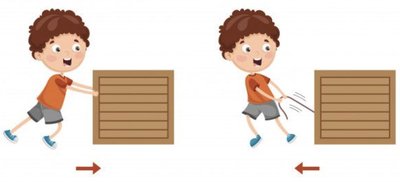
Distance and Displacement
Understanding the Concepts
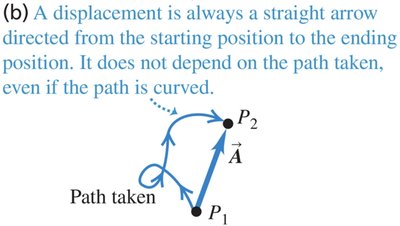
Distance is a scalar quantity representing the total length of the path traveled, regardless of direction. Displacement is a vector quantity representing the change in position from the initial to the final point, with both magnitude and direction.
Distance: Total path length (scalar).
Displacement: Straight-line vector from start to end position.
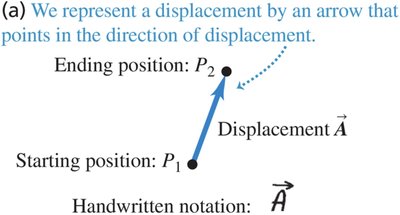
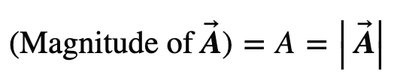
Magnitude of a Vector: The length of the vector, denoted as .
Vector Equality and Negation
Comparing and Reversing Vectors
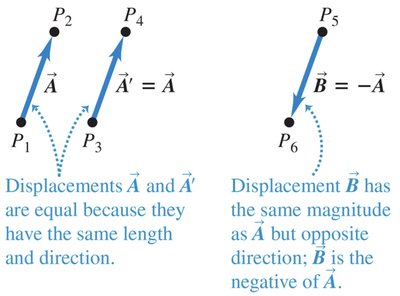
Two vectors are equal if they have the same magnitude and direction, regardless of their initial points. The negative of a vector has the same magnitude but the opposite direction.
Vector Addition
Graphical Methods
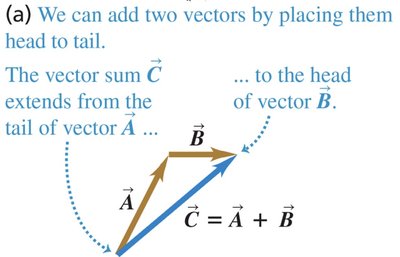
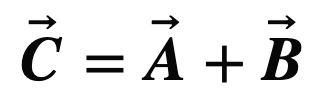
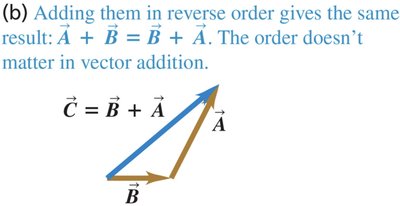
Vectors can be added using the head-to-tail method or by constructing a parallelogram. The resultant vector extends from the tail of the first vector to the head of the last vector.
Commutative property:
Parallelogram method: Place vectors tail-to-tail and complete the parallelogram; the diagonal is the sum.
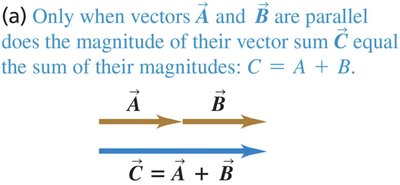
Special Cases: Parallel and Antiparallel Vectors
When vectors are parallel, their magnitudes add. When they are antiparallel (opposite directions), their magnitudes subtract.
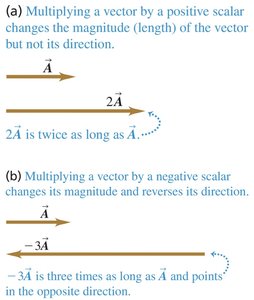
Multiplying Vectors by Scalars
Scaling Vectors
Multiplying a vector by a positive scalar changes its magnitude but not its direction. Multiplying by a negative scalar reverses the direction.
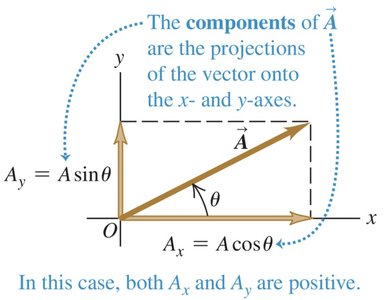
Vector Components
Breaking Vectors into Components
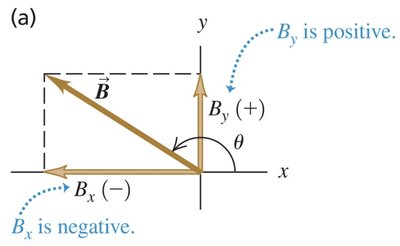
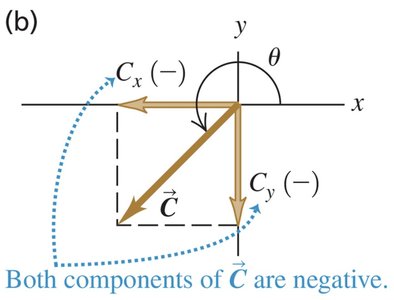
Any vector in a plane can be resolved into components along the x- and y-axes. The components are found using trigonometric functions:
Adding Vectors Using Components
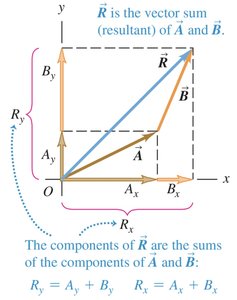
To add vectors, sum their respective components:
Unit Vectors
Expressing Vectors in Component Form
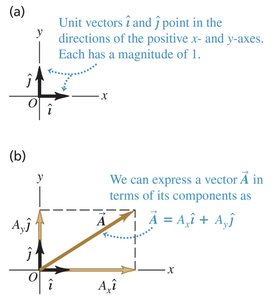
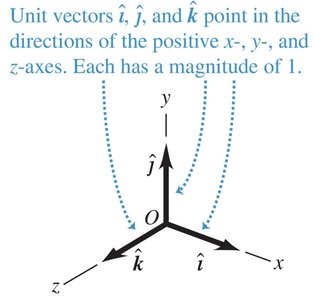
Unit vectors , , and point in the directions of the positive x-, y-, and z-axes, respectively, and have a magnitude of 1. Any vector can be written as a sum of its components multiplied by the corresponding unit vectors:
Example: Vector Operations in Three Dimensions
Finding the Magnitude of a Vector Expression
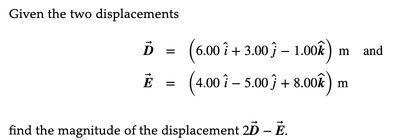
Given m and m, find the magnitude of .
First, compute m
Then, m
Magnitude: m
Applications: Relative Velocity
Example: Airplane Velocities
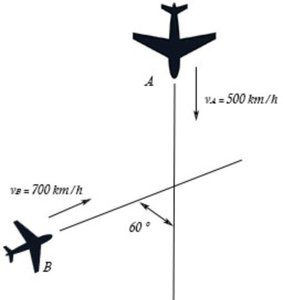
When analyzing the motion of two airplanes, their velocities are vectors that can be added or subtracted to find relative velocity. For example, if plane A is moving at 500 km/h downward and plane B at 700 km/h at a 60° angle, their relative velocity can be found using vector addition.
Summary Table: Scalar vs. Vector Quantities
Quantity | Scalar or Vector | Example |
|---|---|---|
Distance | Scalar | 5 m |
Displacement | Vector | 5 m east |
Speed | Scalar | 60 km/h |
Velocity | Vector | 60 km/h north |
Force | Vector | 10 N right |
Key Equations
Magnitude of a vector:
Vector addition (components):
Displacement:
