 Indietro
Vectors and Motion in Two Dimensions: Physics with Calculus Study Notes
Guida di studio - Note intelligenti
 Appunti personalizzati basati sui tuoi materiali, ampliati con definizioni chiave, esempi e contesto.
Vectors and Motion in Two Dimensions
Introduction
This chapter explores the use of vectors to analyze motion in two dimensions, including projectile and circular motion. Understanding vectors and their components is essential for solving problems involving objects moving in a plane.
Vectors: Definitions and Properties
What is a Vector?
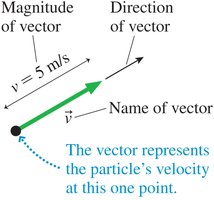
Vector: A quantity with both magnitude (size) and direction. Examples include displacement, velocity, and acceleration.
Scalar: A quantity with only magnitude (e.g., mass, temperature).
The magnitude of a vector is always positive.
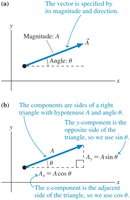
Vectors are represented graphically by arrows; the length indicates magnitude, and the arrow points in the direction.
Equality and Addition of Vectors
Two vectors are equal if they have the same magnitude and direction, regardless of their initial points.
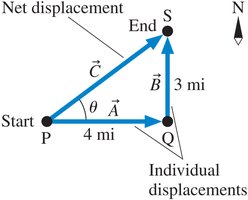
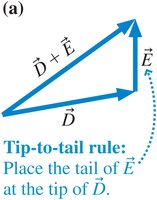
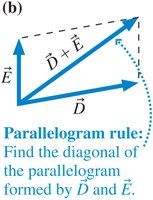
Resultant Vector: The sum of two or more vectors.
Vector Addition: Can be performed using the tip-to-tail method or the parallelogram rule.
Multiplication by a Scalar
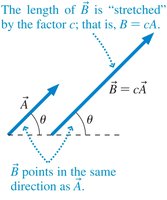
Multiplying a vector by a positive scalar changes its magnitude but not its direction.
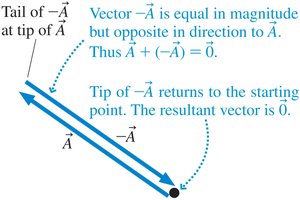
Multiplying by a negative scalar reverses the direction.
The zero vector has zero magnitude and no direction.
Vector Components and Coordinate Systems
Cartesian Coordinate System
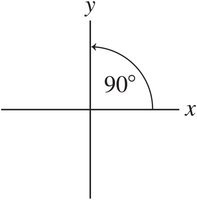
A grid with perpendicular x- and y-axes, intersecting at the origin (0,0).
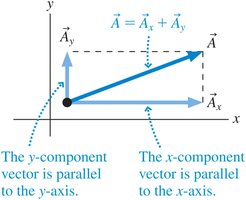
Vectors can be decomposed into components along these axes.
Component Vectors
Any vector \( \vec{A} \) can be written as the sum of its x- and y-components:
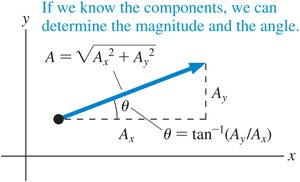
The magnitude of \( \vec{A} \) is found using the Pythagorean theorem:
The direction (angle θ) is given by:
Finding Components Using Trigonometry
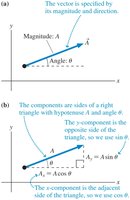
Given a vector of magnitude A at angle θ from the x-axis:
Working with Components
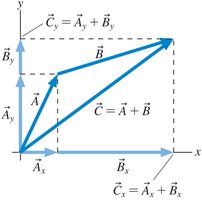
Vectors can be added or subtracted by adding or subtracting their components:
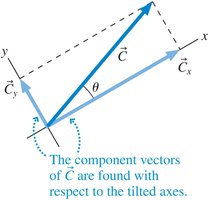
Tilted Axes
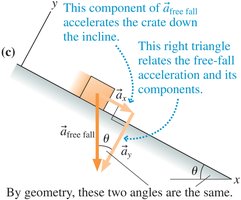
For motion on a slope, it is often useful to align the x-axis with the slope.
Components are found using the same trigonometric rules, but with respect to the tilted axes.
Motion on a Ramp
Constant-Velocity and Accelerated Motion
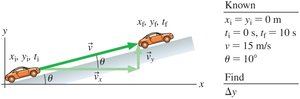
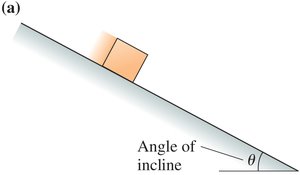
When an object moves up or down a ramp, its motion can be analyzed using vector components parallel and perpendicular to the ramp.
For constant velocity, the vertical component of velocity determines the height gained.
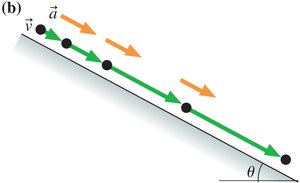
For accelerated motion (e.g., sliding down a frictionless ramp), the acceleration is a component of gravity:
Motion in Two Dimensions
General Two-Dimensional Motion
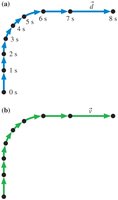
Displacement, velocity, and acceleration are all vectors and can change in both magnitude and direction.
Motion diagrams help visualize changes in position and velocity over time.
Acceleration in Two Dimensions
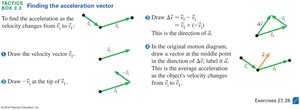
Acceleration occurs when velocity changes in magnitude, direction, or both.
The acceleration vector is found by the change in velocity over time:
Projectile Motion
Definition and Characteristics
A projectile moves in two dimensions under the influence of gravity alone (neglecting air resistance).
The path is a parabola.
Horizontal and vertical motions are independent:
Horizontal: constant velocity ()
Vertical: constant acceleration ()
Kinematic Equations for Projectile Motion
Horizontal position:
Vertical position:
Time of flight, range, and maximum height can be found using these equations.
Example: Dock Jumping
A dog runs off a dock at 8.5 m/s from a height of 0.61 m. The horizontal distance traveled before hitting the water is found by first calculating the time in the air (using vertical motion), then using horizontal velocity to find the range.
Circular Motion
Uniform Circular Motion
An object moving in a circle at constant speed has a velocity vector tangent to the circle and an acceleration vector pointing toward the center (centripetal acceleration).
The magnitude of centripetal acceleration is:
Example: Speed Skaters
Speed skaters rounding a turn of radius 11 m at high speed experience large centripetal accelerations, requiring them to lean into the turn.
Relative Motion
Relative Velocity
The velocity of an object depends on the observer's frame of reference.
Relative velocities are added as vectors:
Example: A plane flying east with a southward wind has a ground velocity that is the vector sum of its airspeed and the wind velocity.
Summary Tables
Summary of Key Equations
Concept | Equation |
|---|---|
Vector Magnitude | |
Vector Direction | |
Projectile Motion (horizontal) | |
Projectile Motion (vertical) | |
Centripetal Acceleration | |
Relative Velocity |
Conclusion
Understanding vectors and their application to two-dimensional motion is fundamental in physics. Mastery of vector addition, decomposition, and the analysis of projectile and circular motion provides the foundation for more advanced topics in mechanics.
