 Indietro
Vectors and Motion in Two Dimensions: Physics with Calculus Study Notes
Guida di studio - Note intelligenti
 Appunti personalizzati basati sui tuoi materiali, ampliati con definizioni chiave, esempi e contesto.
Vectors and Motion in Two Dimensions
Introduction
This chapter explores the use of vectors to analyze motion in two dimensions, a foundational concept in Physics with Calculus. Topics include vector operations, coordinate systems, motion on ramps, projectile motion, and the decomposition of motion into components.
Recap: One-Dimensional Motion
Velocity and Acceleration
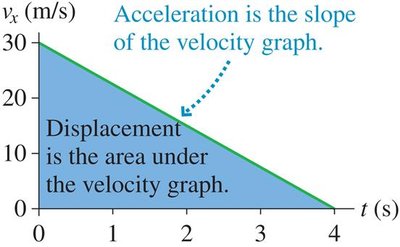
Velocity is the rate of change of position: (units: m/s).
Acceleration is the rate of change of velocity: (units: m/s2).
An object is speeding up if velocity and acceleration have the same sign; slowing down if they have opposite signs.
Free Fall
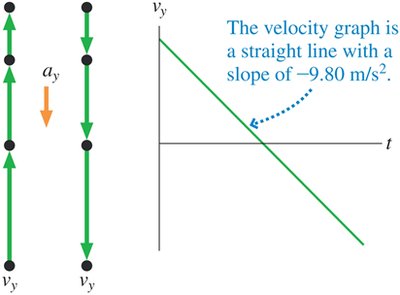
Free fall is a special case of constant acceleration, with (downward, ).
Vectors: Definitions and Properties
What is a Vector?
A vector is a quantity with both magnitude and direction (e.g., displacement, velocity, acceleration).
A scalar has only magnitude (e.g., mass, temperature).
Vector Addition
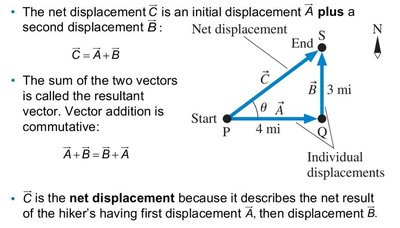
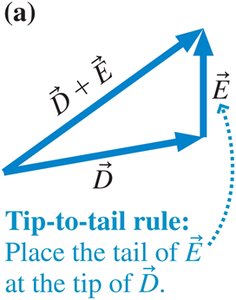
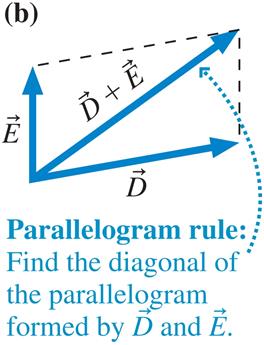
Vectors are added using the tip-to-tail rule or the parallelogram rule.
The resultant vector is the sum of two or more vectors.
Vector addition is commutative: .
Multiplication by a Scalar
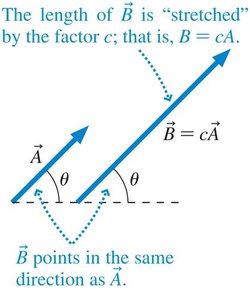
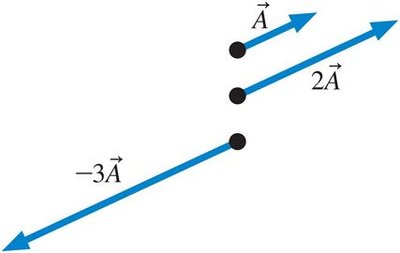
Multiplying a vector by a positive scalar changes its magnitude but not its direction: .
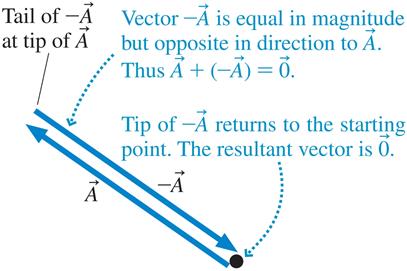
Multiplying by a negative scalar reverses the direction: points opposite to .
The zero vector has zero magnitude and no direction.
Vector Subtraction
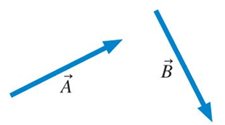
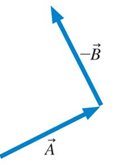
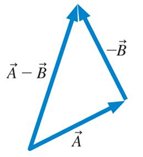
Subtracting vectors: .
Graphically, reverse the direction of and add to .
Coordinate Systems and Vector Components
Cartesian Coordinate System
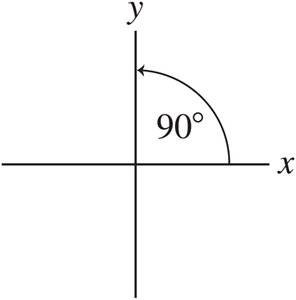
A coordinate system is a grid used to specify positions and directions.
Most problems use Cartesian coordinates (x, y axes at right angles).
Component Vectors
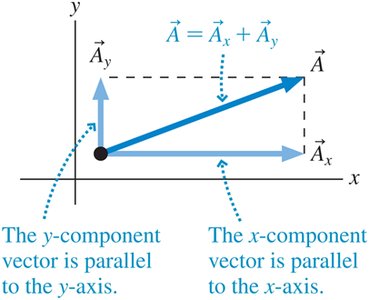
Any vector can be decomposed into x- and y-components: .
The x-component is parallel to the x-axis; the y-component is parallel to the y-axis.
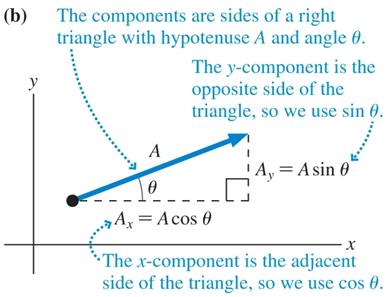
Finding Components from Magnitude and Angle
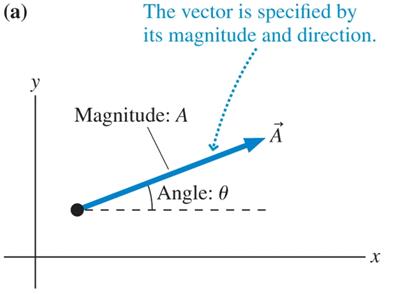
Given and angle from the x-axis:
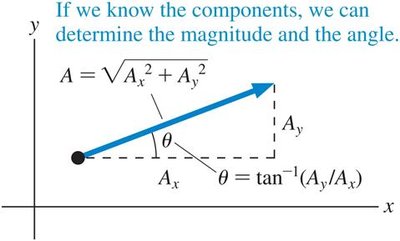
Finding Magnitude and Direction from Components
Given and :
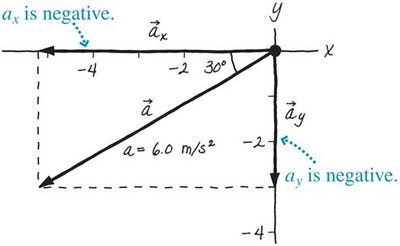
Example: Acceleration Vector Components
For a vector of magnitude 6.0 m/s2 at 30° below the negative x-axis:
Both and are negative.
Adding Vectors Using Components
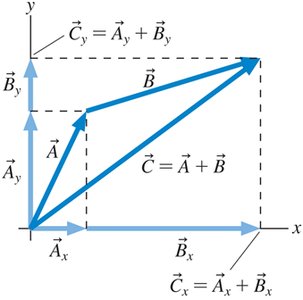
To add vectors and , add their components:
Tilted Axes
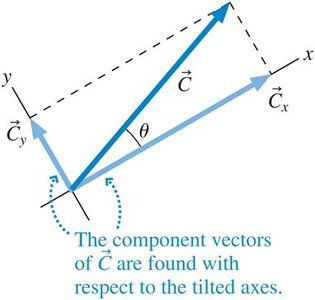
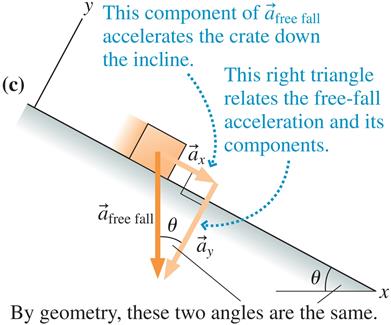
For motion on a slope, align the x-axis with the slope for easier analysis.
Decompose vectors relative to the tilted axes.
Motion on a Ramp
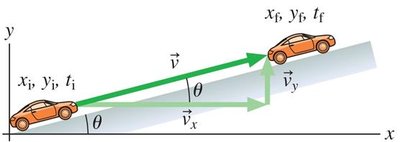
Constant-Velocity Motion on a Ramp
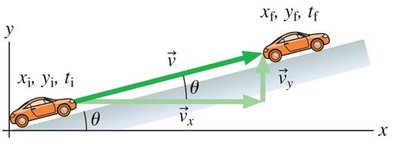
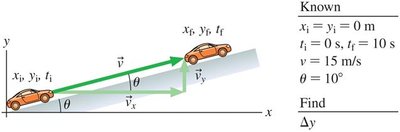
When an object moves up a ramp at constant speed, the vertical height gained is determined by the vertical component of velocity.
Accelerated Motion on a Ramp
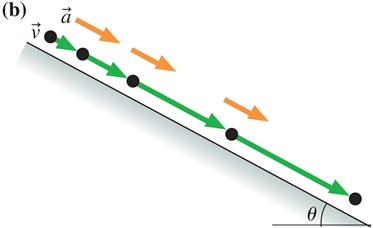
For a frictionless ramp, acceleration is parallel to the ramp and is a component of gravity:
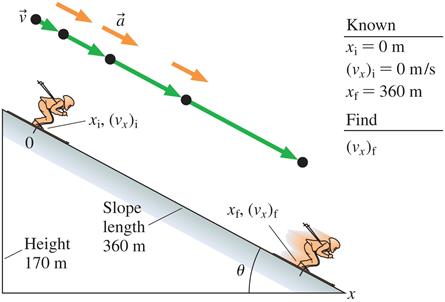
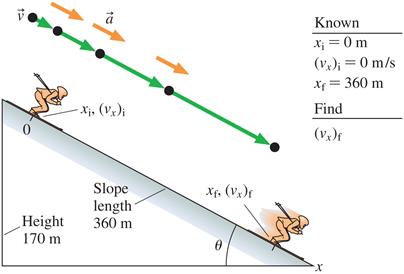
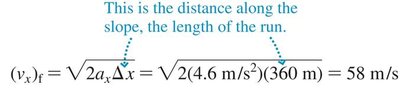
Example: Maximum Speed for a Skier
Given a slope of length 360 m and vertical drop 170 m, the maximum speed is found using kinematics and trigonometry.
Motion in Two Dimensions
General Two-Dimensional Motion
Objects can move in a plane, with displacement, velocity, and acceleration as vectors.
Examples: skating, Ferris wheel, car rounding a curve.
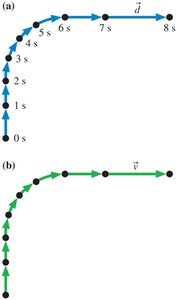
Motion Diagrams and Vectors
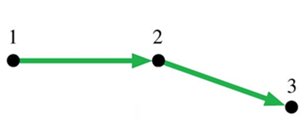
Displacement and velocity vectors can be drawn between successive positions in a motion diagram.
Acceleration in Two Dimensions
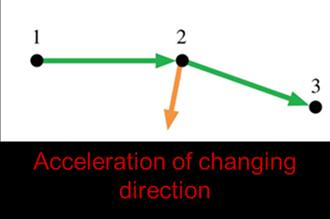
Acceleration occurs when velocity changes in magnitude or direction.
Vector definition:
Projectile Motion
Definition and Characteristics
A projectile moves in two dimensions under gravity alone (neglecting air resistance).
The path is a parabola.
Horizontal and vertical motions are independent.
Kinematic Equations for Projectile Motion
Horizontal motion: (constant velocity, )
Vertical motion: (constant acceleration, )
Problem-Solving Approach
Separate the problem into horizontal and vertical components.
Draw a diagram, define variables, and apply the appropriate kinematic equations.
Time of flight is the same for both components.
Example: Dock Jumping Dog
A dog runs off a dock at 8.5 m/s from a height of 0.61 m. Find the horizontal distance traveled before hitting the water.
Solution involves finding the time to fall vertically, then using horizontal velocity to find range.
Range of a Projectile
The range is the horizontal distance traveled.
Maximum range occurs at a launch angle of 45° (without air resistance).
Flight time depends on the vertical component of velocity.
Summary Table: Key Equations and Concepts
Concept | Equation | Description |
|---|---|---|
Vector Addition | Tip-to-tail or parallelogram rule | |
Components | , | From magnitude and angle |
Magnitude | From components | |
Projectile Motion (horizontal) | Constant velocity | |
Projectile Motion (vertical) | Constant acceleration | |
Ramp Acceleration | Component of gravity along ramp |
Study Tips
Practice decomposing vectors into components and recombining them.
Draw diagrams for all two-dimensional motion problems.
Always separate horizontal and vertical motions in projectile problems.
Check units and reasonableness of answers.
