 Indietro
Vectors and Position in Physics with Calculus
Guida di studio - Note intelligenti
 Appunti personalizzati basati sui tuoi materiali, ampliati con definizioni chiave, esempi e contesto.
Vectors and Coordinate Systems
Representing Position with Vectors
In physics, the position of an object in space can be described using a position vector. This vector indicates both the direction and the distance from the origin to the object's location.
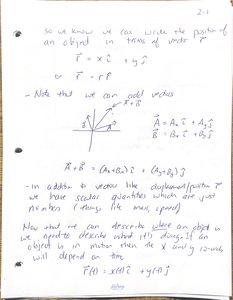
Position Vector \( \vec{r} \): The position of an object can be written as \( \vec{r} = x \hat{i} + y \hat{j} \), where \( x \) and \( y \) are the coordinates along the x- and y-axes, and \( \hat{i} \), \( \hat{j} \) are unit vectors in those directions.
Vector Notation: \( \vec{r} = r_x \hat{i} + r_y \hat{j} \)
Vector Addition
Vectors can be added together to find resultant vectors. This is done by adding their corresponding components.
Component Addition: If \( \vec{A} = A_x \hat{i} + A_y \hat{j} \) and \( \vec{B} = B_x \hat{i} + B_y \hat{j} \), then:
Graphical Representation: Vectors are often represented as arrows in a coordinate system, and their sum can be visualized using the "tip-to-tail" method.
Scalars and Vectors
In addition to vectors, which have both magnitude and direction, physics also uses scalars. Scalars are quantities that have only magnitude (such as time, mass, and speed).
Examples of Scalars: Time, mass, speed, temperature.
Examples of Vectors: Displacement, velocity, force.
Describing Motion in Two Dimensions
When describing the motion of an object in two dimensions, both the x and y components of its position may change with time. The position vector as a function of time is written as:
This allows us to track the object's motion in a plane, accounting for changes in both directions.
