 Indietro
Vectors and Their Applications in Physics with Calculus
Guida di studio - Note intelligenti
 Appunti personalizzati basati sui tuoi materiali, ampliati con definizioni chiave, esempi e contesto.
Vectors in Physics
Scalar and Vector Quantities
Physical quantities in physics are classified as either scalars or vectors. Scalars are completely specified by a single value with an appropriate unit and have no direction, while vectors possess both magnitude and direction.
Scalar Examples: Volume, mass, speed, time, temperature.
Vector Examples: Displacement, velocity, force, acceleration.
Scalar Manipulation: Uses ordinary arithmetic rules.
Vector Manipulation: Requires vector addition rules.
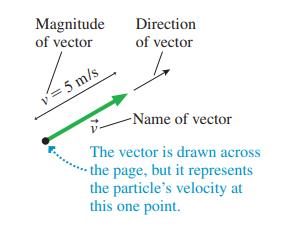
Vector Representation and Equality
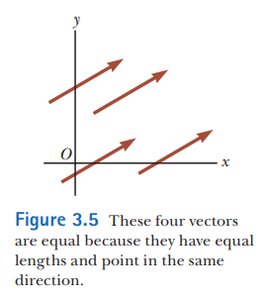
Vectors are represented graphically by arrows, where the length indicates magnitude and the arrow points in the direction. Two vectors are equal if they have the same magnitude and direction, regardless of their initial position.
Notation: Boldface with arrow (\( \vec{A} \)), magnitude as \( A = |\vec{A}| \).
Equality: \( \vec{A} = \vec{B} \) if and only if \( A = B \) and both point in the same direction.
Vector Operations
Vector Addition and Subtraction
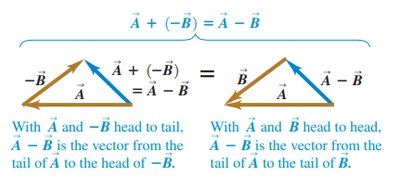
Vectors can be added graphically (head-to-tail method) or algebraically. Subtraction is performed by adding the negative of a vector.
Graphical Addition: Place the tail of one vector at the head of another; the resultant runs from the tail of the first to the head of the last.
Subtraction: \( \vec{A} - \vec{B} = \vec{A} + (-\vec{B}) \).
Magnitude Range: \( (A - B) \leq C \leq (A + B) \) for resultant \( C \).
Multiplying a Vector by a Scalar
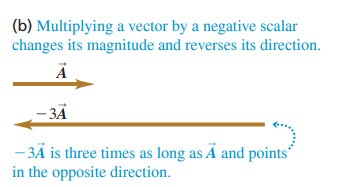
Multiplying a vector by a scalar changes its magnitude. If the scalar is negative, the direction is reversed.
Positive Scalar: Lengthens or shortens the vector.
Negative Scalar: Reverses direction and scales magnitude.
Coordinate Systems and Vector Components
Cartesian and Polar Coordinates
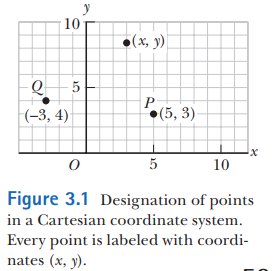
Vectors can be described using coordinate systems. The most common are Cartesian (rectangular) and polar coordinates.
Cartesian Coordinates: Use perpendicular axes (x, y, z) intersecting at the origin.
Polar Coordinates: Use distance from origin (r) and angle (\( \theta \)) from a fixed axis.
Vector Components
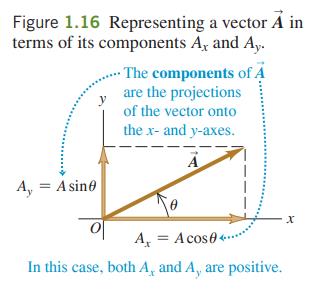
Any vector can be resolved into components along the axes. The components are projections onto the axes and are calculated using trigonometric functions.
Component Formulas:
\( A_x = A \cos \theta \)
\( A_y = A \sin \theta \)
Magnitude from Components: \( A = \sqrt{A_x^2 + A_y^2} \)
Direction from Components: \( \theta = \arctan \left( \frac{A_y}{A_x} \right) \)
Finding Components and Resultant Vectors
To add vectors using components, resolve each vector into its x and y components, sum the respective components, and use the Pythagorean theorem to find the resultant magnitude and direction.
Resultant Components:
\( R_x = A_x + B_x \)
\( R_y = A_y + B_y \)
Resultant Magnitude: \( R = \sqrt{R_x^2 + R_y^2} \)
Resultant Direction: \( \theta = \arctan \left( \frac{R_y}{R_x} \right) \)
Worked Example: Adding Vectors at Right Angles
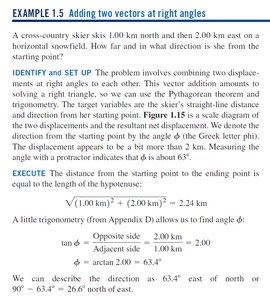
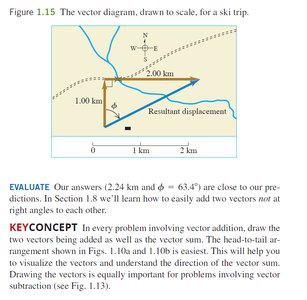
Consider a skier moving 1.00 km north and 2.00 km east. The resultant displacement is found using the Pythagorean theorem and trigonometry.
Resultant Distance: \( \sqrt{(1.00)^2 + (2.00)^2} = 2.24 \) km
Direction: \( \tan \phi = \frac{2.00}{1.00} \Rightarrow \phi = 63.4^\circ \) north of east
Test Your Understanding: Vector Difference Magnitude
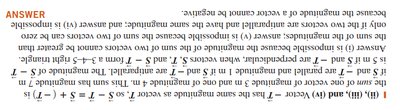
Given two displacement vectors \( S = 3 \) m and \( T = 4 \) m, the possible magnitudes of \( \vec{S} - \vec{T} \) are determined by the triangle inequality.
Possible Magnitudes: 1 m, 5 m, 7 m
Reason: The difference can range from \( |S - T| \) to \( S + T \).

Advanced Vector Operations
Unit Vectors
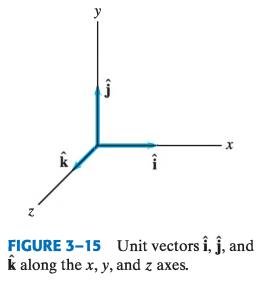
Unit vectors have a magnitude of one and indicate direction along coordinate axes. In three dimensions, the unit vectors are \( \hat{i} \), \( \hat{j} \), and \( \hat{k} \) for the x, y, and z axes respectively.
Vector in Unit Vector Form: \( \vec{A} = A_x \hat{i} + A_y \hat{j} + A_z \hat{k} \)
Magnitude: \( A = \sqrt{A_x^2 + A_y^2 + A_z^2} \)
Vector Addition and Subtraction Using Unit Vectors
Vectors can be added or subtracted by combining their respective components along each axis.
Example: Given \( \vec{D} = 6.00 \hat{i} + 3.00 \hat{j} - 1.00 \hat{k} \) m and \( \vec{E} = 4.00 \hat{i} - 5.00 \hat{j} + 8.00 \hat{k} \) m, find \( \vec{F} = 2\vec{D} - \vec{E} \).
Calculation:
\( \vec{F} = (8.00 \hat{i} + 11.00 \hat{j} - 10.00 \hat{k}) \) m
\( F = \sqrt{(8.00)^2 + (11.00)^2 + (-10.00)^2} = 16.9 \) m
Key Concepts and Cautions
Direction from Components
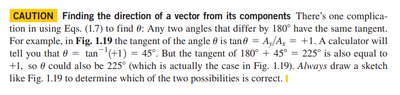
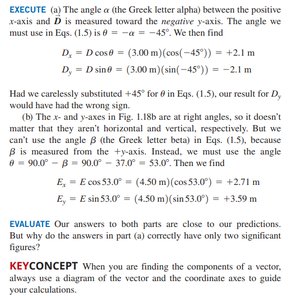
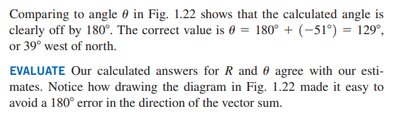
When finding the direction of a vector from its components, be aware that any two angles differing by 180° have the same tangent. Always use a diagram to determine the correct direction.
Summary Table: Vector Operations
Operation | Formula | Result |
|---|---|---|
Addition | \( \vec{A} + \vec{B} \) | Vector sum |
Subtraction | \( \vec{A} - \vec{B} \) | Vector difference |
Scalar Multiplication | \( k\vec{A} \) | Scaled vector |
Magnitude | \( |\vec{A}| = \sqrt{A_x^2 + A_y^2 + A_z^2} \) | Scalar |
Direction | \( \theta = \arctan \left( \frac{A_y}{A_x} \right) \) | Angle |
Key Concept
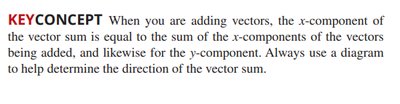
When adding vectors, the x-component of the vector sum is equal to the sum of the x-components of the vectors being added, and likewise for the y-component. Always use a diagram to help determine the direction of the vector sum.
Additional info:
These notes cover the fundamental concepts of vectors, their representation, operations, and applications in Physics with Calculus. The examples and diagrams reinforce the graphical and algebraic methods used in vector analysis, which are essential for solving physics problems involving motion, forces, and other vector quantities.
