 Indietro
Vectors in Physics: Definitions, Representation, and Operations
Guida di studio - Note intelligenti
 Appunti personalizzati basati sui tuoi materiali, ampliati con definizioni chiave, esempi e contesto.
Vectors in Physics
Scalars and Vectors
In physics, quantities are classified as either scalars or vectors. Scalars are described by a magnitude (numerical value) and appropriate units, while vectors require both a magnitude and a direction for their complete description.
Scalar: A physical quantity represented by a number and units (e.g., distance, speed, temperature).
Vector: A physical quantity with both magnitude and direction (e.g., position, displacement, velocity, acceleration).
Vector Notation: Vectors are typically denoted in boldface with an arrow overhead, such as .
Magnitude of a Vector: Denoted as or .
Equality of Vectors: Two vectors are equal if they have the same magnitude and direction, regardless of their initial position.
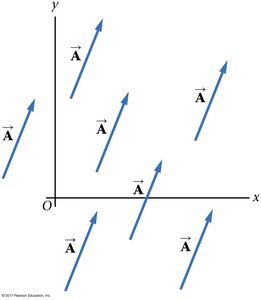
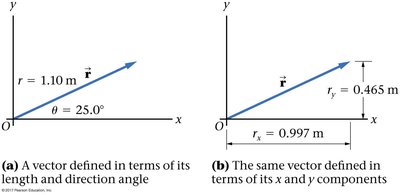
Vector Representation: Components and Polar Form
A vector can be specified in two common ways: by its magnitude and direction (polar representation), or by its components along the coordinate axes (component representation).
Polar Representation: Defined by the vector's length and the angle it makes with a reference axis.
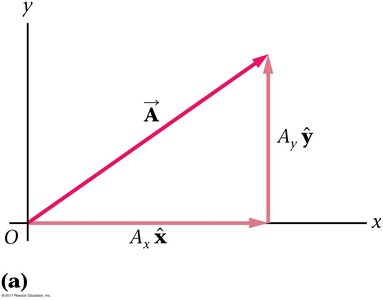
Component Representation: Defined by the projections of the vector along the and axes.
Conversion between Representations:
Given components and , the magnitude and direction are:
Vector Components and Quadrants
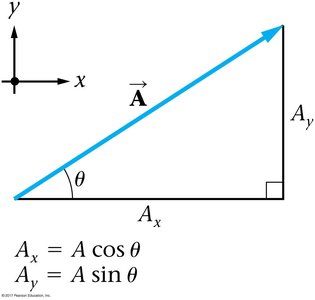
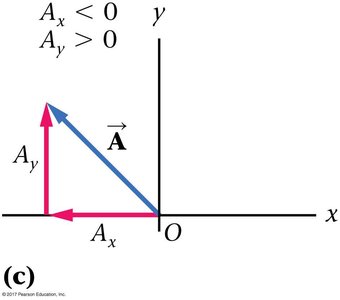
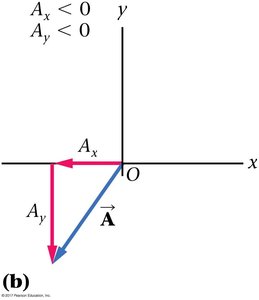
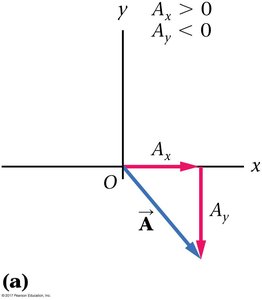
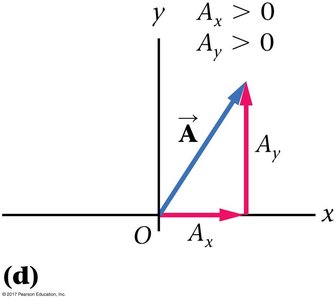
The components of a vector can be positive or negative, depending on the vector's direction relative to the coordinate axes. The angle is measured counterclockwise from the positive -axis. It is important to draw the vector in the correct quadrant to interpret the angle correctly.
Component Formulas:
Quadrant Considerations: The signs of and depend on the quadrant in which the vector lies.
Vector Addition and Subtraction
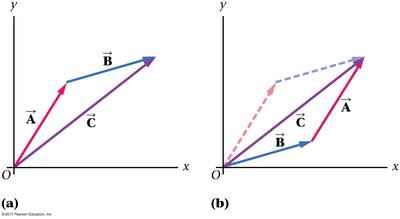
Vectors can be added or subtracted using graphical or component methods. The resultant vector is independent of the order of addition (commutative property).
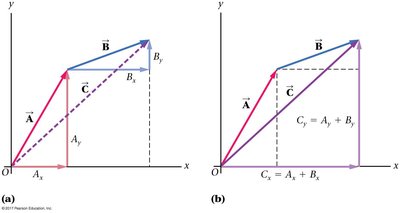
Graphical Addition: Place the tail of the second vector at the tip of the first; the resultant extends from the tail of the first to the tip of the last.
Component Addition: Add the corresponding components of the vectors:
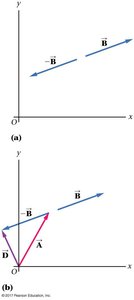
Subtraction: To subtract from , add $\vec{A}$ to (reverse the direction of $\vec{B}$).
Scalar Multiplication and Unit Vectors
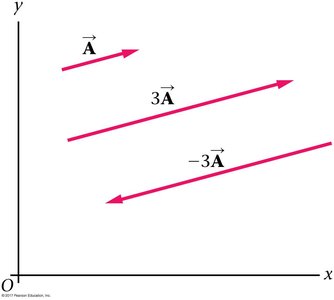
Multiplying a vector by a scalar changes its magnitude but not its direction (unless the scalar is negative, in which case the direction reverses). Any vector in two dimensions can be expressed in terms of unit vectors along the and axes.
Scalar Multiplication: For scalar , has magnitude and direction same as if , opposite if .
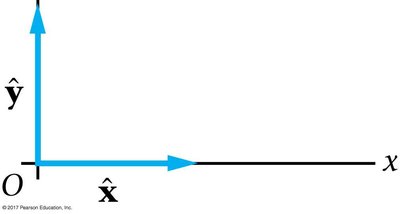
Unit Vectors:
: Unit vector in the positive -direction
: Unit vector in the positive -direction
Any vector can be written as
Worked Example: Vector Addition and Components
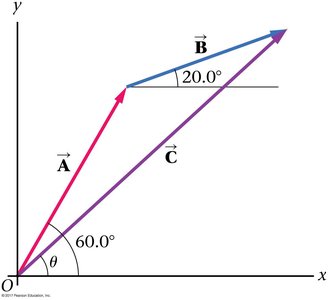
Consider vectors and with given magnitudes and directions. The steps for finding their sum using components are as follows:
Resolve each vector into and components using trigonometric functions.
Tabulate the components for clarity.
Add the corresponding components to find the resultant vector .
Calculate the magnitude and direction of using the Pythagorean theorem and inverse tangent.
Express each vector in unit vector notation.
Vector | x component (m) | y component (m) |
|---|---|---|
43.3 | -25.0 | |
37.5 | 65.0 | |
80.8 | 40.0 |
above the positive -axis
Unit vector notation:
Additional info: Tabulating vector components is a standard practice in physics to organize calculations and reduce errors, especially when dealing with multiple vectors.
