 Indietro
Vectors in Physics: Magnitude, Direction, and Applications
Guida di studio - Note intelligenti
 Appunti personalizzati basati sui tuoi materiali, ampliati con definizioni chiave, esempi e contesto.
Vectors in Physics
Introduction to Vectors
Vectors are quantities that possess both magnitude and direction, making them essential for describing physical phenomena such as displacement, velocity, and acceleration. In physics, vectors are typically represented in component form using unit vectors along the coordinate axes.
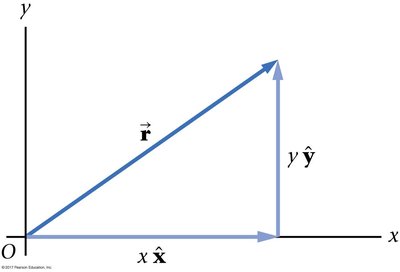
Vector Notation: A vector \( \vec{A} \) in two dimensions can be written as \( \vec{A} = A_x \hat{x} + A_y \hat{y} \).
Magnitude: The magnitude of a vector is found using the Pythagorean theorem:
Direction: The direction (angle \( \theta \)) is given by:
Unit Vectors: \( \hat{x} \) and \( \hat{y} \) are unit vectors in the x and y directions, respectively.
Example: For \( \vec{A} = 1.50\,\text{m}\,\hat{x} - 2.40\,\text{m}\,\hat{y} \), the magnitude is and the direction is (calculator result). Always sketch the vector to confirm the correct quadrant for the angle.
Common Physics Vectors
Vectors are used to represent a variety of physical quantities:
Position Vector (\( \vec{r} \)): Specifies the location of an object in space.
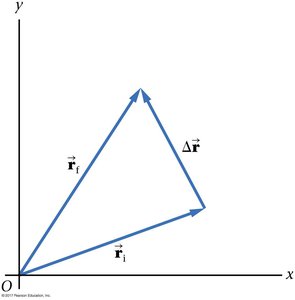
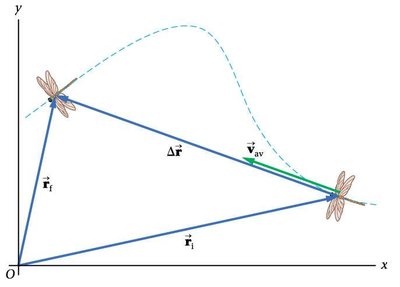
Displacement Vector (\( \Delta \vec{r} \)): Represents the change in position.
Component Method for Vectors
Vectors can be broken into components for easier calculation. For a vector with magnitude \( r \) and angle \( \theta \) from the positive x-axis:
\( x = r \cos \theta \)
\( y = r \sin \theta \)
Example: If \( \vec{r}_i \) has a magnitude of 3.50 m at 145° from the positive x-axis: So, \( \vec{r}_i = -2.87\,\text{m}\,\hat{x} + 2.01\,\text{m}\,\hat{y} \).
Position, Displacement, Velocity, and Acceleration Vectors
Position and Displacement
The position vector locates an object in space, while the displacement vector describes the change in position over time.
Position:
Displacement:
Velocity Vectors
Velocity vectors describe the rate of change of position. There are two main types:
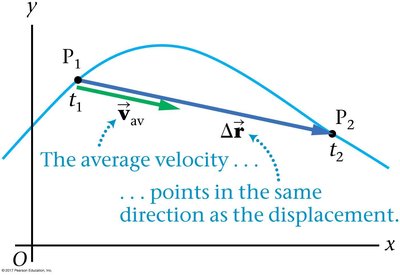
Average Velocity:
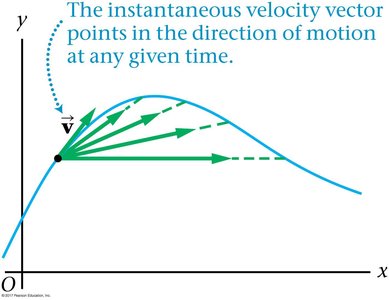
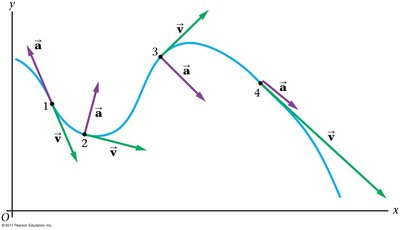
Instantaneous Velocity:
The average velocity vector points in the direction of the displacement, while the instantaneous velocity vector is tangent to the path at any instant.
Example: Displacement and Average Velocity
Example: A dragonfly moves from \( \vec{r}_i = 4.60\,\text{m}\,\hat{x} + 0.960\,\text{m}\,\hat{y} \) to \( \vec{r}_f = 0.520\,\text{m}\,\hat{x} + 2.40\,\text{m}\,\hat{y} \) in 3.00 s.
Acceleration Vectors
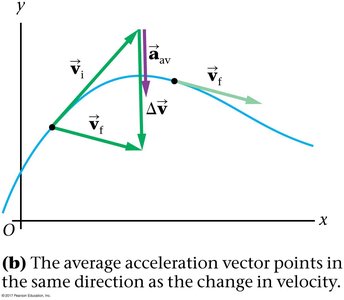
Acceleration vectors describe the rate of change of velocity. Like velocity, there are average and instantaneous forms:
Average Acceleration:
Instantaneous Acceleration:
The average acceleration vector points in the direction of the change in velocity.
Velocity and Acceleration Directions
The velocity vector always points in the direction of motion, while the acceleration vector points in the direction of the change in velocity, which may not always align with the direction of motion.
Example: Calculating Average Acceleration
Example: A car changes velocity from \( \vec{v}_i = -6.36\,\text{m/s}\,\hat{x} + 6.36\,\text{m/s}\,\hat{y} \) to \( \vec{v}_f = 15.00\,\text{m/s}\,\hat{y} \) in 8.00 s. The magnitude is and the direction is .
Summary Table: Vector Quantities in Kinematics
Quantity | Symbol | Formula | SI Unit |
|---|---|---|---|
Position | \( \vec{r} \) | m | |
Displacement | \( \Delta \vec{r} \) | m | |
Average Velocity | \( \vec{v}_{av} \) | m/s | |
Instantaneous Velocity | \( \vec{v} \) | m/s | |
Average Acceleration | \( \vec{a}_{av} \) | m/s2 | |
Instantaneous Acceleration | \( \vec{a} \) | m/s2 |
Additional info: The above notes expand on the lecture content by providing definitions, formulas, and examples for each vector quantity, as well as a summary table for quick reference. The included images directly illustrate the concepts of position, displacement, velocity, and acceleration vectors as discussed in the text.
