 Indietro
Waves, Sound, Resonance, and Damping: Physics with Calculus Study Notes
Guida di studio - Note intelligenti
 Appunti personalizzati basati sui tuoi materiali, ampliati con definizioni chiave, esempi e contesto.
Waves & Sound
Speed of Sound
The speed of sound is the rate at which sound waves propagate through a medium. It is determined by the properties of the medium, not the frequency of the sound itself.
Speed of sound is frequency independent: All frequencies travel at the same speed in a given medium.
Formula for speed of sound in air (as a function of temperature):
where is the speed of sound in m/s, and is the temperature in °C.
At 21°C, m/s in air.
Speed increases with temperature and elasticity, and decreases with density.
Typical values:
Air: 344 m/s
Fresh water: 1480 m/s
Salt water: 1520 m/s
Human body: 1558 m/s
Steel: 5050 m/s
Glass: 5200 m/s
Elasticity is the tendency to resist and recover from distortion. Water, steel, and glass are more elastic than air, which is why sound travels faster in them.
Resonance & Natural Frequency
Natural or Resonant Frequency ()
Every vibrating object has a natural (resonant) frequency at which it prefers to vibrate. This frequency depends on the object's mass and stiffness (elasticity).
Simple harmonic motion describes free vibrations in the absence of friction.
Key relationships:
If mass () increases by 4×, frequency () decreases by 1/2.
If stiffness () increases by 4×, frequency () increases by 2×.
General formula for resonant frequency:
For a pendulum:
For a string: where is tension, is mass per unit length, is length.
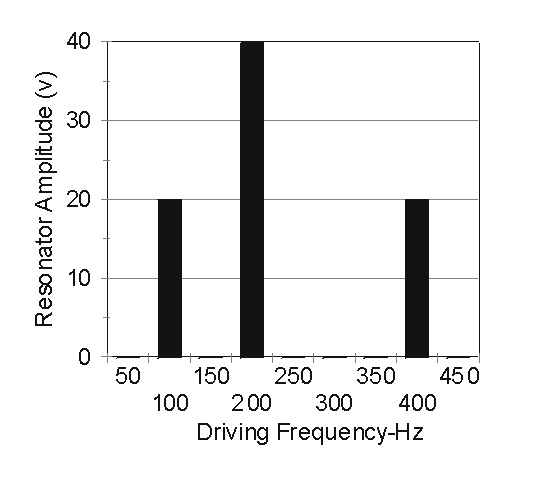
Resonance occurs when the driving frequency matches the natural frequency, resulting in maximum amplitude vibrations.

Vibrational Damping
Damping and Types of Damped Systems
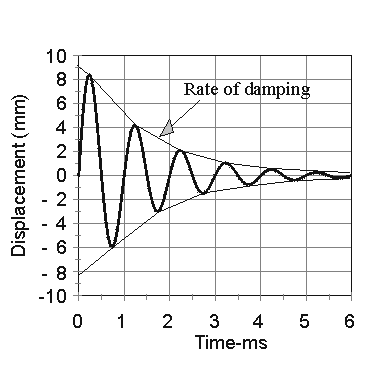
Damping is the decrease in vibration amplitude over time due to resistance (friction or other dissipative forces). Without damping, vibrations would continue indefinitely.
Low damping: Vibrations persist for a long time.
High damping: Vibrations die out quickly.
Types of damping:
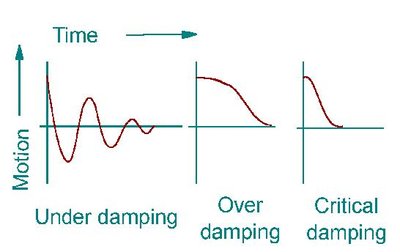
Undamped (lossless): Theoretical, no energy loss, .
Underdamped: Vibrations continue for a long time, slow energy loss.
Overdamped: No oscillation, energy drains slowly.
Critically damped: No oscillation, energy decays to zero as quickly as possible (e.g., car shock absorbers).
Quantifying Damping
The damping factor () quantifies the rate at which amplitude decreases. For two consecutive cycles with amplitudes and :
Example: If , , then .
Acoustic Impedance (Z)
Definition and Components
Acoustic impedance () is the total opposition to motion in a vibrating system. It has two main components:
Resistance (R): Frequency-independent, dissipates energy as heat (analogous to friction).
Reactance (X): Frequency-dependent, stores energy as potential or kinetic energy.
(where is the imaginary unit)
Types of Reactance
Mass Reactance (): Proportional to frequency (),
Compliant Reactance (): Inversely proportional to frequency, (where is compliance, the inverse of stiffness)
At low frequencies, compliant reactance dominates; at high frequencies, mass reactance dominates. At the resonant frequency, and only resistance remains.
Phase Relationships
Mass reactance leads resistance by 90°.
Compliant reactance lags resistance by 90°.
When , they cancel each other, defining the resonant frequency.
Summary Table: Acoustic Impedance Components
Component | Symbol | Frequency Dependence | Physical Meaning |
|---|---|---|---|
Resistance | R | Independent | Energy dissipation (heat) |
Mass Reactance | Xm | Directly proportional | Inertial opposition (stores KE) |
Compliant Reactance | Xc | Inversely proportional | Elastic opposition (stores PE) |
Applications and Examples
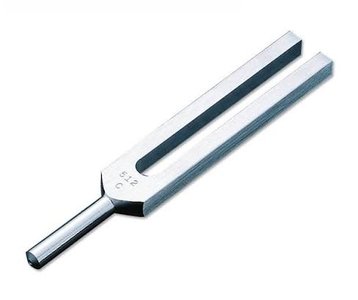
Tuning forks: Demonstrate resonance and natural frequency. When struck, they vibrate at their natural frequency, producing a pure tone.
Musical instruments: Strings, air columns, and membranes all have natural frequencies determined by their physical properties.
Engineering: Damping is crucial in designing systems like car suspensions to avoid unwanted oscillations.
Biological Example: Cochlear Outer Hair Cells (OHCs)
In the human cochlea, the length of outer hair cells varies with the characteristic frequency they detect. Shorter OHCs are found at the base (high frequency), and longer OHCs at the apex (low frequency).
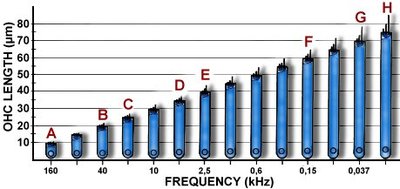
Additional info: This illustrates how physical properties (length, stiffness) determine resonant frequency in biological systems, analogous to physical oscillators.
