Ch 19: Work, Heat, and the First Law of Thermodynamics
Knight Calc - Physics for Scientists and Engineers 5th Edition
Knight Calc5th EditionPhysics for Scientists and EngineersISBN: 9780137344796Non è quello che usi tu?Cambia libro di testo
Capitolo 19, Problema 11

500 J of heat energy are transferred to a gas during a process in which the gas expands at constant pressure from 400 cm3 to 800 cm3. The gas's thermal energy increases by 300 J during this process. What is the gas pressure?

Guida verificata passo dopo passo
1
Step 1: Understand the problem. The gas undergoes a process where heat energy is transferred, and it expands at constant pressure. The thermal energy change and the work done by the gas are related to the heat energy transferred. We need to calculate the pressure of the gas.
Step 2: Recall the first law of thermodynamics: \( Q = \Delta U + W \), where \( Q \) is the heat energy transferred, \( \Delta U \) is the change in thermal energy, and \( W \) is the work done by the gas. Substitute the given values: \( Q = 500 \; \text{J} \) and \( \Delta U = 300 \; \text{J} \).
Step 3: Calculate the work done by the gas using \( W = Q - \Delta U \). Substitute \( Q = 500 \; \text{J} \) and \( \Delta U = 300 \; \text{J} \) into the equation to find \( W \).
Step 4: Recall the formula for work done by a gas at constant pressure: \( W = P \Delta V \), where \( P \) is the pressure and \( \Delta V \) is the change in volume. Convert the volume from \( \text{cm}^3 \) to \( \text{m}^3 \) (since \( 1 \; \text{cm}^3 = 10^{-6} \; \text{m}^3 \)) and calculate \( \Delta V = V_{\text{final}} - V_{\text{initial}} \).
Step 5: Rearrange the formula \( W = P \Delta V \) to solve for \( P \): \( P = \frac{W}{\Delta V} \). Substitute the values of \( W \) and \( \Delta V \) into the equation to find the pressure of the gas.

Risposta video verificata per un problema simile:

Questa soluzione video è stata consigliata dai nostri tutor come utile per risolvere questo problema.
Durata del video:
4m

Concetti chiave

Ecco i concetti essenziali che devi comprendere per rispondere correttamente alla domanda.

First Law of Thermodynamics

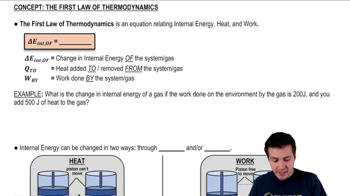
The First Law of Thermodynamics states that energy cannot be created or destroyed, only transformed from one form to another. In the context of thermodynamic processes, it relates the change in internal energy of a system to the heat added to the system and the work done by the system. This principle is crucial for analyzing energy transfers in processes involving gases.
Video consigliato:
Percorso guidato
08:04
The First Law of Thermodynamics

Work Done by a Gas

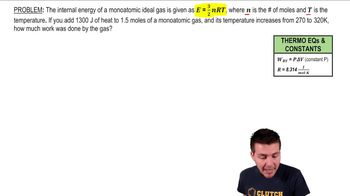
When a gas expands at constant pressure, the work done by the gas can be calculated using the formula W = PΔV, where P is the pressure and ΔV is the change in volume. This work represents the energy transferred as the gas pushes against external pressure during expansion. Understanding this concept is essential for determining the pressure of the gas in the given scenario.
Video consigliato:
Percorso guidato
03:47
Calculating Work Done on Monoatomic Gas

Ideal Gas Law

The Ideal Gas Law, expressed as PV = nRT, relates the pressure (P), volume (V), and temperature (T) of an ideal gas, where n is the number of moles and R is the ideal gas constant. This law is fundamental in thermodynamics and allows for the calculation of pressure when the volume and temperature of a gas are known. In this problem, it can be used to find the pressure after determining the work done and the change in internal energy.
Video consigliato:
Percorso guidato
07:21
Ideal Gases and the Ideal Gas Law