
Ch 19: Work, Heat, and the First Law of Thermodynamics
Knight Calc - Physics for Scientists and Engineers 5th Edition
Knight Calc5th EditionPhysics for Scientists and EngineersISBN: 9780137344796Non è quello che usi tu?Cambia libro di testo
Capitolo 19, Problema 2a

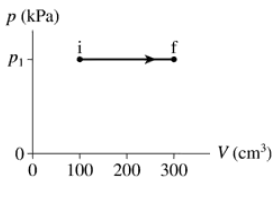
–60 J of work are done on the gas in the process shown in FIGURE EX19.2. What is p₁ in kPa?

Guida verificata passo dopo passo
1
Step 1: Analyze the graph provided. The graph shows a horizontal line from point 'i' to point 'f', indicating that the pressure (p) remains constant during the process. This is an isobaric process.
Step 2: Recall the formula for work done on a gas during an isobaric process: \( W = -p \Delta V \), where \( W \) is the work done, \( p \) is the pressure, and \( \Delta V \) is the change in volume.
Step 3: Determine \( \Delta V \) from the graph. The initial volume \( V_i \) is 100 cm³, and the final volume \( V_f \) is 300 cm³. Thus, \( \Delta V = V_f - V_i = 300 \, \text{cm}^3 - 100 \, \text{cm}^3 = 200 \, \text{cm}^3 \). Convert this to m³: \( \Delta V = 200 \, \text{cm}^3 \times 10^{-6} \, \text{m}^3/\text{cm}^3 = 2 \times 10^{-4} \, \text{m}^3 \).
Step 4: Rearrange the formula \( W = -p \Delta V \) to solve for \( p \): \( p = -\frac{W}{\Delta V} \). Substitute \( W = -60 \, \text{J} \) and \( \Delta V = 2 \times 10^{-4} \, \text{m}^3 \) into the equation.
Step 5: Perform the calculation to find \( p \) in Pascals, then convert to kilopascals (kPa) by dividing by 1000. This will give the value of \( p_1 \), which is the constant pressure during the process.

Risposta video verificata per un problema simile:

Questa soluzione video è stata consigliata dai nostri tutor come utile per risolvere questo problema.

Concetti chiave

Ecco i concetti essenziali che devi comprendere per rispondere correttamente alla domanda.

Work Done on a Gas

Work done on a gas during a thermodynamic process is defined as the energy transferred to the gas when it is compressed or expanded. In this context, the work done is negative when the gas is compressed, indicating that energy is being added to the system. The relationship between work, pressure, and volume change is crucial for understanding how the gas behaves under different conditions.
Video consigliato:
Percorso guidato
03:47
Calculating Work Done on Monoatomic Gas

Pressure-Volume Relationship

The pressure-volume (P-V) relationship is a fundamental concept in thermodynamics that describes how the pressure of a gas changes with its volume. In a P-V diagram, a horizontal line indicates constant pressure, while a vertical line indicates constant volume. Understanding this relationship helps in analyzing processes such as isothermal and adiabatic changes, which are essential for solving problems involving gases.
Video consigliato:
Percorso guidato
17:04
Pressure and Atmospheric Pressure

Units of Pressure

Pressure is defined as force per unit area and is commonly measured in pascals (Pa) or kilopascals (kPa). In this problem, the pressure p₁ is expressed in kPa, which is a convenient unit for dealing with gas pressures in many practical applications. Recognizing how to convert between different pressure units and understanding their significance in thermodynamic equations is vital for accurate calculations.
Video consigliato:
Percorso guidato
17:04
Pressure and Atmospheric Pressure