 Indietro
Angles and Radian Measure: Precalculus Study Notes
Guida di studio - Note intelligenti
 Appunti personalizzati basati sui tuoi materiali, ampliati con definizioni chiave, esempi e contesto.
Section 4.1: Angles and Radian Measure
Angle Basics
An angle is formed by two rays with a common endpoint, called the vertex. The initial side remains fixed, while the terminal side rotates to form the angle.
Positive angles are generated by counterclockwise rotation.
Negative angles are generated by clockwise rotation.
Angles are in standard position if the vertex is at the origin and the initial side lies along the positive x-axis.
Example: Sketch 60° and -135° in standard position.
To sketch 60°, start from the positive x-axis and rotate counterclockwise 60°. For -135°, start from the positive x-axis and rotate clockwise 135°.
Example: Identify whether 300° is positive or negative, and in which quadrant its terminal side lies. 300° is a positive angle (counterclockwise rotation). Its terminal side lies in the fourth quadrant.
Complementary and Supplementary Angles
Angles can be related by their sums:
Complementary Angles: Two angles are complementary if their measures sum to 90° (or radians).
Supplementary Angles: Two angles are supplementary if their measures sum to 180° (or radians).
Which Angles Can or Cannot Have Complements or Supplements?
An angle strictly less than 90° has a complement.
An angle equal to 90° does not have a complement (the other angle would have to be 0°).
An angle greater than 90° does not have a complement.
An angle strictly less than 180° has a supplement.
An angle equal to 180° does not have a supplement (the other angle would have to be 0°).
An angle greater than 180° does not have a supplement.
Examples
The complement of 30° is 60°.
The supplement of 70° is 110°.
A 90° angle has no complement, but it does have a supplement: 90°.
A 100° angle has no complement, but it does have a supplement: 80°.
A 180° angle has no supplement.
A 200° angle has neither a complement nor a supplement.
Radian Measure and Arc Length
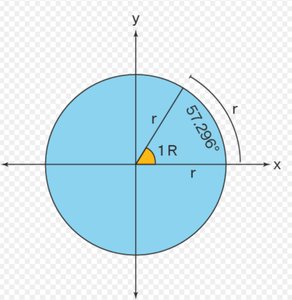
The radian is a unit of angle measure based on the radius of a circle. One radian is the angle at the center of a circle that subtends an arc equal in length to the radius.
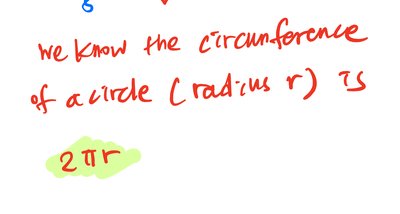
The circumference of a circle with radius r is:
There are radians in a full circle (360°), so:
radians
To convert between degrees and radians:
Degrees to radians:
Radians to degrees:
Degree–Minute–Second (DMS) Notation
Angles can also be expressed in degree–minute–second (DMS) notation.
1° = 60′ (minutes)
1′ = 60″ (seconds)
Thus, 1° = 60′ = 3600″
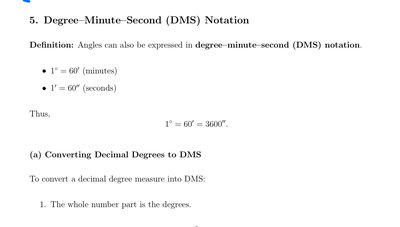
Converting Decimal Degrees to DMS
The whole number part is the degrees.
Multiply the decimal part by 60 to get minutes.
Multiply the decimal part of the minutes by 60 to get seconds.
Converting DMS to Decimal Degrees
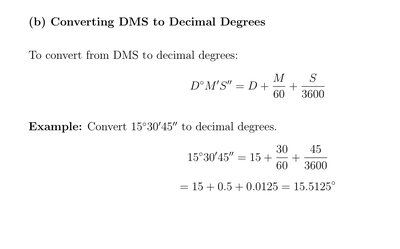
To convert from DMS to decimal degrees:
Example: Convert 15°30′45″ to decimal degrees.
Coterminal Angles and Arc Length
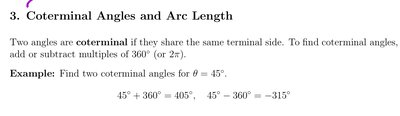
Two angles are coterminal if they share the same terminal side. To find coterminal angles, add or subtract multiples of 360° (or radians).
Example: Find two coterminal angles for .
Longitude and Latitude
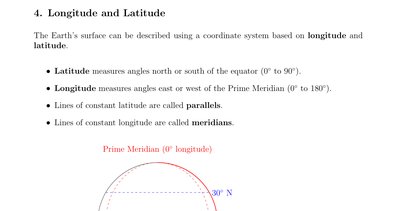
The Earth's surface can be described using a coordinate system based on longitude and latitude.
Latitude measures angles north or south of the equator (0° to 90°).
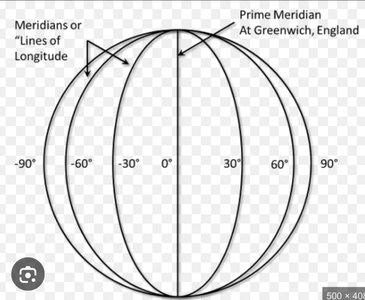
Longitude measures angles east or west of the Prime Meridian (0° to 180°).
Lines of constant latitude are called parallels.
Lines of constant longitude are called meridians.
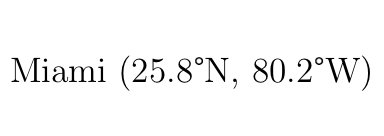
Example: Tampa (27.9°N, 82.5°W), Miami (25.8°N, 80.2°W)
Finding Distance Using Latitude and Longitude
To find the distance between two cities at the same latitude but different longitudes:
Find the difference in longitude in degrees, convert to radians.
Use the formula:
Example: Two cities are both at 40°N latitude. One is at 75°W longitude, the other at 85°W longitude. Find the distance between them.
radians d = 3960 \times \cos(40^\circ) \times \frac{\pi}{18} \approx 3960 \times 0.766 \times 0.175 \approx 530$ miles
Area of a Sector
The area of a sector of a circle with radius r and central angle (in radians) is:
Example: Find the area of a sector with , .
Summary Table: Angle Relationships
Type | Definition | Formula |
|---|---|---|
Complementary | Sum to 90° | |
Supplementary | Sum to 180° | |
Coterminal | Same terminal side |
Additional info: These notes cover foundational concepts in trigonometry and analytic geometry, including angle measurement, relationships, and applications to Earth's coordinate system.
