 Indietro
Chapter 4: Trigonometric Functions and Their Applications
Guida di studio - Note intelligenti
 Appunti personalizzati basati sui tuoi materiali, ampliati con definizioni chiave, esempi e contesto.
Angles and Radian Measure
Angles in Standard Position
Angles are fundamental in trigonometry and are measured from an initial side (usually along the positive x-axis) to a terminal side. The vertex is at the origin. Positive angles are measured counterclockwise, while negative angles are measured clockwise.
Initial Side: The starting position of the angle, typically along the positive x-axis.
Terminal Side: The position after rotation.
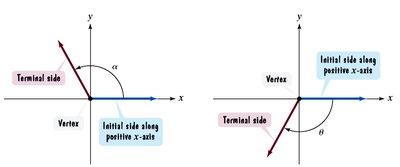
Angle Measure: Degrees and Radians
Angles can be measured in degrees or radians. One degree is 1/360 of a full rotation. Common angles include acute (< 90°), right (90°), obtuse (90° < θ < 180°), and straight (180°).
Degree: A unit of angle measure; 360° in a full circle.
Radian: The measure of a central angle that intercepts an arc equal in length to the radius of the circle.

Definition and Calculation of Radian Measure
Radian measure relates the length of an arc (s) to the radius (r) of a circle. The central angle θ in radians is given by:
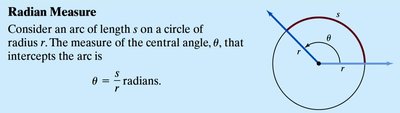
Definition of a Radian: One radian is the measure of the central angle of a circle that intercepts an arc equal in length to the radius of the circle.

Relationship Between Degrees and Radians
The circumference of a circle is , so one full revolution is radians or 360°.

Converting Between Degrees and Radians
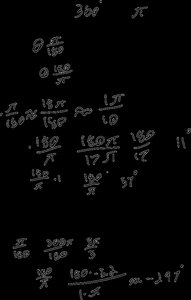
To convert degrees to radians, multiply by .
To convert radians to degrees, multiply by .
Example: Convert 300° to radians: radians.
Coterminal Angles
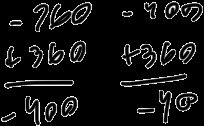
Coterminal angles share the same initial and terminal sides. They differ by integer multiples of a full revolution ( radians or 360°):
or
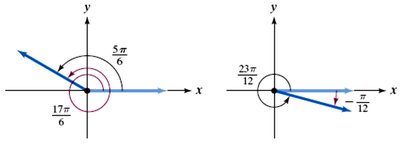
Example: The positive coterminal angle for -760° is -760° + 2×360° = -40°.
Arc Length
The length of an arc intercepted by a central angle θ (in radians) on a circle of radius r is:
Example: For inches and radians, inches.
Linear and Angular Speed
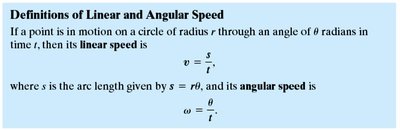
Linear speed (v) and angular speed (ω) describe motion along a circular path:
Linear speed: , where s is arc length and t is time.
Angular speed: , where θ is in radians.
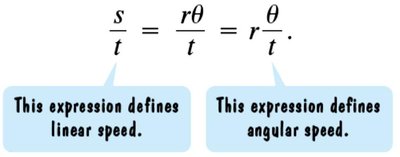
Relationship:

The Unit Circle
Equation and Properties of the Unit Circle
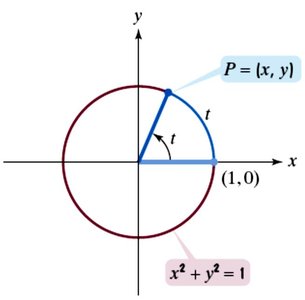
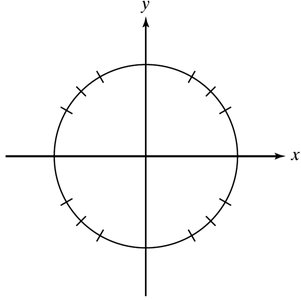
The unit circle is a circle of radius 1 centered at the origin. Its equation is . The unit circle is fundamental for defining trigonometric functions for all real numbers.
Commonly Used Coordinates
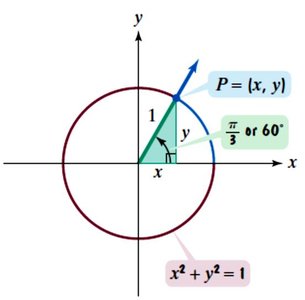
Key angles on the unit circle correspond to coordinates , where and for an angle t in radians.
Definitions of Trigonometric Functions on the Unit Circle
If is a point on the unit circle corresponding to angle t, then:
(if )
(if )
(if )
(if )

Domain and Range of Sine and Cosine
Domain: All real numbers
Range:
Even and Odd Trigonometric Functions
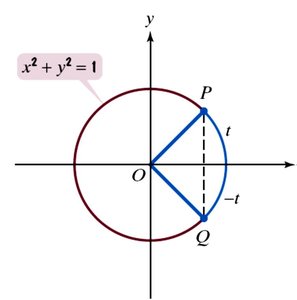
Even function: (e.g., cosine)
Odd function: (e.g., sine, tangent)
, ,
Periodic Properties
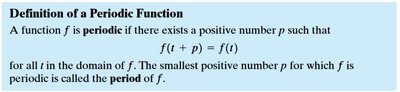
A function is periodic if there exists a positive number such that for all in the domain. The smallest such $p$ is the period.
Fundamental Trigonometric Identities
Reciprocal identities:
Quotient identities:
Pythagorean identities:
Right Triangle Trigonometry
Right Triangle Definitions
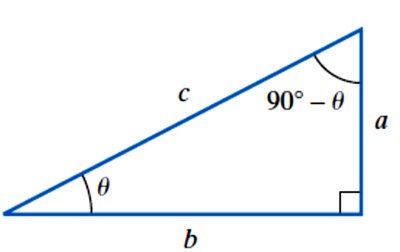
For a right triangle with angle :
Special Right Triangles
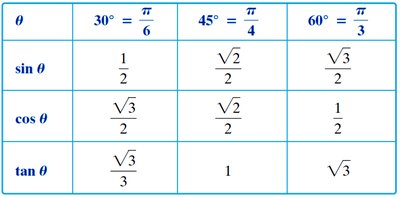
Special triangles such as 45°-45°-90° and 30°-60°-90° have side ratios that simplify trigonometric calculations.
Cofunction Identities
Cofunction identities relate trigonometric functions of complementary angles:
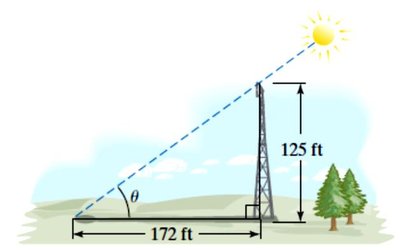
Applications: Angles of Elevation and Depression
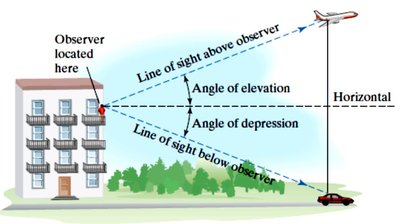
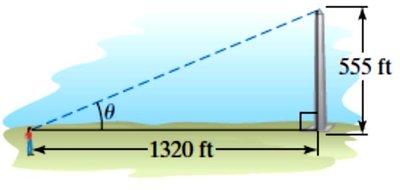
Angles of elevation and depression are used in real-world applications such as navigation and surveying. The angle of elevation is measured upward from the horizontal, while the angle of depression is measured downward.
Trigonometric Functions of Any Angle
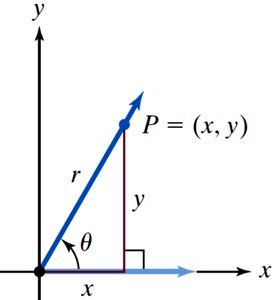
Definitions for Any Angle
For any angle , with a point on its terminal side and distance from the origin:
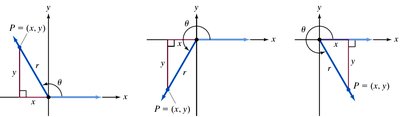
Signs of Trigonometric Functions by Quadrant
The sign of each trigonometric function depends on the quadrant in which the terminal side of the angle lies:
Quadrant I: All functions positive
Quadrant II: Sine positive
Quadrant III: Tangent positive
Quadrant IV: Cosine positive
Reference Angles
The reference angle is the acute angle formed by the terminal side of and the x-axis. It is used to evaluate trigonometric functions for any angle.
Graphs of Sine and Cosine Functions
Basic Graphs
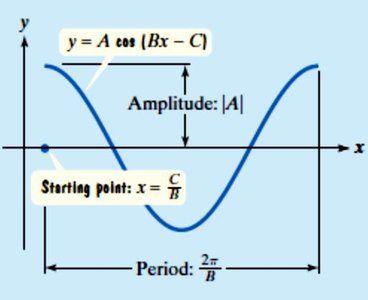
The graphs of and are periodic with period and amplitude 1.
Transformations
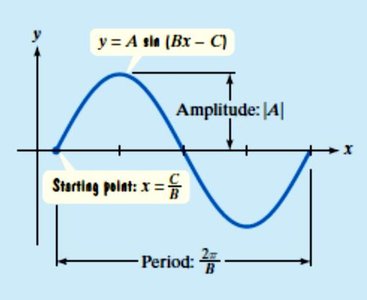
Amplitude: (vertical stretch/shrink)
Period:
Phase Shift:
Vertical Shift: or
Graphs of Other Trigonometric Functions
Tangent and Cotangent
The period of and is . Both have vertical asymptotes and are undefined at certain points.
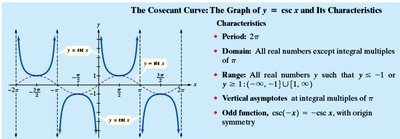
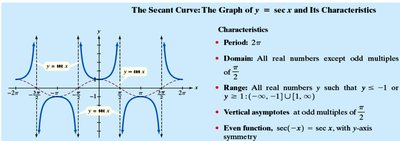
Cosecant and Secant
and are the reciprocals of sine and cosine, respectively. Their graphs have vertical asymptotes where the original function is zero.
Inverse Trigonometric Functions
Properties and Notation
Inverse trigonometric functions are defined by restricting the domain of the original function to make it one-to-one.
For example, (arcsin) is defined for with range .
Applications of Trigonometric Functions
Solving Right Triangles
To solve a right triangle, find all missing sides and angles using trigonometric ratios and the Pythagorean theorem.
Bearings
Bearings are used in navigation and are measured clockwise from the north direction.
Simple Harmonic Motion
Simple harmonic motion can be modeled by or , where amplitude, period, and phase shift describe the motion.
