 Indietro
Complex Numbers, Quadratic and Polynomial Functions: Essential Precalculus Concepts
Guida di studio - Note intelligenti
 Appunti personalizzati basati sui tuoi materiali, ampliati con definizioni chiave, esempi e contesto.
Complex Numbers
Imaginary Unit and Complex Numbers
The concept of complex numbers extends the real number system to include solutions to equations that have no real solutions. The imaginary unit, denoted as i, is defined as follows:
Imaginary Unit: , and therefore .

A complex number is any number of the form , where and are real numbers. The value is called the real part and is the imaginary part.
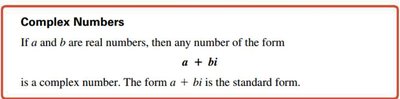
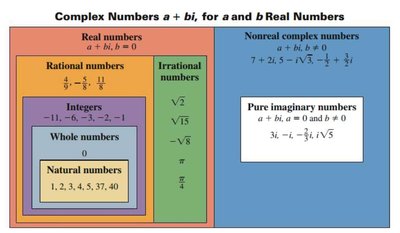
If , the number is called a purely imaginary number.
If , the number is a real number.
Complex numbers can be classified as real or nonreal, and further as rational, irrational, or pure imaginary.
Square Roots of Negative Numbers
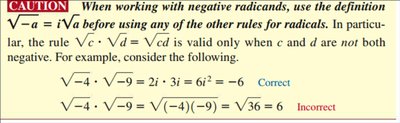
To evaluate the square root of a negative number, use the definition for .

Caution: When working with negative radicands, always use before applying other rules for radicals. The rule is valid only when c and d are not both negative.
Operations with Complex Numbers
Addition and Subtraction
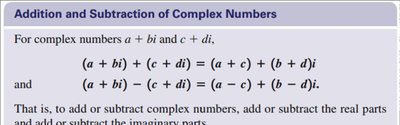
To add or subtract complex numbers, add or subtract the real parts and the imaginary parts separately:
Multiplication
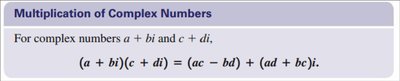
To multiply complex numbers, use the distributive property and the fact that :
Complex Conjugates
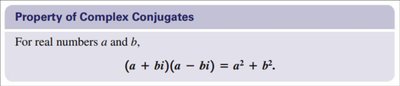
The complex conjugate of is . The product of a complex number and its conjugate is always a real number:
Powers of i
Powers of repeat in a cycle of four:
Any power of with an exponent that is a multiple of 4 has value 1.
Quadratic Functions and Equations
Quadratic Functions
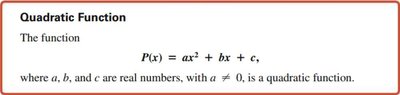
A quadratic function is a function of the form , where are real numbers and .
Vertex Form
The vertex form of a quadratic function is . The graph is a parabola with vertex and axis of symmetry .
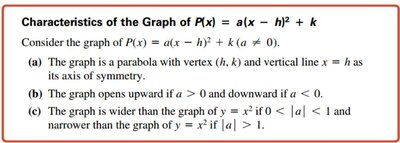
The graph opens upward if and downward if .
The graph is wider than if and narrower if .
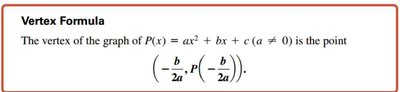
Vertex Formula
The vertex of the graph is at:
Quadratic Equations
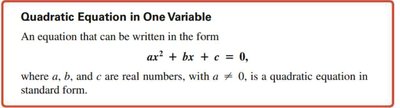
A quadratic equation in one variable is an equation that can be written in the form , where .
Zero-Product Property
If and are complex numbers and , then or (or both).

Solving Quadratic Equations
Quadratic equations can be solved by factoring, completing the square, or using the quadratic formula.
Completing the Square
If , divide each side by .
Rewrite the equation so the constant term is alone on one side.
Square half the coefficient of , and add this square to each side.
Factor the resulting trinomial as a perfect square, and combine like terms on the other side.
Use the square root property to complete the solution.

Quadratic Formula
The solutions to are given by:
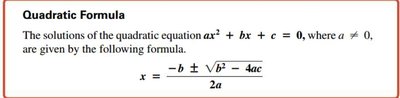
The expression is called the discriminant. It determines the nature of the roots:
If , two distinct real solutions.
If , one real solution (a repeated root).
If , two complex conjugate solutions.
Polynomial Functions
Definition and Degree
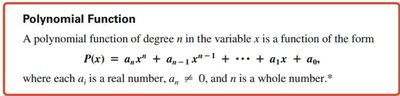
A polynomial function of degree in the variable is a function of the form:
, where each is a real number, , and is a whole number.
Graphs of Polynomial Functions
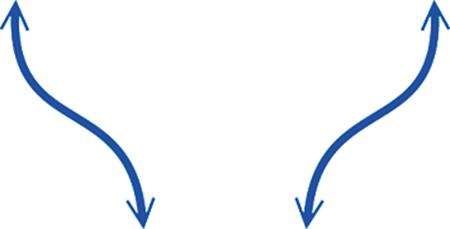
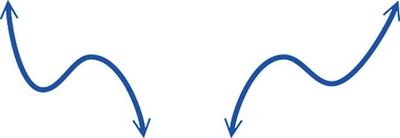
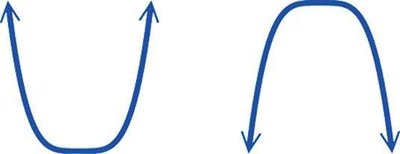
The graph of a polynomial function depends on its degree and leading coefficient. For example:
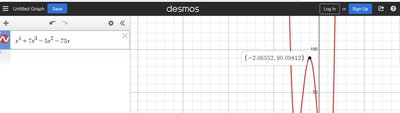
Cubic function (degree 3): , .
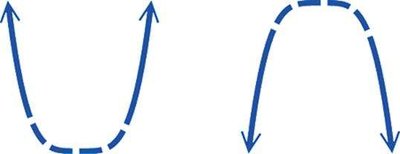
Quartic function (degree 4): , .
Behavior at Zeros
The behavior of the graph at its zeros depends on the multiplicity of the zero:
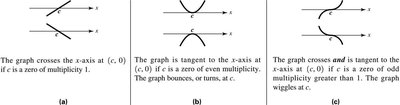
If the zero has odd multiplicity, the graph crosses the x-axis.
If the zero has even multiplicity, the graph is tangent to the x-axis and bounces off.
Turning Points and End Behavior
A polynomial function of degree has at most turning points. The end behavior depends on the degree and leading coefficient.
Number of x-Intercepts
The graph of a polynomial function of degree will have at most x-intercepts (real zeros).
Intermediate Value Theorem
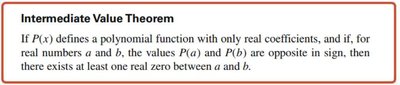
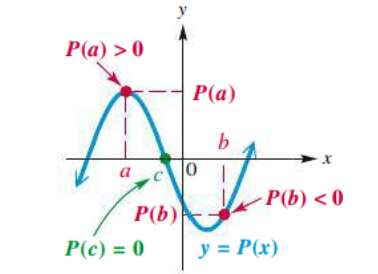
If is a polynomial function with real coefficients, and and have opposite signs for real numbers and , then there exists at least one real zero between and .
Division of Polynomials
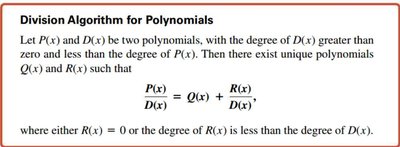
The Division Algorithm for Polynomials states that for polynomials and , there exist unique polynomials and such that:
, where the degree of is less than the degree of .
Remainder Theorem
If a polynomial is divided by , the remainder is .

Factor Theorem
A polynomial has a factor if and only if .

