 Indietro
Composite Functions: Definitions, Domains, and Applications
Guida di studio - Note intelligenti
 Appunti personalizzati basati sui tuoi materiali, ampliati con definizioni chiave, esempi e contesto.
Chapter 4: Exponential and Logarithmic Functions
Section 4.1: Composite Functions
This section introduces the concept of composite functions, explains how to form them, and details how to determine their domains. Composite functions are foundational in understanding more advanced topics in precalculus, including exponential and logarithmic functions.
Definition of Composite Functions
A composite function is formed when the output of one function becomes the input of another. Given two functions f and g, the composite function is denoted by (f \circ g)(x) and is defined as:
Notation:
Domain: The domain of is the set of all in the domain of such that is in the domain of .
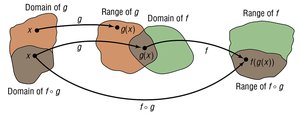
Additional info: The diagram above visually represents how the domain of and the range of $g$ interact with the domain of to determine the domain of the composite function .
Forming a Composite Function
To form a composite function, substitute the entire function into every occurrence of in :
Given and , .
Example: Suppose and . Then:
Finding the Domain of a Composite Function
To find the domain of a composite function :
Identify the domain of .
Find all in the domain of such that is in the domain of .
Example: If (domain: ) and (domain: all real numbers), then:
Domain:
Examples of Composite Functions and Their Domains
Example 1: If and , then both have domain all real numbers. Thus, and its domain is all real numbers.
Example 2: If and , then:
Domain of :
Domain of :
For , exclude and solve for additional restrictions.
Showing Equality of Composite Functions
To show that two composite functions are equal, substitute and simplify both expressions to verify they yield the same result for all in their common domain.
Example: If and , show that for all in their domains.
Since , the functions are not equal.
Decomposing a Composite Function
Given a function , you can often write it as a composition of two simpler functions and such that .
Example: If , let and , so .
Example: If , let and , so .
