 Indietro
Comprehensive Precalculus Study Guide – Step-by-Step Guidance
Guida di studio - Note intelligenti
 Appunti personalizzati basati sui tuoi materiali, ampliati con definizioni chiave, esempi e contesto.
Q15. Use transformations to graph the following equation:
Background
Topic: Graphing Quadratic Functions Using Transformations
This question tests your understanding of how to apply transformations (shifts, stretches, reflections) to the parent quadratic function .
Key Terms and Formulas:
Parent function:
Vertical stretch/compression:
Horizontal shift: shifts left by units
Vertical shift: shifts up by units
Reflection: Negative coefficient reflects the graph across the x-axis
Step-by-Step Guidance
Start with the parent function .
Apply the horizontal shift: means the graph moves 5 units to the left.
Apply the vertical compression and reflection: The coefficient compresses the graph vertically by a factor of and reflects it across the x-axis.
Apply the vertical shift: The at the end moves the graph up by 2 units.
Identify the new vertex based on these transformations, and set up the graph accordingly.
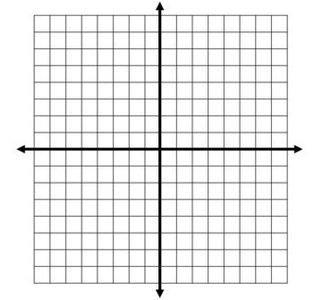
Try solving on your own before revealing the answer!
Final Answer:
The graph of is a downward-opening parabola, compressed vertically by a factor of , shifted left by 5 units, and up by 2 units. The vertex is at .
To graph, plot the vertex at , reflect the shape of downward, and apply the compression. The axis of symmetry is .
Q16. Use transformations to graph the following equation:
Background
Topic: Graphing Absolute Value Functions Using Transformations
This question tests your ability to apply transformations to the parent absolute value function .
Key Terms and Formulas:
Parent function:
Vertical stretch/compression:
Horizontal shift: shifts right by units
Vertical shift: shifts up by units
Reflection: Negative coefficient reflects the graph across the x-axis
Step-by-Step Guidance
Start with the parent function .
Apply the horizontal shift: means the graph moves 5 units to the right.
Apply the vertical stretch and reflection: The coefficient stretches the graph vertically by a factor of 2 and reflects it across the x-axis.
Apply the vertical shift: The at the end moves the graph up by 6 units.
Identify the new vertex based on these transformations, and set up the graph accordingly.
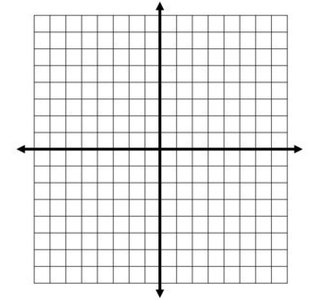
Try solving on your own before revealing the answer!
Final Answer:
The graph of is a downward-opening "V" shape, stretched vertically by a factor of 2, shifted right by 5 units, and up by 6 units. The vertex is at .
To graph, plot the vertex at , reflect the shape of downward, and apply the stretch. The axis of symmetry is .
Q21. Determine if the graph represents a graph that contains an inverse.
Background
Topic: Inverse Functions and Graphs
This question tests your understanding of whether a function has an inverse based on its graph, typically using the Horizontal Line Test.
Key Terms and Formulas:
Inverse function: A function has an inverse if it is one-to-one (passes the Horizontal Line Test).
Horizontal Line Test: If every horizontal line intersects the graph at most once, the function has an inverse.
Step-by-Step Guidance
Examine the graph and consider the Horizontal Line Test.
Ask: Does any horizontal line intersect the graph more than once?
If yes, the function does not have an inverse. If no, the function does have an inverse.
Identify the relevant sections of the graph and analyze their behavior.
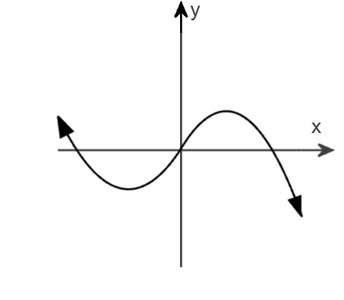
Try solving on your own before revealing the answer!
Final Answer:
The graph shown does not represent a function that has an inverse, because some horizontal lines intersect the graph more than once. This means the function is not one-to-one.
Only one-to-one functions (passing the Horizontal Line Test) have inverses.
