 Indietro
Equations and Inequalities: Precalculus Study Notes
Guida di studio - Note intelligenti
 Appunti personalizzati basati sui tuoi materiali, ampliati con definizioni chiave, esempi e contesto.
Equations and Inequalities
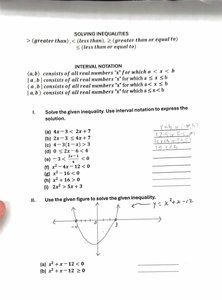
Solving Inequalities
Inequalities are mathematical statements that compare two values or expressions using symbols such as > (greater than), < (less than), ≥ (greater than or equal to), and ≤ (less than or equal to). Solving inequalities involves finding the set of values that satisfy the inequality.
> (greater than): Indicates that one value is larger than another.
< (less than): Indicates that one value is smaller than another.
≥ (greater than or equal to): Indicates that one value is larger than or equal to another.
≤ (less than or equal to): Indicates that one value is smaller than or equal to another.
Interval Notation
Interval notation is a concise way to describe sets of real numbers that satisfy inequalities. It uses parentheses and brackets to indicate whether endpoints are included or excluded.
(a, b): All real numbers x for which a < x < b (endpoints not included).
[a, b]: All real numbers x for which a ≤ x ≤ b (endpoints included).
(a, b]: All real numbers x for which a < x ≤ b.
[a, b): All real numbers x for which a ≤ x < b.
Solving Linear Inequalities
Linear inequalities are similar to linear equations but use inequality signs. The solution is often expressed in interval notation.
Example: Solve Step 1: Subtract 2 from both sides: Step 2: Divide both sides by 3: Solution:
Example: Solve Step 1: Add 5 to both sides: Step 2: Divide both sides by 2: Solution:
Solving Quadratic Inequalities
Quadratic inequalities involve expressions of the form . Solutions are often found by factoring or using the quadratic formula, then testing intervals.
Example: Solve Step 1: Factor: Step 2: Find zeros: , Step 3: Test intervals:
: Both factors negative, product positive
: One factor positive, one negative, product negative
: Both factors positive, product positive
Solution:
Solving Equations: Linear, Quadratic, Rational, and Radical
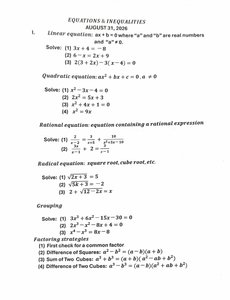
Equations are mathematical statements asserting equality. Different types require different methods:
Linear Equation: Example: Solution:
Quadratic Equation: Example: Solution:
Rational Equation: Contains fractions with variables in the denominator. Example: Solution:
Radical Equation: Contains square roots or other roots. Example: Solution:
Factoring Techniques
Factoring is a method used to solve equations and simplify expressions. Common techniques include:
Difference of Squares:
Sum and Difference of Cubes:
Grouping: Used for polynomials with four or more terms.
Grouping Example
Example: Step 1: Factor: Step 2: Set each factor to zero: or Solution: or
Summary Table: Types of Equations and Methods
Type of Equation | General Form | Solution Method |
|---|---|---|
Linear | Isolate variable | |
Quadratic | Factoring, quadratic formula | |
Rational | Clear denominators, solve | |
Radical | Isolate radical, square both sides |
Additional info:
Interval notation is essential for expressing solutions to inequalities.
Factoring is a foundational skill for solving quadratic and higher-order equations.
Graphical representations, such as the parabola in image_1, help visualize solutions to quadratic inequalities.
