Indietro
Exponential Functions: Concepts, Properties, and Applications
Guida di studio - Note intelligenti
 Appunti personalizzati basati sui tuoi materiali, ampliati con definizioni chiave, esempi e contesto.
Exponential Functions
Definition and Basic Properties
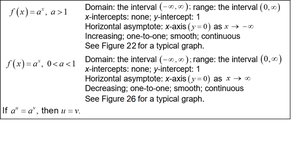
An exponential function is a function of the form , where a is a positive real number (the base), and x is any real number. The domain of an exponential function is all real numbers, and the range is all positive real numbers.
Growth Factor: The base a determines whether the function is increasing or decreasing.
Initial Value: for any base .
One-to-One: Exponential functions are one-to-one, meaning each input yields a unique output.
Horizontal Asymptote: The x-axis () is a horizontal asymptote.
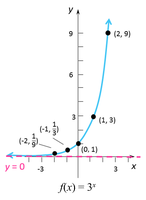
Example: is an exponential function with base 3.
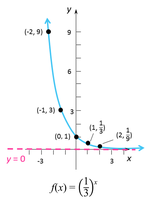
Example: is an exponential function with base less than 1.
Laws of Exponents
The laws of exponents are fundamental rules for manipulating exponential expressions:
Identifying Linear vs. Exponential Functions
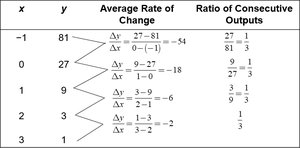
To distinguish between linear and exponential functions, examine the average rate of change and the ratio of consecutive outputs:
Linear Function: Constant average rate of change (slope).
Exponential Function: Constant ratio of consecutive outputs.
Example Table: Linear Function
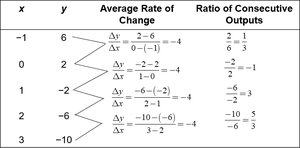
Example Table: Exponential Function
Graphing Exponential Functions
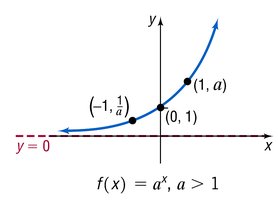
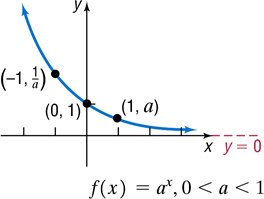
Exponential functions can be graphed by plotting points and observing their behavior:
For , the function increases rapidly as increases.
For , the function decreases rapidly as increases.
The y-intercept is always 1.
The x-axis is a horizontal asymptote.
General Graphs:
Transformations of Exponential Functions
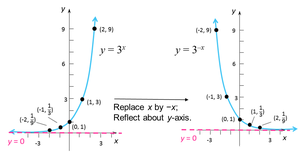
Exponential functions can be transformed by reflecting, shifting, or stretching:
Reflection: reflects about the y-axis.
Vertical Shift: shifts the graph up by units.
Horizontal Shift: shifts the graph right by units.
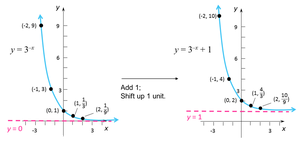
Example: Transformations of and
The Number e
The number e is a fundamental mathematical constant, approximately equal to 2.71828. It is defined as the limit:
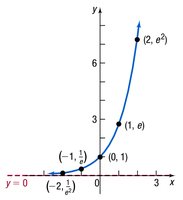
Exponential functions with base are called natural exponential functions.
Example: Graph of
Graphing Exponential Functions Using Transformations (with e)
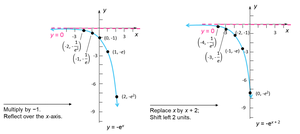
Transformations can also be applied to functions with base :
Reflections, shifts, and stretches follow the same rules as for other bases.
Solving Exponential Equations
To solve exponential equations, rewrite each side with the same base and use properties of exponents:
If , then .
Use logarithms if the bases cannot be made equal.
Example: Solve . Since , .
Applications: Exponential Probability
Exponential functions are used in probability and statistics to model events such as arrival times:
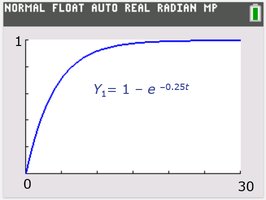
The probability that an event occurs within minutes is , where is the rate parameter.
Example: Probability that a car arrives within 5 minutes:
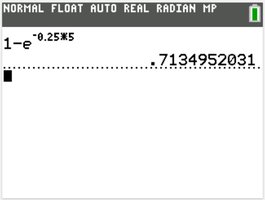
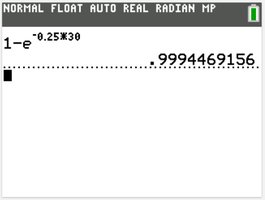
Example: Probability that a car arrives within 30 minutes:
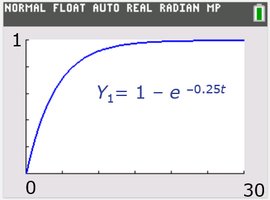
Graph: Probability function as increases:
Summary Table: Properties of Exponential Functions
Function | Domain | Range | x-intercepts | y-intercept | Horizontal Asymptote | Behavior | Graph |
|---|---|---|---|---|---|---|---|
None | 1 | Increasing, one-to-one, smooth, continuous | See Figure 22 | ||||
None | 1 | Decreasing, one-to-one, smooth, continuous | See Figure 26 |