 Indietro
Functions and Their Graphs: Foundations and Operations
Guida di studio - Note intelligenti
 Appunti personalizzati basati sui tuoi materiali, ampliati con definizioni chiave, esempi e contesto.
Functions and Their Graphs
Relations
A relation is a correspondence between two sets: the domain (set X) and the range (set Y). Each element from the domain is paired with at least one element from the range. Relations can be described verbally, numerically (as tables or ordered pairs), graphically, or as mappings.
Domain: The set of all possible input values (x-values).
Range: The set of all possible output values (y-values).
Notation: If x is in the domain and y is in the range, x → y means y corresponds to x.
Input is often called the independent variable, and output is the dependent variable.
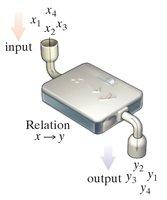
Relations can be represented as mappings, where arrows show how each domain element is paired with range elements.
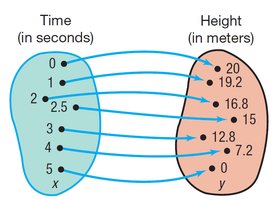
Example: Describing a Relation
Verbal: The average retail price of gasoline in the U.S. over several years.
Domain: {2010, 2012, 2014, 2016, 2018}
Range: {$2.78, $3.62, $3.36, $2.14, $2.72}
Ordered pairs: {(2010, $2.78), (2012, $3.62), (2014, $3.36), (2016, $2.14), (2018, $2.72)}
Functions
A function is a special type of relation in which each element of the domain is paired with exactly one element of the range. The set X is the domain, and for each x in X, the corresponding y in Y is called the value of the function at x or the image of x. The range is the set of all images of elements in the domain.
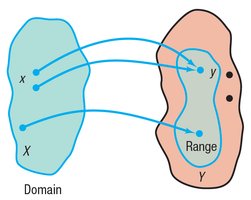
Not every element in Y must be an image of some x in X; the range may be a proper subset of Y.
Examples: Determining Functions
If each domain element is paired with only one range element, the relation is a function.
If any domain element is paired with more than one range element, the relation is not a function.
Example: Ordered Pairs
{(1, 5), (3, 9), (5, 1), (9, 2)} is a function (no repeated x-values).
{(–5, 1), (–5, –3), ...} is not a function (–5 is paired with two different y-values).
Example: Equations
y = 3x + 7 defines y as a function of x (each x gives one y).
6x + 3y2 = 2 does not define y as a function of x (some x yield two y-values).
Function Notation and Evaluation
Function notation uses symbols such as f(x) to denote the value of function f at x. The variable x is the independent variable (argument), and y = f(x) is the dependent variable.
Example: If f(x) = 2x – 5, then f(1) = –3 and f(3) = 1.
Think of a function as a machine: input x, output f(x).
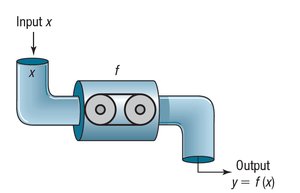
Evaluating Functions
Substitute the input value into the function rule.
Examples: For f(x) = 2x2 – 5x, find f(2), f(–x), f(x + 2), etc.
Calculator Evaluation
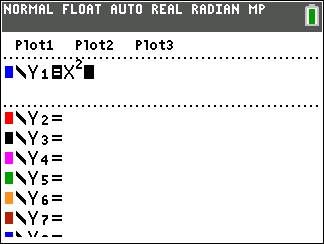
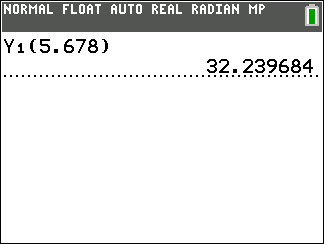
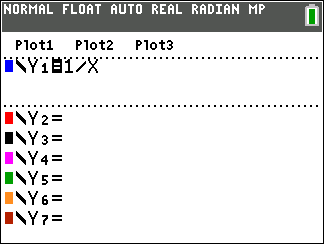
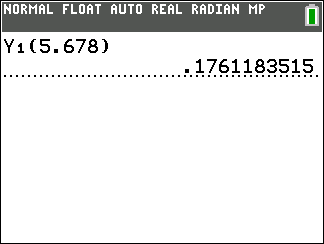
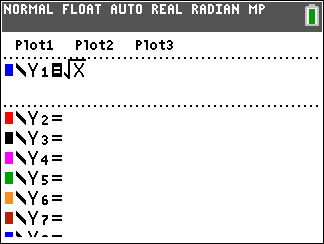
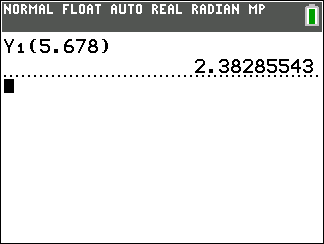
Functions can be evaluated using graphing calculators by entering the function and substituting values.
Implicit and Explicit Functions
Implicit form: The function is defined by an equation involving x and y (e.g., 2x + y = 4).
Explicit form: The equation is solved for y in terms of x (e.g., y = f(x)).
Important Facts about Functions
Each x in the domain has exactly one image in the range.
More than one x can have the same image in the range.
f denotes the function; x is the argument; f(x) is the value at x.
Difference Quotient
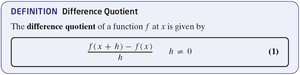
The difference quotient is a fundamental concept for understanding rates of change and is defined as:
Domain of a Function
The domain of a function is the set of all real numbers for which the function is defined (i.e., produces real values). To find the domain:
Start with all real numbers.
Exclude values that make denominators zero.
Exclude values that make even-indexed radicals negative.
Express the domain using interval notation, set notation, or words.
Examples: Finding Domains
f(x) = x2 + 1: Domain is all real numbers.
g(x) = x/(x2 – 25): Exclude x = 5 and x = –5.
h(t) = sqrt(5 – 5t): Require 5 – 5t ≥ 0.
F(x) = sqrt(2x + 6)/(x – 2): Require 2x + 6 > 0 and x ≠ 2.
Application Example: Volume of a Cube
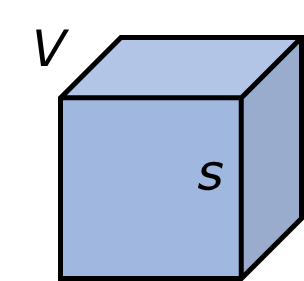
The volume V of a cube with side length s is given by:
Domain: {s | s > 0} (since side length must be positive).
Operations on Functions
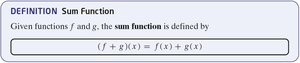
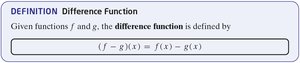
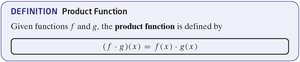
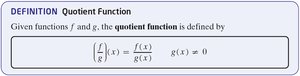
Functions can be combined using addition, subtraction, multiplication, and division. The domain of the resulting function is the intersection of the domains of the original functions (and for division, exclude where the denominator is zero).
Operation | Definition |
|---|---|
Sum | |
Difference | |
Product | |
Quotient |
Example: Operations on Functions
Let f and g be two functions. The domain of f + g, f – g, f · g, and f/g is the set of all real numbers in the domains of both f and g (and for f/g, where g(x) ≠ 0).
