 Indietro
Functions and Their Graphs: Precalculus Study Notes
Guida di studio - Note intelligenti
 Appunti personalizzati basati sui tuoi materiali, ampliati con definizioni chiave, esempi e contesto.
Functions and Their Graphs
Relations and Functions
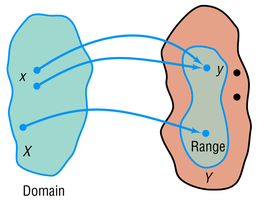
Understanding the concepts of relations and functions is fundamental in precalculus. A relation is a correspondence between two sets, typically called the domain and range. A function is a special type of relation where each element in the domain is paired with exactly one element in the range.
Relation: A correspondence between two sets, X (domain) and Y (range), where each element in X is associated with at least one element in Y.
Function: A relation from X to Y such that each element in X is associated with exactly one element in Y.
Domain: The set of all possible input values (typically x-values).
Range: The set of all possible output values (typically y-values).
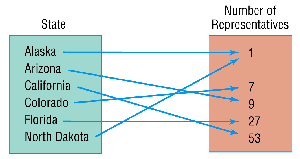
Example: In the diagram, each state is paired with a number of representatives. This is a relation because each state is associated with at least one number.
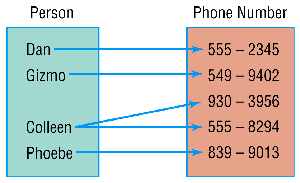
Example: In the phone number diagram, each person is paired with a phone number. If every person has exactly one phone number, this is a function.
Determining Whether a Relation is a Function
To determine if a relation is a function, check if each element in the domain is paired with only one element in the range. If any domain element is paired with more than one range element, the relation is not a function.
If two ordered pairs have the same first element but different second elements, the relation is not a function.
It is acceptable for different domain elements to be paired with the same range element.
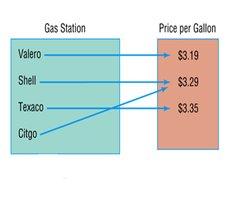
Example: The gas station diagram shows a function because each station is paired with exactly one price.
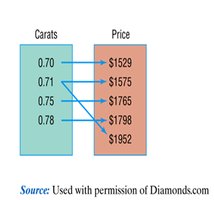
Example: The diamond carat diagram is not a function because the same carat value is paired with multiple prices.
The Vertical Line Test
The Vertical Line Test is a graphical method to determine if a set of points represents a function. If every vertical line intersects the graph at most once, the graph represents a function.
Theorem: A set of points in the xy-plane is the graph of a function if and only if every vertical line intersects the graph in at most one point.
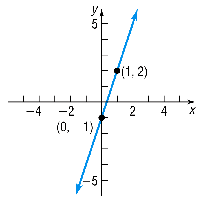
Example: The graph of passes the vertical line test, so it is a function.
Function Notation and Evaluation
Functions are often written using function notation, such as , which denotes the output of the function f for the input x. Evaluating a function means finding the value of $f(x)$ for a given x.
Function Notation: means "the value of function f at x".
Evaluation: Substitute the input value into the function's formula to find the output.
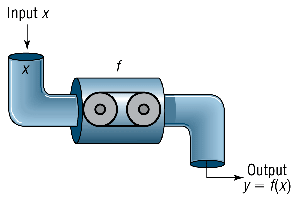
Example: If , then .
Difference Quotient
The difference quotient is a fundamental concept in calculus and precalculus, used to measure the average rate of change of a function over an interval. It is defined as:
Difference Quotient:
Example: For , the difference quotient is .
Finding the Domain of a Function Defined by an Equation
The domain of a function defined by an equation is the set of all real numbers for which the equation produces a valid output. Restrictions may occur due to denominators or radicals.
Start with all real numbers.
Exclude values that make the denominator zero.
Exclude values that make the expression inside an even-index radical negative.
Example: For , the domain is all real numbers except .
Example: For , the domain is .
Operations on Functions
Functions can be combined using addition, subtraction, multiplication, and division. The domain of the resulting function is the intersection of the domains of the original functions, with additional restrictions for division.
Sum:
Difference:
Product:
Quotient: ,
Example: If and , then .
Example: , domain excludes .
Summary Table: Function vs. Relation
Type | Definition | Example |
|---|---|---|
Relation | Pairs elements from domain to range; not necessarily unique | State to Representatives |
Function | Each domain element paired with exactly one range element | Gas Station to Price |
Not a Function | Domain element paired with multiple range elements | Carat to Price |
Additional info: These notes expand on brief points from the original materials, providing definitions, examples, and formulas for clarity and completeness.
