 Indietro
Geometry Essentials for Precalculus: Circles, Triangles, and Solids
Guida di studio - Note intelligenti
 Appunti personalizzati basati sui tuoi materiali, ampliati con definizioni chiave, esempi e contesto.
Fundamental Concepts of Algebra
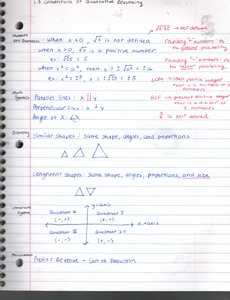
Square Roots and Properties
Understanding square roots is essential for solving equations and working with geometric formulas. The square root of a negative number is not defined in the set of real numbers.
Square Root Definition: For a positive number x, is the positive number whose square is x.
Examples: , ,
Properties:
Not Defined: is not defined for real numbers.
Geometry: Lines and Angles
Parallel and Perpendicular Lines
Lines are fundamental objects in geometry. Parallel lines never intersect, while perpendicular lines intersect at a right angle.
Parallel Lines: Notation:
Perpendicular Lines: Notation:
Angle: denotes the angle at point X.
Similar and Congruent Shapes
Shapes can be classified as similar or congruent based on their properties.
Similar Shapes: Same shape, angles, and proportions.
Congruent Shapes: Same shape, angles, proportions, and size.
Transformations
Transformations move or change shapes in the plane. Common transformations include translation, rotation, and reflection.
Translation: Moves a shape without rotating or flipping it.
Rotation: Turns a shape around a fixed point.
Reflection: Flips a shape over a line (axis).
Circles
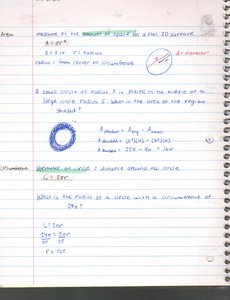
Area and Circumference
The area and circumference of a circle are fundamental geometric properties.
Area: where r is the radius.
Diameter:
Circumference:
Annulus (Ring-Shaped Region)
An annulus is the region between two concentric circles.
Area of Annulus: where R is the outer radius and r is the inner radius.
Sectors and Arcs
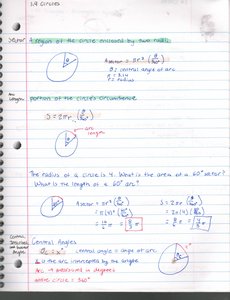
A sector is a region of a circle bounded by two radii and the arc between them. The arc is a portion of the circle's circumference.
Area of Sector: where is the central angle in degrees.
Length of Arc:
Central and Inscribed Angles
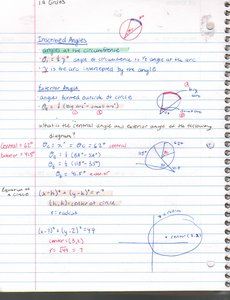
Central angles are formed at the center of the circle, while inscribed angles are formed on the circumference.
Central Angle: The angle at the center; its measure equals the arc it intercepts.
Inscribed Angle: The angle at the circumference; its measure is half the intercepted arc.
Triangles
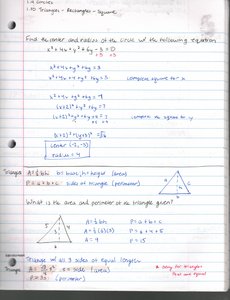
Area and Perimeter of Triangles
The area and perimeter of triangles are calculated using their base and height or side lengths.
Area: where b is the base and h is the height.
Perimeter: where a, b, and c are the side lengths.
Equilateral Triangles
Equilateral triangles have all sides of equal length and all angles equal to 60°.
Area: where s is the side length.
Perimeter:
Rectangles and Squares
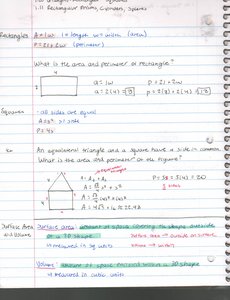
Area and Perimeter of Rectangles
Rectangles have opposite sides equal and four right angles.
Area: where l is length and w is width.
Perimeter:
Area and Perimeter of Squares
Squares have all sides equal and four right angles.
Area:
Perimeter:
Solids: Prisms, Cylinders, and Spheres
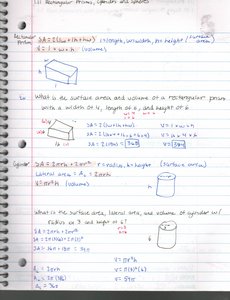
Rectangular Prisms
Rectangular prisms are three-dimensional solids with six rectangular faces.
Surface Area:
Volume:
Cylinders
Cylinders are solids with two parallel circular bases connected by a curved surface.
Surface Area:
Lateral Area:
Volume:
Spheres
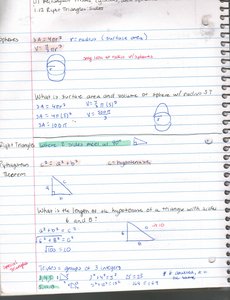
Spheres are perfectly round three-dimensional objects.
Surface Area:
Volume:
Right Triangles and the Pythagorean Theorem
Pythagorean Theorem
The Pythagorean Theorem relates the sides of a right triangle.
Theorem: where c is the hypotenuse.
Application: Used to find the length of a side when the other two are known.
Surface Area and Volume
Definitions
Surface area is the total area covering the surface of a 3D shape, while volume is the space contained within it.
Surface Area: Measured in square units.
Volume: Measured in cubic units.
Summary Table: Area and Volume Formulas
Shape | Area Formula | Perimeter/Surface Area | Volume Formula |
|---|---|---|---|
Circle | — | ||
Rectangle | — | ||
Square | — | ||
Triangle | — | ||
Rectangular Prism | — | ||
Cylinder | — | ||
Sphere | — |
