 Indietro
Graphing Techniques: Transformations of Functions
Guida di studio - Note intelligenti
 Appunti personalizzati basati sui tuoi materiali, ampliati con definizioni chiave, esempi e contesto.
Functions and Their Graphs
Graphing Techniques: Transformations
This section explores how the graphs of functions can be manipulated using various transformations. Understanding these transformations is essential for analyzing and sketching the behavior of functions in Precalculus.
Vertical and Horizontal Shifts
Vertical Shifts
Vertical shifts move the graph of a function up or down without changing its shape.
Upward Shift: If a positive real number k is added to the output, the graph of y = f(x) + k is the graph of f(x) shifted up k units.
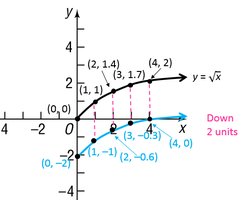
Downward Shift: If k is subtracted, y = f(x) - k is the graph of f(x) shifted down k units.
Domain and Range: The domain remains unchanged, but the range is shifted by k units.
Example: The graph of g(x) = \sqrt{x} - 2 is the graph of f(x) = \sqrt{x} shifted down 2 units. The domain is [0, ∞), and the range is [–2, ∞).
Horizontal Shifts
Horizontal shifts move the graph left or right.
Right Shift: Replacing x with x - h in f(x) shifts the graph right h units: y = f(x - h).
Left Shift: Replacing x with x + h shifts the graph left h units: y = f(x + h).
Domain and Range: The range remains unchanged, but the domain is shifted by h units.
Combining Vertical and Horizontal Shifts
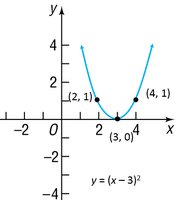
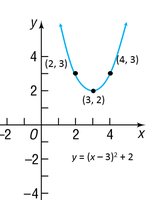
Multiple transformations can be applied in sequence. For example, f(x) = (x - 3)^2 + 2 is the graph of y = x^2 shifted right 3 units and up 2 units.
Domain: (–∞, ∞)
Range: [2, ∞)
Vertical and Horizontal Compressions and Stretches
Vertical Compression or Stretch
Multiplying a function by a constant a changes its vertical scale.
Vertical Stretch: If a > 1, y = a f(x) stretches the graph vertically by a factor of a.
Vertical Compression: If 0 < a < 1, y = a f(x) compresses the graph vertically by a factor of a.
Each y-coordinate is multiplied by a.
Horizontal Compression or Stretch
Multiplying the input x by a constant a changes the horizontal scale.
Horizontal Compression: If a > 1, y = f(ax) compresses the graph horizontally by a factor of 1/a.
Horizontal Stretch: If 0 < a < 1, y = f(ax) stretches the graph horizontally by a factor of 1/a.
Each x-coordinate is multiplied by 1/a.
Example: Stretches and Compressions
y = 3f(x): Vertical stretch by 3.
y = f(2x): Horizontal compression by 1/2.
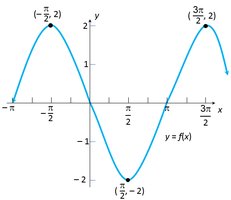
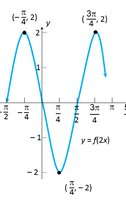
Reflections
Reflection about the x-Axis
Multiplying a function by –1 reflects its graph about the x-axis.
y = -f(x): Every point (x, y) on the graph of f(x) becomes (x, –y).
Reflection about the y-Axis
Replacing x with –x reflects the graph about the y-axis.
y = f(–x): Every point (x, y) on the graph of f(x) becomes (–x, y).
Combining Transformations
Order of Transformations
When multiple transformations are applied, the order matters. Typically, apply horizontal shifts and stretches/compressions first, then vertical stretches/compressions, and finally vertical shifts.
Example: To graph y = –(x – 3)^2 – 2 from y = x^2:
Shift right 3 units: y = (x – 3)^2
Reflect about the x-axis: y = –(x – 3)^2
Shift down 2 units: y = –(x – 3)^2 – 2
Step-by-Step Graphing Examples
Example: Applying Multiple Transformations
Consider f(x) = \frac{x^2}{2} + 1. The graph can be obtained in steps:
Start with y = x^2.
Vertical compression by 1/2: y = \frac{x^2}{2}.
Vertical shift up 1 unit: y = \frac{x^2}{2} + 1.
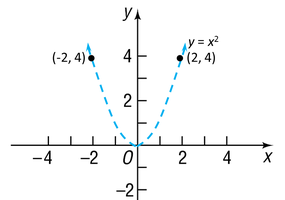
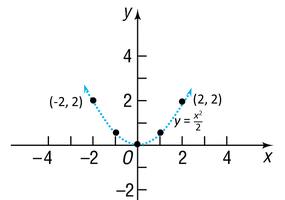
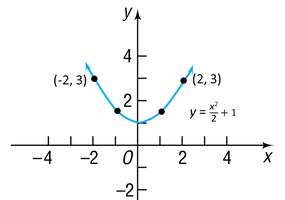
Domain: (–∞, ∞)
Range: [1, ∞)
Example: Transforming the Square Root Function
Consider f(x) = –\sqrt{x + 2} + 1. To graph this function:
Start with y = \sqrt{x}.
Reflect about the x-axis: y = –\sqrt{x}.
Shift left 2 units: y = –\sqrt{x + 2}.
Shift up 1 unit: y = –\sqrt{x + 2} + 1.
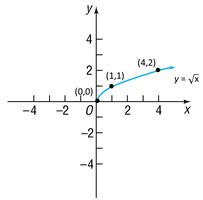
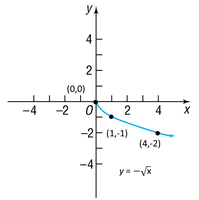
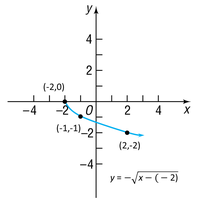
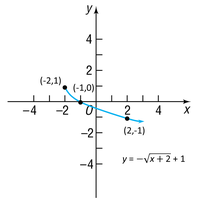
Domain: [–2, ∞)
Range: (–∞, 1]
Summary Table: Common Function Transformations
Transformation | Equation | Effect on Graph |
|---|---|---|
Vertical Shift Up | Up k units | |
Vertical Shift Down | Down k units | |
Horizontal Shift Right | Right h units | |
Horizontal Shift Left | Left h units | |
Vertical Stretch | Stretched vertically by a | |
Vertical Compression | Compressed vertically by a | |
Horizontal Compression | Compressed horizontally by 1/a | |
Horizontal Stretch | Stretched horizontally by 1/a | |
Reflection about x-axis | Reflected over x-axis | |
Reflection about y-axis | Reflected over y-axis |
