 Indietro
Inverse Circular (Trigonometric) Functions: Definitions, Properties, and Applications
Guida di studio - Note intelligenti
 Appunti personalizzati basati sui tuoi materiali, ampliati con definizioni chiave, esempi e contesto.
Inverse Functions and Their Properties
Definition and Graphical Interpretation
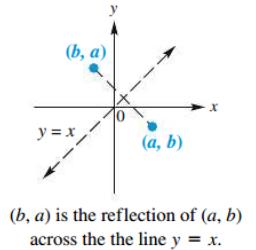
Inverse functions are fundamental in mathematics, allowing us to reverse the effect of a function. For a function f to have an inverse, it must be one-to-one, meaning each output corresponds to exactly one input. The graph of an inverse function f-1 is the reflection of the graph of f across the line y = x.
One-to-one function: Each x-value maps to a unique y-value, and vice versa.
Inverse function: If f is one-to-one, then f-1 exists such that f(f-1(x)) = x and f-1(f(x)) = x.
Domain and range: The domain of f becomes the range of f-1 and vice versa.
Graphical reflection: The point (a, b) on f corresponds to (b, a) on f-1.
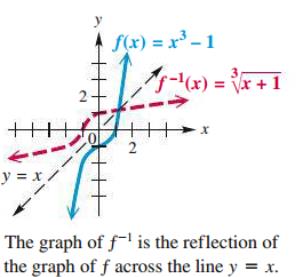
Steps to find an inverse function:
Replace f(x) with y and interchange x and y.
Solve for y.
Replace y with f-1(x).
Restricting Domains to Obtain Inverses
Horizontal Line Test and Domain Restriction
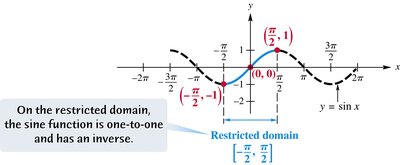
Not all functions are one-to-one over their entire domains. The horizontal line test determines if a function has an inverse: if any horizontal line crosses the graph more than once, the function is not one-to-one. By restricting the domain, we can often obtain a one-to-one function and thus define an inverse.
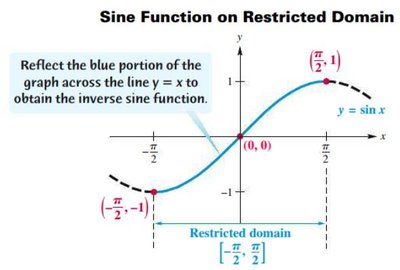
Example: The sine function y = \sin x is not one-to-one on (-\infty, \infty), but restricting the domain to \left[ -\frac{\pi}{2}, \frac{\pi}{2} \right] makes it one-to-one.
Inverse Sine Function (arcsin)
Definition, Domain, and Range
The inverse sine function is denoted as y = \sin^{-1} x or y = \arcsin x. It returns the angle y in the interval \left[ -\frac{\pi}{2}, \frac{\pi}{2} \right] whose sine is x.
Domain: [-1, 1]
Range: \left[ -\frac{\pi}{2}, \frac{\pi}{2} \right]
Odd function: \sin^{-1}(-x) = -\sin^{-1}(x)
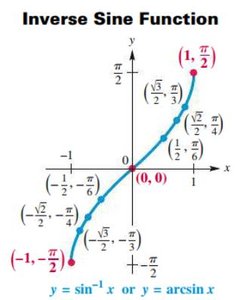
Examples:
\( y = \arcsin \frac{1}{2} = \frac{\pi}{6} \)
\( y = \sin^{-1}(-1) = -\frac{\pi}{2} \)
\( y = \sin^{-1}(-2) \) is undefined (since -2 is outside the domain).
Inverse Cosine Function (arccos)
Definition, Domain, and Range
The inverse cosine function is denoted as y = \cos^{-1} x or y = \arccos x. It returns the angle y in the interval [0, \pi] whose cosine is x.
Domain: [-1, 1]
Range: [0, \pi]
Not symmetric with respect to the origin or y-axis.
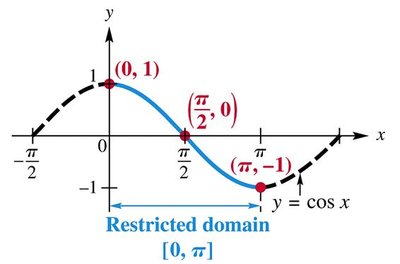
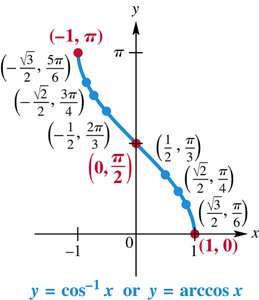
Examples:
\( y = \arccos 1 = 0 \)
\( y = \cos^{-1} \left(-\frac{\sqrt{2}}{2}\right) = \frac{3\pi}{4} \)
Inverse Tangent Function (arctan)
Definition, Domain, and Range
The inverse tangent function is denoted as y = \tan^{-1} x or y = \arctan x. It returns the angle y in the interval \left( -\frac{\pi}{2}, \frac{\pi}{2} \right) whose tangent is x.
Domain: (-\infty, \infty)
Range: \left( -\frac{\pi}{2}, \frac{\pi}{2} \right)
Odd function: \tan^{-1}(-x) = -\tan^{-1}(x)
Horizontal asymptotes: y = \frac{\pi}{2}, y = -\frac{\pi}{2}
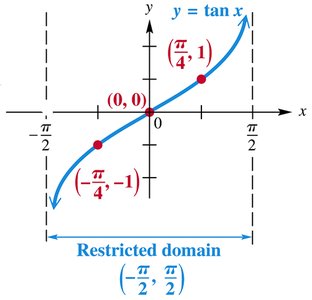
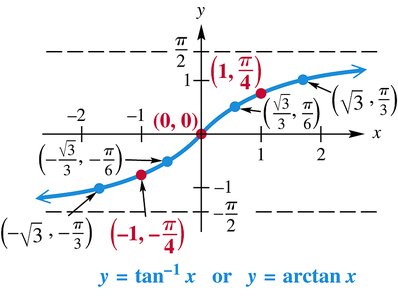
Examples:
\( y = \arctan 1 = \frac{\pi}{4} \)
\( y = \tan^{-1}(-1) = -\frac{\pi}{4} \)
Inverse Cotangent, Secant, and Cosecant Functions
Definitions, Domains, and Ranges
Inverse Cotangent: y = \cot^{-1} x or y = \text{arccot} x
Domain: (-\infty, \infty)
Range: (0, \pi)
Horizontal asymptotes: y = 0, y = \pi
Inverse Cosecant: y = \csc^{-1} x or y = \text{arccsc} x
Domain: (-\infty, -1] \cup [1, \infty)
Range: \left[ -\frac{\pi}{2}, 0 \right) \cup \left( 0, \frac{\pi}{2} \right]
Odd function: \csc^{-1}(-x) = -\csc^{-1}(x)
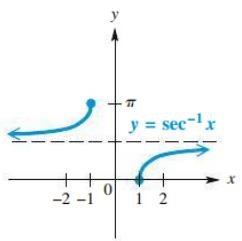
Inverse Secant: y = \sec^{-1} x or y = \text{arcsec} x
Domain: (-\infty, -1] \cup [1, \infty)
Range: [0, \frac{\pi}{2}) \cup (\frac{\pi}{2}, \pi]
Horizontal asymptote: y = \frac{\pi}{2}
Summary Table: Inverse Trigonometric Functions
Function | Domain | Range | Quadrants |
|---|---|---|---|
y = sin-1 x | [–1, 1] | [–π/2, π/2] | I and IV |
y = cos-1 x | [–1, 1] | [0, π] | I and II |
y = tan-1 x | (–∞, ∞) | (–π/2, π/2) | I and IV |
y = cot-1 x | (–∞, ∞) | (0, π) | I and II |
y = sec-1 x | (–∞, –1] ∪ [1, ∞) | [0, π/2) ∪ (π/2, π] | I and II |
y = csc-1 x | (–∞, –1] ∪ [1, ∞) | [–π/2, 0) ∪ (0, π/2] | I and IV |
Evaluating Inverse Trigonometric Functions
Calculator Use and Exact Values
Calculator keys typically provide sin-1, cos-1, and tan-1.
Other inverses can be computed as:
cot-1 x = π/2 – tan-1 x
sec-1 x = cos-1 (1/x)
csc-1 x = sin-1 (1/x)
Always ensure x is in the correct domain for the function.
Inverse Trigonometric Values as Angles
Inverse trigonometric functions return angles in radians, but sometimes degree measures are required. For example:
\( \theta = \arctan 1 = \frac{\pi}{4} = 45^\circ \)
\( \theta = \sin^{-1}(-\frac{1}{2}) = -\frac{\pi}{6} = -30^\circ \)
\( \theta = \cos^{-1} \frac{1}{2} = \frac{\pi}{3} = 60^\circ \)
Compositions and Applications
Finding Exact Values Using Definitions
Inverse trigonometric functions can be used in composition with other trigonometric functions to find exact values. For example:
\( \sin(\tan^{-1}(\frac{3}{2})) \)
\( \tan(\cos^{-1}(-\frac{5}{13})) \)
\( \cos(\arctan 3 + \arcsin \frac{1}{3}) \)
\( \tan(2 \arcsin \frac{2}{5}) \)
These can be solved by drawing right triangles and using the definitions of the trigonometric functions.
