 Indietro
Inverse Trigonometric Functions: Definitions, Properties, and Applications
Guida di studio - Note intelligenti
 Appunti personalizzati basati sui tuoi materiali, ampliati con definizioni chiave, esempi e contesto.
Inverse Trigonometric Functions
Introduction
Inverse trigonometric functions are essential tools in precalculus for solving equations involving trigonometric expressions. Because the six basic trigonometric functions are periodic and not one-to-one over their entire domains, their inverses are defined by restricting their domains to intervals where they are one-to-one. This section covers the definitions, properties, graphs, and applications of the inverse sine, cosine, and tangent functions.
Inverse Sine Function (Arcsine)
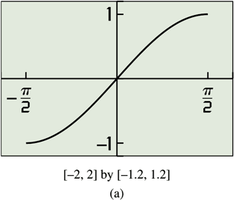
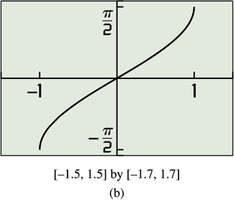
The inverse sine function, denoted as or , returns the unique angle in the interval such that . The domain of is , and its range is $\left[ -\frac{\pi}{2}, \frac{\pi}{2} \right]$.
Definition: means and .
Domain:
Range:
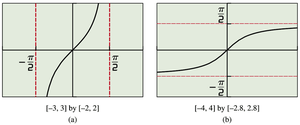
Graph: The graph of is an increasing curve from to .
Example: Evaluating Inverse Sine Without a Calculator
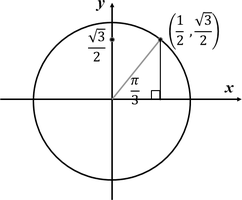
Problem: Find .
Solution: The angle in whose sine is is .
Example: Evaluating Inverse Sine With a Calculator
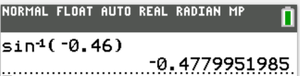
Problem: Find (in radians).
Solution: Using a calculator, radians.
Inverse Cosine Function (Arccosine)
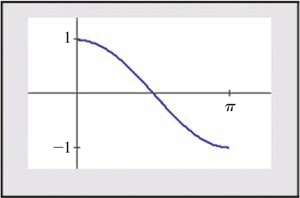
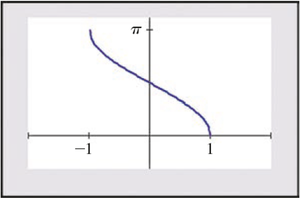
The inverse cosine function, denoted as or , returns the unique angle in the interval such that . The domain of is , and its range is $[0, \pi]$.
Definition: means and .
Domain:
Range:
Graph: The graph of is a decreasing curve from to .
Inverse Tangent Function (Arctangent)
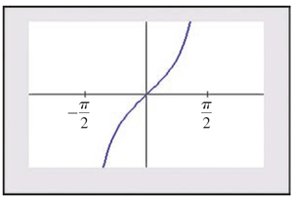
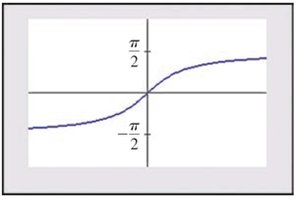
The inverse tangent function, denoted as or , returns the unique angle in the interval such that . The domain of is , and its range is $\left( -\frac{\pi}{2}, \frac{\pi}{2} \right)$.
Definition: means and .
Domain:
Range:
Graph: The graph of is an increasing curve with horizontal asymptotes at .
End Behavior of Inverse Tangent Function
As , .
As , .
Composing Trigonometric and Inverse Trigonometric Functions
Compositions of trigonometric and inverse trigonometric functions can simplify expressions and solve equations. The following identities are always true for all in the domain:
for
for
for
However, , , and are only true for in the restricted domains of the respective inverse functions.
Example: Composing Trig Functions with Arccosine
Problem: Express as an algebraic expression.
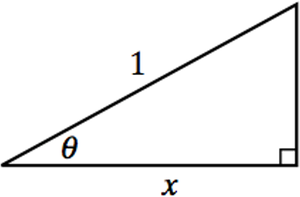
Solution: Let , so . In a right triangle with adjacent side and hypotenuse $1\sqrt{1 - x^2}\sin(\arccos(x)) = \sqrt{1 - x^2}$.
Applications of Inverse Trigonometric Functions
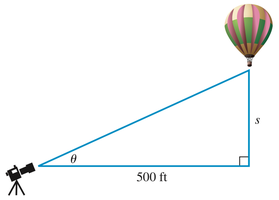
Inverse trigonometric functions are used in real-world applications such as calculating angles of elevation, navigation, and physics problems. For example, the viewing angle of a photographer observing a rising balloon can be modeled using the inverse tangent function.
Example: Calculating a Viewing Angle
Problem: A photographer is 500 ft from a balloon rising vertically. Let be the height of the balloon. Find the viewing angle as a function of $s$.
Solution:
Observation: The change in is greater for small values of than for large values, because increases rapidly near and slowly as approaches infinity.
Summary Table: Properties of Inverse Trigonometric Functions
Function | Domain | Range | Notation |
|---|---|---|---|
Inverse Sine | or | ||
Inverse Cosine | or | ||
Inverse Tangent | or |
Additional info: The notes above expand on the textbook content by providing explicit domain and range intervals, algebraic derivations for compositions, and practical applications for inverse trigonometric functions.
