Indietro
Inverse Trigonometric Functions: Definitions, Properties, and Applications
Guida di studio - Note intelligenti
 Appunti personalizzati basati sui tuoi materiali, ampliati con definizioni chiave, esempi e contesto.
Inverse Trigonometric Functions
Introduction to Inverse Trigonometric Functions
Inverse trigonometric functions allow us to determine the angle that corresponds to a given trigonometric value. Since the six basic trigonometric functions are periodic and not one-to-one over their entire domains, we restrict their domains to intervals where they are one-to-one to define their inverses. These inverse functions are essential for solving trigonometric equations and modeling real-world scenarios involving angles.
Key Point: The six basic trigonometric functions (sine, cosine, tangent, cosecant, secant, cotangent) are not one-to-one, so their inverses are defined on restricted domains.
Key Point: Inverse trigonometric functions are denoted as arcsin, arccos, arctan, etc.
Application: Inverse trig functions are used to solve equations and model angles in geometry and physics.
Inverse Sine Function (Arcsine)
Definition and Properties
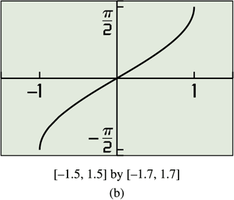
The inverse sine function, denoted as or , gives the unique angle in the interval such that .
Domain:
Range:
Equation: and

Examples: Evaluating Inverse Sine Without a Calculator
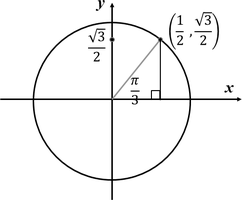
Example: Find the angle in such that . Solution:
Examples: Evaluating Inverse Sine With a Calculator
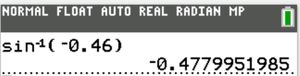
Example: Solution: Use a calculator to find radians.
Inverse Cosine Function (Arccosine)
Definition and Properties
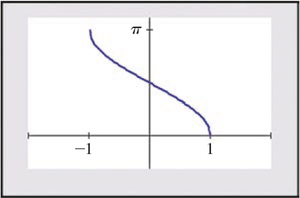
The inverse cosine function, denoted as or , gives the unique angle in the interval such that .
Domain:
Range:
Equation: and

Inverse Tangent Function (Arctangent)
Definition and Properties
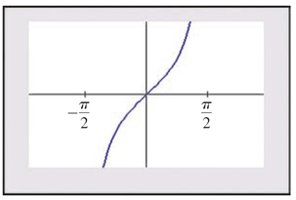
The inverse tangent function, denoted as or , gives the unique angle in the interval such that .
Domain:
Range:
Equation: and
End Behavior of the Inverse Tangent Function
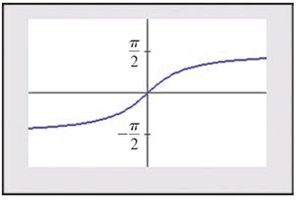
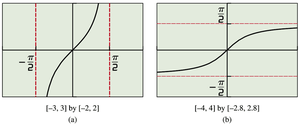
As approaches , approaches . As $x$ approaches , $\arctan(x)$ approaches . These are horizontal asymptotes for the function.
Composing Trigonometric and Inverse Trigonometric Functions
Key Properties and Simplification
Composing a trigonometric function with its inverse (or vice versa) can simplify to an algebraic expression, but only when the input is within the restricted domain of the inverse function.
Always True: for
Always True: for
Similar properties hold for cosine and tangent.
Example: Composing Trig Functions with Arccosine
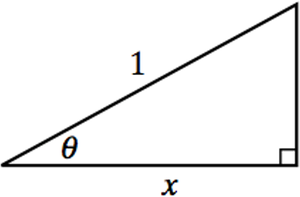
To simplify , draw a right triangle with angle , so . The adjacent side is , the hypotenuse is $1\sqrt{1 - x^2}\sin(\arccos(x)) = \sqrt{1 - x^2}$.
Applications of Inverse Trigonometric Functions
Example: Calculating a Viewing Angle
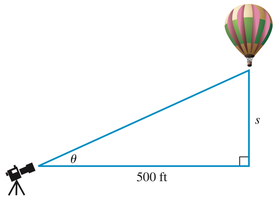
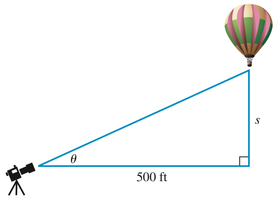
Suppose a photographer is 500 feet from a rising balloon. The angle of elevation to the balloon as a function of its height is given by . The rate of change of $\theta$ with respect to $s$ is greater when $s$ is small, and decreases as $s$ increases, due to the horizontal asymptote of the arctangent function.
Equation:
Observation: The angle increases rapidly for small , but more slowly for large $s$.