 Indietro
Inverse Trigonometric Functions: Definitions, Properties, and Applications
Guida di studio - Note intelligenti
 Appunti personalizzati basati sui tuoi materiali, ampliati con definizioni chiave, esempi e contesto.
Inverse Trigonometric Functions
Introduction to Inverse Trigonometric Functions
Inverse trigonometric functions allow us to determine the angle that corresponds to a given trigonometric value. Since the six basic trigonometric functions are periodic and not one-to-one over their entire domains, we restrict their domains to intervals where they are one-to-one to define their inverses. These functions are essential for solving trigonometric equations and for applications in geometry and calculus.
Key Point: The inverse trigonometric functions are defined by restricting the domains of the original trigonometric functions to intervals where they are one-to-one.
Key Point: The principal values (ranges) of the inverse functions are chosen to ensure each input yields a unique output.
Inverse Sine Function (Arcsine)
Definition and Properties
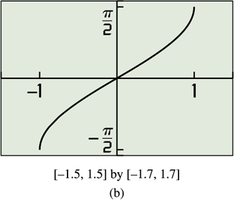
The inverse sine function, also called arcsine, is denoted as or . It gives the unique angle in the interval such that .
Domain:
Range:
Equation: and

Evaluating Inverse Sine Without a Calculator
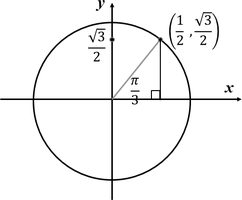
Key Point: To find for special values, locate the angle in whose sine is .
Example: , since .
Evaluating Inverse Sine With a Calculator
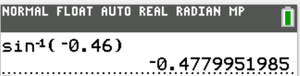
Key Point: Use the calculator's inverse sine function to find approximate values in radians or degrees.
Example: radians.
Inverse Cosine Function (Arccosine)
Definition and Properties
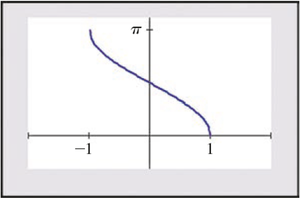
The inverse cosine function, or arccosine, is denoted as or . It gives the unique angle in the interval such that .
Domain:
Range:
Equation: and

Inverse Tangent Function (Arctangent)
Definition and Properties
The inverse tangent function, or arctangent, is denoted as or . It gives the unique angle in the interval such that .
Domain:
Range:
Equation: and
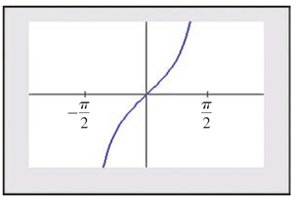
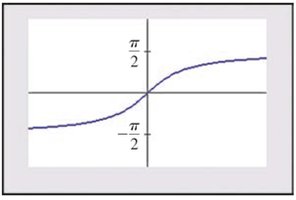
End Behavior of Inverse Tangent Function
Key Point: As , ; as , .
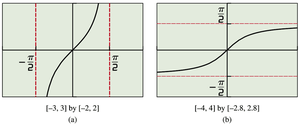
Applications of Inverse Trigonometric Functions
Example: Calculating a Viewing Angle
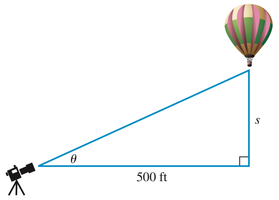
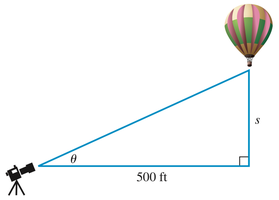
Inverse trigonometric functions are used in real-world applications such as determining angles of elevation or depression. For example, to find the angle at which a photographer must look to see a rising balloon, use the arctangent function.
Key Point: If the horizontal distance is 500 ft and the balloon's height is , then implies that .
Key Point: The rate of change of with respect to is greater when "s" is small, due to the shape of the arctangent curve.
Summary Table: Inverse Trigonometric Functions
Function | Notation | Domain | Range | Equation |
|---|---|---|---|---|
Inverse Sine | ||||
Inverse Cosine | ||||
Inverse Tangent |
