 Indietro
Library of Functions and Piecewise-defined Functions
Guida di studio - Note intelligenti
 Appunti personalizzati basati sui tuoi materiali, ampliati con definizioni chiave, esempi e contesto.
Functions and Their Graphs
Introduction to the Library of Functions
The "library of functions" refers to a set of basic functions that serve as building blocks for more complex functions. Understanding their properties and graphs is essential for analyzing and constructing mathematical models in precalculus.
Key Functions in the Library
Constant Function
The constant function is defined as , where is a real number. Its graph is a horizontal line.

Identity Function
The identity function is defined as . Its graph is a straight line passing through the origin with a slope of 1.

Square Function
The square function is defined as . Its graph is a parabola opening upwards, symmetric with respect to the y-axis.

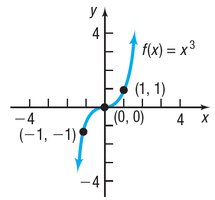
Cube Function
The cube function is defined as . Its graph is symmetric with respect to the origin and passes through the origin.
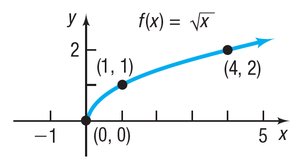
Square Root Function
The square root function is defined as . It is only defined for and its graph starts at the origin and increases slowly.
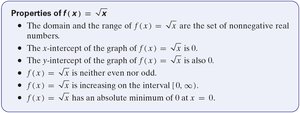
Properties of :
The domain and range are the set of nonnegative real numbers.
The x- and y-intercepts are both 0.
Neither even nor odd.
Increasing on .
Has an absolute minimum of 0 at .
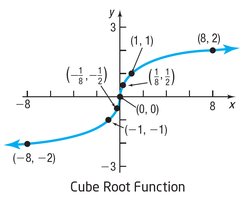
Cube Root Function
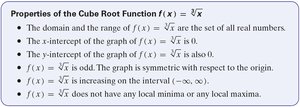
The cube root function is defined as . It is defined for all real numbers and is symmetric with respect to the origin (odd function).
Properties of :
Domain and range: all real numbers.
x- and y-intercepts: 0.
Odd function; symmetric with respect to the origin.
Increasing on .
No local minima or maxima.
Absolute Value Function
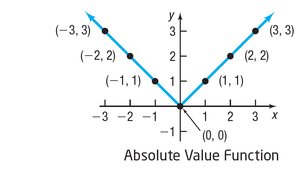
The absolute value function is defined as . Its graph is a "V" shape, symmetric with respect to the y-axis (even function).
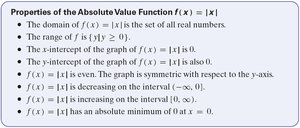
Properties of :
Domain: all real numbers.
Range: .
x- and y-intercepts: 0.
Even function; symmetric with respect to the y-axis.
Decreasing on , increasing on .
Absolute minimum at .
Reciprocal Function
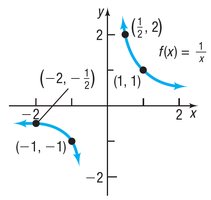
The reciprocal function is defined as . It is undefined at and has two branches, one in each quadrant.
Greatest Integer Function
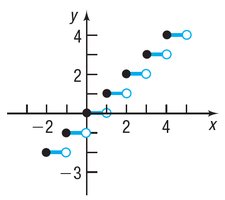
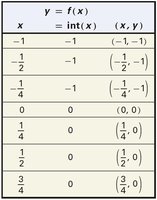
The greatest integer function (also called the floor function) is defined as , which returns the greatest integer less than or equal to . Its graph consists of horizontal segments.
x | f(x) = int(x) | (x, y) |
|---|---|---|
-1 | -1 | (-1, -1) |
-1/2 | -1 | (-1/2, -1) |
-1/4 | -1 | (-1/4, -1) |
0 | 0 | (0, 0) |
1/4 | 0 | (1/4, 0) |
1/2 | 0 | (1/2, 0) |
3/4 | 0 | (3/4, 0) |
Piecewise-defined Functions
Definition and Analysis
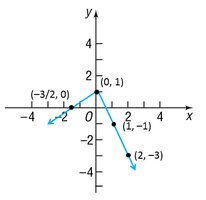
A piecewise-defined function is a function defined by different expressions on different intervals of its domain. Analyzing such functions involves evaluating the function at specific points, determining the domain and range, and graphing each piece according to its interval.
Example: Piecewise-defined Function
Consider the function:
To evaluate f(0): Since , use .
To evaluate f(1): Since , use .
To evaluate f(2): Since , use .
Domain: (all real numbers).
Intercepts: y-intercept at ; x-intercept at .
Range: .
Example: Piecewise-defined Function with Three Pieces
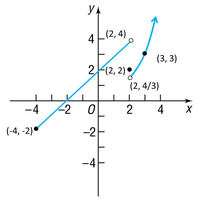
Consider the function:
To evaluate f(0): , so .
To evaluate f(2): , so .
To evaluate f(3): , so .
Domain: .
Intercepts: y-intercept at ; x-intercept at .
Range: .
Applications of Piecewise-defined Functions
Cost of Electricity Example
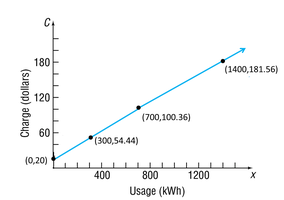
Piecewise-defined functions are often used in real-world applications, such as utility billing. For example, the monthly charge for electricity can be modeled as:
For 500 kWh: dollars.
For 1900 kWh: dollars.
The two pieces are linear but have different slopes and meet at .
Summary Table: Key Library Functions
Function Name | Equation | Domain | Range | Symmetry |
|---|---|---|---|---|
Constant | Even | |||
Identity | Odd | |||
Square | Even | |||
Cube | Odd | |||
Square Root | Neither | |||
Cube Root | Odd | |||
Absolute Value | Even | |||
Reciprocal | Odd | |||
Greatest Integer | Integers | Neither |
