 Indietro
One-to-One and Inverse Functions: Precalculus Study Notes
Guida di studio - Note intelligenti
 Appunti personalizzati basati sui tuoi materiali, ampliati con definizioni chiave, esempi e contesto.
Exponential and Logarithmic Functions
One-to-One Functions and Inverse Functions
This section explores the concept of one-to-one functions, how to determine if a function is one-to-one, and the process of finding and verifying inverse functions. These concepts are foundational for understanding exponential and logarithmic functions in precalculus.
One-to-One Functions
Definition and Identification
A one-to-one function is a function in which every element of the range is paired with exactly one element of the domain. In other words, no two different inputs produce the same output.
Formal Definition: A function f is one-to-one if, for any two different inputs x1 and x2, f(x1) \neq f(x2).
Example: If two different ages correspond to the same cholesterol score, the function is not one-to-one.
The Horizontal Line Test
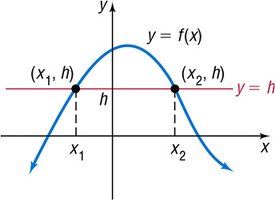
The Horizontal Line Test is a graphical method to determine if a function is one-to-one. If every horizontal line intersects the graph of a function at most once, the function is one-to-one.
If a horizontal line crosses the graph more than once, the function is not one-to-one.
Examples Using the Horizontal Line Test
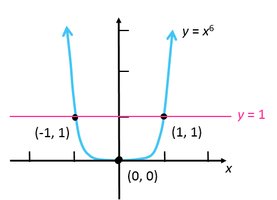
Example 1: The function y = x^6 is not one-to-one because the horizontal line y = 1 intersects the graph at two points: (-1, 1) and (1, 1).
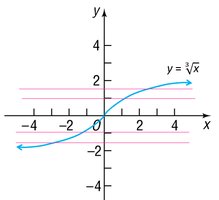
Example 2: The function y = \sqrt[3]{x} is one-to-one because every horizontal line intersects the graph exactly once.
Monotonic Functions
A function that is increasing or decreasing on an interval is one-to-one on that interval.
Inverse Functions
Definition and Notation
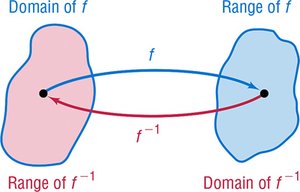
If f is a one-to-one function, its inverse function is denoted by f^{-1}. The inverse function reverses the correspondence of f: it maps each output of f back to its original input.
Notation: If f(a) = b, then f^{-1}(b) = a.
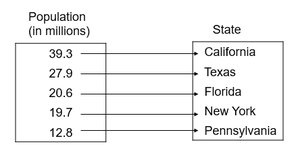
Finding the Inverse from a Map or Set of Ordered Pairs
To find the inverse, interchange the domain and range elements.
State | Population (in millions) |
|---|---|
California | 39.3 |
Texas | 27.9 |
Florida | 20.6 |
New York | 19.7 |
Pennsylvania | 12.8 |
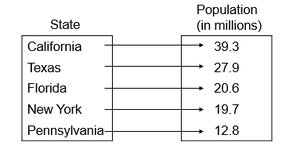
After interchanging, the inverse function is:
Population (in millions) | State |
|---|---|
39.3 | California |
27.9 | Texas |
20.6 | Florida |
19.7 | New York |
12.8 | Pennsylvania |
Domain and Range of Inverse Functions
The domain of f becomes the range of f^{-1}, and vice versa.
Graphing Inverse Functions
Symmetry with Respect to y = x
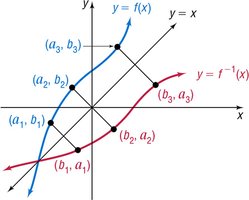
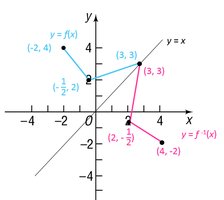
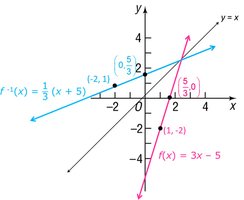
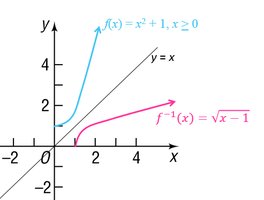
The graphs of a one-to-one function and its inverse are symmetric with respect to the line y = x.
Example: Graphing a Function and Its Inverse
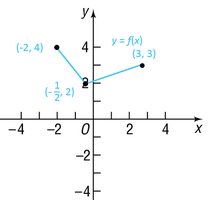
Given a function f with points (-2, 4), (-1/2, 2), and (3, 3), the inverse function will have points (4, -2), (2, -1/2), and (3, 3).
Verifying Inverse Functions
Definition
Two functions f and g are inverses if:
for all x in the domain of g
for all x in the domain of f
Finding the Inverse of a Function Defined by an Equation
Procedure
Replace f(x) with y.
Interchange x and y in the equation.
Solve for y to obtain the explicit form of the inverse function.
Check by verifying and .
Example: Linear Function
Given , find the inverse.
Step 1: Replace with :
Step 2: Interchange and :
Step 3: Solve for :
Example: Domain-Restricted Function
Given with , find the inverse.
Step 1: Replace with :
Step 2: Interchange and :
Step 3: Solve for : (since )
Summary Table: Properties of Inverse Functions
Property | Function f | Inverse f^{-1} |
|---|---|---|
Domain | Domain of f | Range of f |
Range | Range of f | Domain of f |
Verification | ||
Graphical Symmetry | Graphs are symmetric about the line y = x | |
