 Indietro
Precalculus Practice Exam 1 – Step-by-Step Study Guidance
Guida di studio - Note intelligenti
 Appunti personalizzati basati sui tuoi materiali, ampliati con definizioni chiave, esempi e contesto.
Q1. State the definition of a function.
Background
Topic: Functions and Their Definitions
This question tests your understanding of what a function is in mathematics, which is foundational for all of precalculus.
Key Terms:
Function: A relation that assigns exactly one output for each input from a given set.
Domain: The set of all possible input values (usually x-values).
Range: The set of all possible output values (usually y-values).
Step-by-Step Guidance
Recall that a function relates each element of the domain to exactly one element of the range.
Think about how you would describe this relationship in your own words, emphasizing the "one output for each input" rule.
Consider using set notation or mapping notation if you are comfortable with it, but a clear sentence is sufficient.
Try solving on your own before revealing the answer!
Final Answer:
A function is a relation in which each element of the domain is paired with exactly one element of the range.
In other words, for every input value, there is only one output value.
Q2. Given that , what is the domain of ?
Background
Topic: Domain of Rational Functions
This question tests your ability to find the domain of a rational function, which involves identifying values that make the denominator zero.
Key Terms and Formulas:
Rational Function: A function of the form where .
Domain: All real numbers except those that make the denominator zero.
Step-by-Step Guidance
Identify the denominator of the function: .
Set the denominator equal to zero: .
Solve for to find the value(s) that are not allowed in the domain.
Express the domain in interval notation, excluding the value(s) found in the previous step.
Try solving on your own before revealing the answer!
Final Answer:
The domain is all real numbers except .
In interval notation: .
Q3. Use the TI-83 or TI-84 calculator to solve the equation . All solutions lie between -10 and 10. Approximate the solutions to two decimal places.
Background
Topic: Solving Polynomial Equations Numerically
This question tests your ability to use a graphing calculator to find approximate solutions (roots) of a higher-degree polynomial equation.
Key Terms and Concepts:
Root (Zero): A value of where .
Graphing Calculator: Use the 'zero' or 'root' function to find where the graph crosses the x-axis.
Step-by-Step Guidance
Enter the equation into your calculator's Y= menu.
Set the window to values between -10 and 10 to ensure you see all possible roots in the given interval.
Use the 'zero' or 'root' function on your calculator to find the x-values where the graph crosses the x-axis.
Record each solution, rounding to two decimal places as required.
Try solving on your own before revealing the answer!
Final Answer:
The approximate solutions (to two decimal places) are , .
These are the x-values where the function crosses the x-axis within the interval [-10, 10].
Q4. Given the points and :
Background
Topic: Linear Equations and Distance Formula
This question tests your ability to find the equation of a line given two points and to calculate the distance between those points.
Key Terms and Formulas:
Slope-Intercept Form:
Slope Formula:
Distance Formula:
Step-by-Step Guidance
Find the slope using the two points: and .
Use the slope and one point to write the equation in point-slope form, then convert to slope-intercept form.
For the distance, substitute the coordinates into the distance formula and simplify under the square root.
Leave the distance in exact form (do not approximate).
Try solving on your own before revealing the answer!
Final Answer:
a) The equation of the line is .
b) The exact distance between the points is .
Q5. Given and , find each of the following:
Background
Topic: Function Evaluation and Operations
This question tests your ability to evaluate functions, add and subtract functions, and find intercepts.
Key Terms and Formulas:
Function Evaluation: Substitute the given value for in the function.
Sum of Functions:
Difference of Functions:
y-intercept: The point where .
Step-by-Step Guidance
For , substitute into and simplify.
For , add and together and combine like terms.
For , substitute into both and , then subtract from .
For the y-intercept of , substitute into and write the coordinates as .
Try solving on your own before revealing the answer!
Final Answer:
a)
b)
c)
d) The y-intercept of is .
Q6. Solve each inequality or equation. Exact values only. Reduce fractions, and provide your answer using interval notation where appropriate.
Background
Topic: Absolute Value Equations and Linear Inequalities
This question tests your ability to solve equations involving absolute values and inequalities, and to express solutions in interval notation.
Key Terms and Formulas:
Absolute Value Equation: leads to two equations: and .
Linear Inequality: Solve as you would a linear equation, but reverse the inequality if you multiply or divide by a negative.
Step-by-Step Guidance
For , set up two equations: and .
Solve each equation for .
For , distribute and combine like terms.
Isolate and express the solution in interval notation.
Try solving on your own before revealing the answer!
Final Answer:
a) or
b)
Interval notation:
Q7. Solve the system of equations:
Background
Topic: Systems of Linear Equations
This question tests your ability to solve a system of two linear equations using substitution or elimination.
Key Terms and Formulas:
System of Equations: Two or more equations with the same variables.
Substitution Method: Solve one equation for one variable and substitute into the other.
Elimination Method: Add or subtract equations to eliminate a variable.
Step-by-Step Guidance
Solve the second equation for in terms of .
Substitute this expression for into the first equation.
Solve for .
Substitute the value of back into one of the original equations to find .
Try solving on your own before revealing the answer!
Final Answer:
,
The solution to the system is the point .
Q8. Use the graph of the given function to answer the following questions. The turning points and x-intercepts have been labeled.
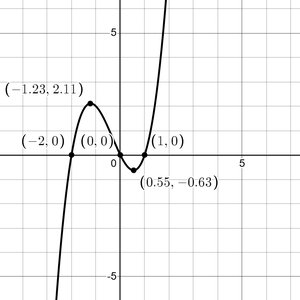
Background
Topic: Analyzing Graphs of Functions
This question tests your ability to interpret key features of a function's graph, including degree, extrema, intercepts, and intervals of increase/decrease.
Key Terms and Concepts:
Degree: The highest power of in the function.
Local Maximum/Minimum: Highest/lowest point in a local region of the graph.
Increasing/Decreasing Intervals: Where the graph rises or falls as increases.
: Where the graph is below the x-axis.
Step-by-Step Guidance
Look at the end behavior and number of turning points to determine if the degree is even or odd.
Identify the highest labeled point (local maximum) and lowest labeled point (local minimum) on the graph.
Find the intervals where the graph is rising (increasing) and where it is falling (decreasing).
Determine the intervals where the graph is below the x-axis ().
Try solving on your own before revealing the answer!
Final Answer:
a) The degree is odd.
b) Local maximum:
c) Local minimum:
d) Increasing on and
e) Decreasing on
f) on
Q9. Match each equation to its graph.
Background
Topic: Parent Functions and Their Graphs
This question tests your ability to recognize the graphs of basic functions such as linear, quadratic, cubic, exponential, and reciprocal functions.
Key Terms and Concepts:
Parent Function: The simplest form of a function type.
Common Parent Functions: , , , ,
Step-by-Step Guidance
Recall the general shape of each parent function listed.
Match each equation to the graph that best fits its shape (e.g., parabola for , S-curve for , etc.).
Be careful with the reciprocal and exponential functions, as their graphs are distinct.
Try solving on your own before revealing the answer!
Final Answer:
matches graph A
matches graph B
matches graph C
matches graph D
matches graph F
Q10. a) What transformations have been applied to the parent function to arrive at ?
Background
Topic: Transformations of Functions
This question tests your understanding of how to describe transformations such as shifts, stretches, and translations applied to a parent function.
Key Terms and Concepts:
Vertical Stretch: Multiplying the function by a constant greater than 1.
Horizontal Shift: Adding or subtracting inside the function argument.
Vertical Shift: Adding or subtracting outside the function.
Step-by-Step Guidance
Identify the coefficient in front of the squared term to determine if there is a vertical stretch or compression.
Look at the value subtracted from inside the parentheses to determine the horizontal shift.
Look at the value added outside the squared term to determine the vertical shift.
Describe each transformation in order.
Try solving on your own before revealing the answer!
Final Answer:
a) The function is shifted right by 5 units, vertically stretched by a factor of 2, and shifted up by 1 unit.
b) The correct graph is the one that shows a parabola opening upwards, vertex at (5, 1), and narrower than .
