 Indietro
Precalculus Review: Functions, Domain & Range, Symmetry, and Parent Functions
Guida di studio - Note intelligenti
 Appunti personalizzati basati sui tuoi materiali, ampliati con definizioni chiave, esempi e contesto.
Q1. State the domain and range of the relation. Determine whether the relation is a function or not. Then complete the mapping diagram: {(-2, 4), (5, 5), (-6, 8), (7, 5), (-10, -10), (7, -1)}
Background
Topic: Relations and Functions
This question tests your understanding of how to identify the domain and range from a set of ordered pairs, determine if the relation is a function, and represent the relation using a mapping diagram.
Key Terms:
Domain: The set of all possible input values (x-values).
Range: The set of all possible output values (y-values).
Function: A relation in which each input (x) is paired with exactly one output (y).
Step-by-Step Guidance
List all the x-values from the given pairs to find the domain.
List all the y-values from the given pairs to find the range.
Check if any x-value is paired with more than one y-value. If so, the relation is not a function.
Draw a mapping diagram by connecting each x-value to its corresponding y-value.
Try solving on your own before revealing the answer!
Final Answer:
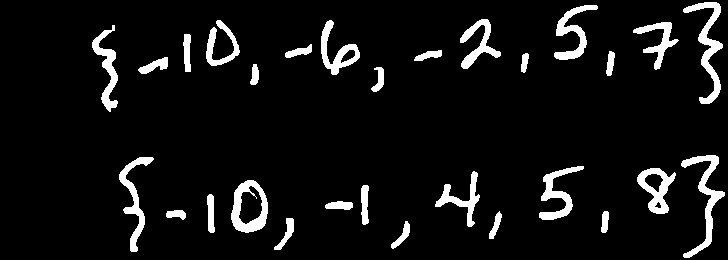
Domain: {-10, -6, -2, 5, 7}
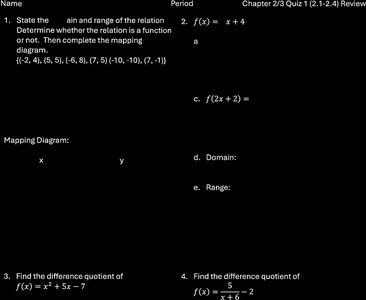
Range: {-10, -1, 4, 5, 8}
This relation is not a function because the x-value 7 is paired with both 5 and -1.
Q2. For the function :
a. Write the function.
c. Find .
d. State the domain.
e. State the range.
Background
Topic: Function Evaluation and Properties
This question tests your ability to evaluate a function for a given expression, and to determine the domain and range of a linear function.
Key Terms and Formulas:
Function Evaluation: Substitute the input value or expression into the function.
Domain of Linear Function: Usually all real numbers unless restricted.
Range of Linear Function: Usually all real numbers unless restricted.
Step-by-Step Guidance
Write the function as .
To find , substitute for in the function.
For domain and range, consider the properties of linear functions.
Set up the expressions for domain and range, but do not compute the final values yet.
Try solving on your own before revealing the answer!
Final Answer:
a.
c.
d. Domain:
e. Range:
Linear functions have domain and range of all real numbers unless otherwise specified.
Q3. Find the difference quotient of
Background
Topic: Difference Quotient
This question tests your ability to compute the difference quotient, which is foundational for understanding rates of change and derivatives.
Key Formula:
Difference Quotient:
Step-by-Step Guidance
Write the formula for the difference quotient.
Find by substituting into the function.
Subtract from .
Set up the expression for the difference quotient, but do not simplify to the final answer yet.
Try solving on your own before revealing the answer!
Final Answer:
Difference quotient:
After simplifying, the difference quotient is .
Q4. Find the difference quotient of
Background
Topic: Difference Quotient for Rational Functions
This question tests your ability to apply the difference quotient to a rational function, which is important for understanding more complex rates of change.
Key Formula:
Difference Quotient:
Step-by-Step Guidance
Write the formula for the difference quotient.
Find by substituting into the function.
Subtract from .
Set up the expression for the difference quotient, but do not simplify to the final answer yet.
Try solving on your own before revealing the answer!
Final Answer:
Difference quotient:
This can be further simplified by combining the fractions and simplifying the numerator.
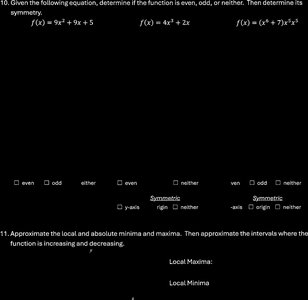
Q10. Given the following equations, determine if the function is even, odd, or neither. Then determine its symmetry:
Background
Topic: Even and Odd Functions, Symmetry
This question tests your ability to classify functions as even, odd, or neither, and to determine their symmetry (y-axis, origin, or neither).
Key Terms:
Even Function: for all (symmetric about the y-axis).
Odd Function: for all (symmetric about the origin).
Neither: If neither condition is met.
Step-by-Step Guidance
For each function, substitute for and simplify.
Compare to and to determine if the function is even, odd, or neither.
Identify the type of symmetry based on your classification.
Try solving on your own before revealing the answer!
Final Answer:
: Neither, symmetric about neither.
: Neither, symmetric about neither.
: Odd, symmetric about the origin.
Even functions are symmetric about the y-axis, odd functions about the origin, and neither if neither condition is met.
Q12. Find the average rate of change of over the interval .
Background
Topic: Average Rate of Change
This question tests your ability to calculate the average rate of change of a function over a specified interval, which is foundational for understanding slopes and derivatives.
Key Formula:
Average Rate of Change: , where and are the endpoints of the interval.
Step-by-Step Guidance
Identify and .
Calculate and by substituting and into the function.
Set up the formula .
Do not compute the final value yet; set up the expressions for and .
Try solving on your own before revealing the answer!
Final Answer:
Average rate of change:
The average rate of change over the interval is 13.
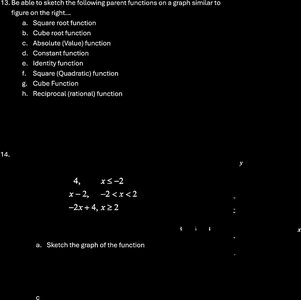
Q13. Be able to sketch the following parent functions on a graph:
Square root function
Cube root function
Absolute (Value) function
Constant function
Identity function
Square (Quadratic) function
Cube function
Reciprocal (rational) function
Background
Topic: Parent Functions and Graphs
This question tests your ability to recognize and sketch the basic shapes of parent functions, which is essential for understanding transformations and graphing.
Key Terms:
Parent Function: The simplest form of a function type.
Graph: Visual representation of the function.
Step-by-Step Guidance
Recall the basic shape and formula for each parent function.
Identify key points (such as intercepts and symmetry) for each graph.
Sketch or describe the general appearance of each graph.
Try solving on your own before revealing the answer!

Final Answer:
Square root: (starts at origin, curves upward)
Cube root: (passes through origin, S-shaped)
Absolute value: (V-shaped)
Constant: (horizontal line)
Identity: (diagonal line)
Quadratic: (U-shaped parabola)
Cube: (passes through origin, S-shaped)
Reciprocal: (hyperbola, two branches)
Each parent function has a distinct graph shape that helps identify its properties and transformations.
