 Indietro
Precalculus Study Guide: Algebraic Expressions, Equations, and Polynomials
Guida di studio - Note intelligenti
 Appunti personalizzati basati sui tuoi materiali, ampliati con definizioni chiave, esempi e contesto.
Algebraic Expressions and Simplification
Basic Operations with Numbers and Variables
Algebraic expressions involve numbers, variables, and arithmetic operations. Simplifying these expressions is a foundational skill in precalculus, requiring the application of arithmetic rules, properties of exponents, and order of operations.
Addition and Subtraction: Combine like terms (terms with the same variable and exponent).
Multiplication: Use the distributive property and properties of exponents.
Division: Simplify fractions and reduce to lowest terms.
Order of Operations: Follow PEMDAS (Parentheses, Exponents, Multiplication/Division, Addition/Subtraction).
Example: Simplify First, calculate the exponent: Then, inside p
arentheses: Multiply: Add:
Fractions and Least Common Multiple (LCM)
Operations with Fractions
When adding or subtracting fractions, it is necessary to find a common denominator, often the least common multiple (LCM) of the denominators.
LCM: The smallest positive integer that is a multiple of two or more numbers.
Example: The LCM of 18 and 12 is 36.
Adding Fractions: Find LCM (36), convert fractions:
Opposites and Reciprocals
Definitions and Examples
Opposite: The opposite of a number is .
Reciprocal: The reciprocal of a nonzero number is .
Example: The opposite of $19-19\frac{5}{2}\frac{2}{5}$.
Solving Linear Equations
Isolating the Variable
To solve linear equations, isolate the variable on one side using inverse operations.
Example: Subtract from both sides: Divide by :
Exponents and Radicals
Properties and Simplification
Exponents and radicals are used to express repeated multiplication and roots. Simplifying expressions with exponents often involves applying the laws of exponents.
Product Rule:
Quotient Rule:
Power Rule:
Negative Exponent:
Radical to Exponent:
Example:
Polynomials: Addition, Subtraction, and Multiplication
Combining and Expanding Polynomials
Polynomials are algebraic expressions with terms consisting of variables raised to whole-number exponents. Operations include addition, subtraction, and multiplication.
Standard Form: Write terms in descending order of exponents.
Example:
Multiplying Binomials:
Factoring Polynomials
Common Methods
Factoring is the process of expressing a polynomial as a product of its factors. Common methods include factoring out the greatest common factor, difference of squares, and the AC method for trinomials.
Difference of Squares:
Trinomial Factoring: where and are numbers such that and
Example:
Solving Quadratic Equations
Factoring and the Quadratic Formula
Quadratic equations are equations of the form . They can be solved by factoring, completing the square, or using the quadratic formula.
Factoring: Set each factor equal to zero and solve for .
Quadratic Formula: For , the solutions are:
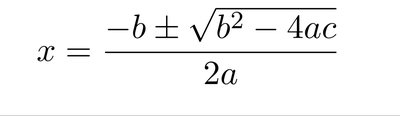
Example: Solve using the quadratic formula: , ,
Summary Table: Key Algebraic Properties
Property | Formula | Example |
|---|---|---|
Product of Powers | ||
Quotient of Powers | ||
Power of a Power | ||
Negative Exponent | ||
Difference of Squares | ||
Quadratic Formula |
