 Indietro
Precalculus Study Guide: Analysis of Graphs of Functions
Guida di studio - Note intelligenti
 Appunti personalizzati basati sui tuoi materiali, ampliati con definizioni chiave, esempi e contesto.
Q1. Solve the following equation by completing the square:
Background
Topic: Quadratic Equations & Completing the Square
This question tests your ability to solve a quadratic equation by the method of completing the square, which is a fundamental algebraic technique used in Precalculus.
Key Terms and Formulas:
Quadratic equation:
Completing the square: Transforming into
Square root property: If , then
Step-by-Step Guidance
Start by moving the constant term to the other side:
To complete the square, take half of the coefficient of (which is ), square it, and add it to both sides:
Add $16y^2 - 8y + 16 = 3 + 16$
Rewrite the left side as a perfect square:
Try solving on your own before revealing the answer!
Final Answer:
After completing the square, you use the square root property to solve for .
This matches option d.
Q2. For the line segment bounded by the given endpoints, and , find the midpoint.
Background
Topic: Coordinate Geometry – Midpoint Formula
This question tests your understanding of how to find the midpoint of a line segment given two endpoints in the coordinate plane.
Key Terms and Formulas:
Midpoint formula:
Endpoints: and
Step-by-Step Guidance
Identify the coordinates of the endpoints: and
Apply the midpoint formula to the -coordinates:
Apply the midpoint formula to the -coordinates:
Write the midpoint as an ordered pair
Try solving on your own before revealing the answer!
Final Answer:
By calculating the averages, you find the midpoint is , which matches option b.
Q3. Solve: and also find domain of $f \circ g(x)$ where ,
Background
Topic: Function Composition and Domain
This question tests your ability to compose two functions and determine the domain of the resulting function.
Key Terms and Formulas:
Function composition:
Domain: Set of input values for which the function is defined
Square root function: is defined for
Step-by-Step Guidance
Write as
Substitute into :
Determine the domain: Since , must be
Express the domain in interval notation:
Try solving on your own before revealing the answer!
Final Answer: ; Domain:
The composition is and the domain is all .
This matches option b.
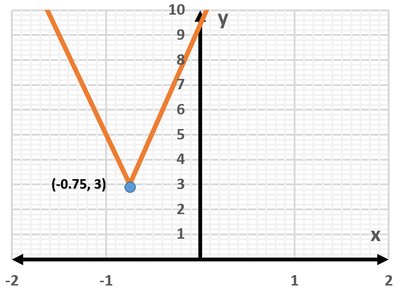
Q4. Use the standard graph of to transform it into the following function
Background
Topic: Transformations of Absolute Value Functions
This question tests your understanding of how to apply transformations (stretch, shift, translation) to the absolute value function.
Key Terms and Formulas:
Absolute value function:
Transformations:
Vertical stretch: ; Horizontal compression: ; Horizontal shift: ; Vertical shift:
Step-by-Step Guidance
Identify the transformations: (vertical stretch), (horizontal compression), (horizontal shift), (vertical shift)
Find the vertex: Set
The graph is vertically stretched by $2\frac{3}{4}
Compare the transformed graph to the options provided
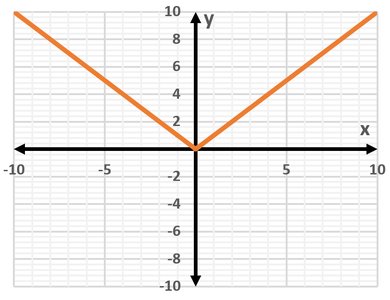
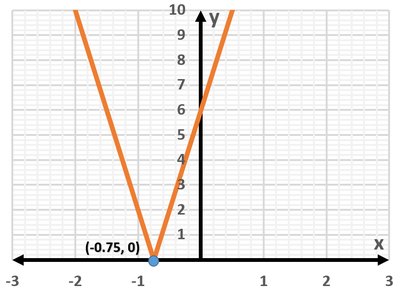
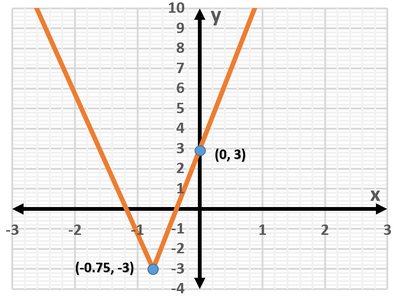
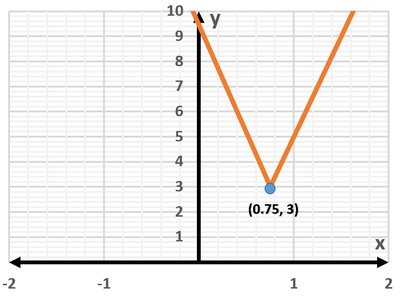
Try solving on your own before revealing the answer!
Final Answer: The correct graph is image_5
The vertex is at , matching the transformation .
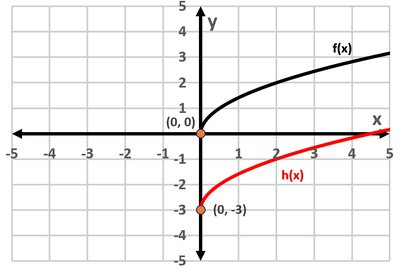
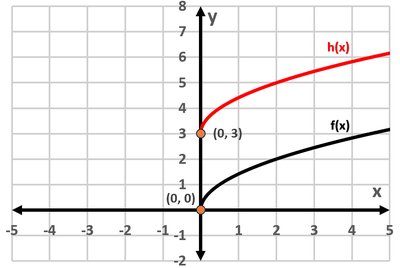
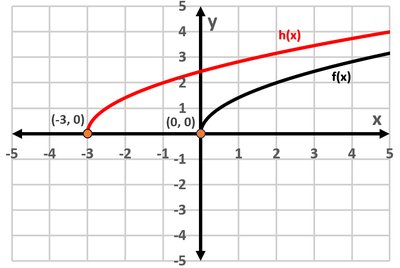
Q5. Graph as a transformation of the square root function
Background
Topic: Transformations of Square Root Functions
This question tests your ability to graph a transformed square root function and recognize shifts and translations.
Key Terms and Formulas:
Square root function:
Transformation:
Horizontal shift:
Step-by-Step Guidance
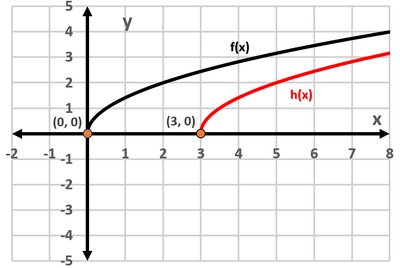
Set the inside of the square root to zero to find the starting point:
The graph of is shifted right by $3f(x)$
Compare the transformed graph to the options provided
Try solving on your own before revealing the answer!
Final Answer: The correct graph is image_9
The graph is shifted right by $3h(x) = \sqrt{2x - 6}$.
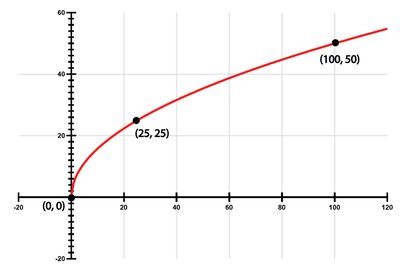
Q6. For the following function, sketch its graph:
Background
Topic: Graphing Square Root Functions
This question tests your ability to graph a square root function with a coefficient inside the radical.
Key Terms and Formulas:
Square root function:
Domain:
Transformation: Horizontal stretch/compression
Step-by-Step Guidance
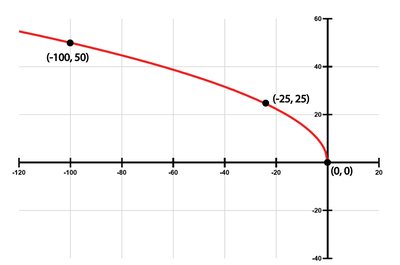
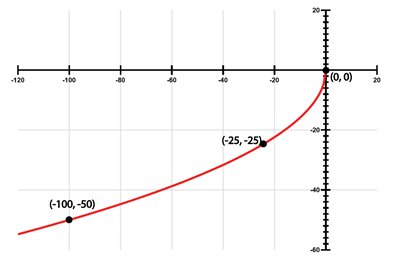
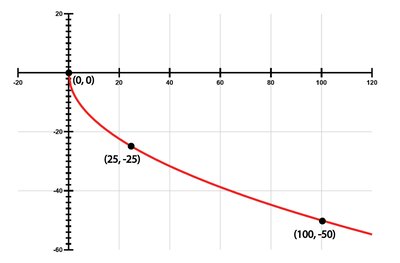
Set to find the starting point:
For , increases as increases
Compare the graph to the options provided
Try solving on your own before revealing the answer!
Final Answer: The correct graph is image_13
The graph starts at and increases rapidly, matching the square root function with a large coefficient inside the radical.
Q7. Given the two functions and , find and identify the domain.
Background
Topic: Function Operations – Multiplication and Domain
This question tests your ability to multiply two functions and determine the domain of the resulting function.
Key Terms and Formulas:
Function multiplication:
Domain: Set of input values for which both functions are defined
Step-by-Step Guidance
Write as
Substitute the expressions:
Expand the product:
Simplify the expression and consider the domain (both functions are defined for all real numbers)
Try solving on your own before revealing the answer!
Final Answer: ; Domain:
Both functions are defined everywhere, so the domain is all real numbers.
This matches option c.
Q8. For the given one-to-one function, find the inverse function, , and verify that your equation is correct.
Background
Topic: Inverse Functions
This question tests your ability to find the inverse of a linear function and verify it by composition.
Key Terms and Formulas:
Inverse function:
To find the inverse, solve for
Verification:
Step-by-Step Guidance
Write
Solve for in terms of :
Replace with to write the inverse:
Verify by checking
Try solving on your own before revealing the answer!
Final Answer:
Composing and gives , confirming the inverse.
This matches option d.
Q9. Find and if and
Background
Topic: Inverse Functions and Composition
This question tests your ability to find the inverse of a composition of functions and the composition of their inverses.
Key Terms and Formulas:
Function composition:
Inverse of composition:
Inverse functions: ,
Composition of inverses:
Step-by-Step Guidance
Find :
To find , solve for
Find and separately
Compose
Try solving on your own before revealing the answer!
Final Answer: ,
Solving for in the composition and composing the inverses gives these results.
This matches option a.
