 Indietro
Precalculus Study Guide: Asymptotes and Rational Functions
Guida di studio - Note intelligenti
 Appunti personalizzati basati sui tuoi materiali, ampliati con definizioni chiave, esempi e contesto.
Q1. In your own words, explain what a vertical asymptote is and what a horizontal asymptote is.
Background
Topic: Asymptotes of Rational Functions
This question is testing your understanding of the definitions and significance of vertical and horizontal asymptotes in the context of rational functions.
Key Terms:
Vertical Asymptote: A line where the function approaches infinity or negative infinity as the input approaches a certain value.
Horizontal Asymptote: A line that the function approaches as the input becomes very large (positive or negative).
Step-by-Step Guidance
Think about what happens to the graph of a rational function near certain values of where the denominator is zero.
Consider how the function behaves as approaches infinity or negative infinity.
Try to describe, in your own words, what each type of asymptote represents for the graph.
Try solving on your own before revealing the answer!
Final Answer:
A vertical asymptote is a vertical line (usually written as ) where the function increases or decreases without bound as approaches . A horizontal asymptote is a horizontal line (usually written as ) that the function approaches as goes to infinity or negative infinity.
Vertical asymptotes often occur where the denominator of a rational function is zero, and horizontal asymptotes describe the end behavior of the function.
Q2. Given the graph below, state any horizontal and vertical asymptotes. Make sure you state your answers as equations.
Background
Topic: Identifying Asymptotes from Graphs
This question is testing your ability to read a graph and identify the equations of the vertical and horizontal asymptotes.
Key Terms:
Vertical Asymptote: Appears as a dashed vertical line on the graph where the function diverges.
Horizontal Asymptote: Appears as a dashed horizontal line that the function approaches as increases or decreases.
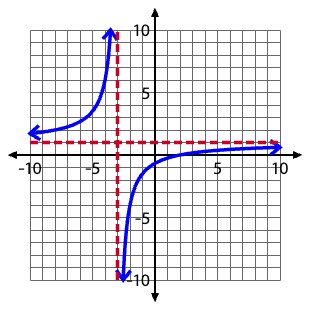
Step-by-Step Guidance
Look for the dashed lines on the graph. These usually represent the asymptotes.
Identify the equation of the vertical asymptote by finding the -value where the function diverges.
Identify the equation of the horizontal asymptote by finding the -value that the function approaches as goes to infinity.
Write your answers in the form for vertical and for horizontal asymptotes.
Try solving on your own before revealing the answer!
Final Answer:
The vertical asymptote is and the horizontal asymptote is .
These are the lines where the function diverges and approaches, respectively, as seen in the graph.
Q3. Consider the parent rational function which has asymptotes at and . Using your knowledge of transformations from Unit 1 (Section 1.5), sketch the transformation and then state the asymptotes of the transformation.
Background
Topic: Transformations of Rational Functions
This question is testing your ability to apply transformations (shifts) to the parent rational function and determine the new asymptotes.
Key Terms and Formulas:
Parent Function:
Transformation: Horizontal shift by and vertical shift by
New Function:
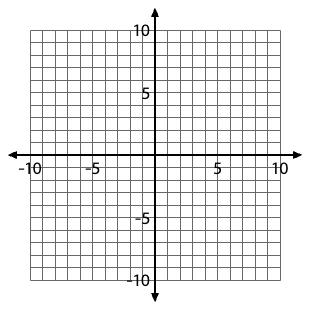
Step-by-Step Guidance
Recall that has vertical asymptote at and horizontal asymptote at .
Apply the horizontal shift: is replaced by , so the vertical asymptote moves to .
Apply the vertical shift: moves the horizontal asymptote to .
Sketch the new function on the graph, showing the new asymptotes.
Try solving on your own before revealing the answer!
Final Answer:
The vertical asymptote is and the horizontal asymptote is .
These are the new locations after applying the horizontal and vertical shifts to the parent function.
Q4. Consider the function . Without graphing, state the following if they exist: Location of removable discontinuities, vertical asymptote(s), horizontal asymptote.
Background
Topic: Rational Functions—Discontinuities and Asymptotes
This question is testing your ability to analyze a rational function for removable discontinuities, vertical asymptotes, and horizontal asymptotes using algebraic methods.
Key Terms and Formulas:
Removable Discontinuity: Occurs when a factor cancels in the numerator and denominator.
Vertical Asymptote: Occurs where the denominator is zero and the factor does not cancel.
Horizontal Asymptote: Determined by comparing degrees of numerator and denominator.
Step-by-Step Guidance
Factor both the numerator and denominator to identify common factors.
Find values of where the denominator is zero: and .
Check if any of these factors cancel with the numerator to identify removable discontinuities.
Determine which values lead to vertical asymptotes (non-cancelled denominator factors).
Compare the degrees of the numerator and denominator to find the horizontal asymptote.
Try solving on your own before revealing the answer!
Final Answer:
Removable discontinuity: (since cancels)
Vertical asymptote: (since does not cancel)
Horizontal asymptote: (degrees are equal, so ratio of leading coefficients is $1$)
Q5. Find the domain, vertical asymptote(s), and horizontal asymptote of .
Background
Topic: Domain and Asymptotes of Simple Rational Functions
This question is testing your ability to find the domain, vertical asymptote(s), and horizontal asymptote for a rational function with a linear denominator.
Key Terms and Formulas:
Domain: All real numbers except where the denominator is zero.
Vertical Asymptote: Set denominator equal to zero and solve for .
Horizontal Asymptote: For , as , .
Step-by-Step Guidance
Set to find where the function is undefined.
Solve for to find the vertical asymptote.
State the domain as all real numbers except the value found above.
Determine the horizontal asymptote by considering the end behavior as becomes very large.
Try solving on your own before revealing the answer!
Final Answer:
Domain: All real numbers except
Vertical asymptote:
Horizontal asymptote:
Q6. Find the domain, vertical asymptote(s), and horizontal asymptote of .
Background
Topic: Domain and Asymptotes of Rational Functions
This question is testing your ability to analyze a rational function with quadratic numerator and denominator for domain, vertical asymptotes, and horizontal asymptote.
Key Terms and Formulas:
Domain: All real numbers except where the denominator is zero.
Vertical Asymptote: Set denominator equal to zero and solve for .
Horizontal Asymptote: Compare degrees of numerator and denominator.
Step-by-Step Guidance
Factor the numerator and denominator to find zeros.
Set the denominator equal to zero and solve for to find vertical asymptotes.
State the domain as all real numbers except the values found above.
Compare the degrees of numerator and denominator to determine the horizontal asymptote.
Try solving on your own before revealing the answer!
Final Answer:
Domain: All real numbers except and
Vertical asymptotes: and
Horizontal asymptote:
Q7. Find any x- and y-intercepts of . Be sure to state your answers as ordered pairs.
Background
Topic: Intercepts of Rational Functions
This question is testing your ability to find the x- and y-intercepts of a rational function by setting and respectively.
Key Terms and Formulas:
x-intercept: Set numerator equal to zero and solve for .
y-intercept: Set and solve for .
Step-by-Step Guidance
Factor the numerator to find values of where (x-intercepts).
Set in the function to find the y-intercept.
Write the intercepts as ordered pairs.
Try solving on your own before revealing the answer!
Final Answer:
x-intercepts: and
y-intercept:
These are found by factoring and substituting as described above.
