 Indietro
Quadratic Functions and Their Properties – Precalculus Study Guide
Guida di studio - Note intelligenti
 Appunti personalizzati basati sui tuoi materiali, ampliati con definizioni chiave, esempi e contesto.
Q1. Write the two forms of a quadratic equation.
Background
Topic: Quadratic Functions
This question tests your understanding of the two main ways to express a quadratic function: vertex form and general (standard) form.
Key Terms and Formulas
Vertex Form:
General Form:
Step-by-Step Guidance
Recall that the general form is the expanded version of a quadratic, showing all terms.
The vertex form highlights the vertex of the parabola and is useful for graphing.
Write both forms clearly, using the correct variables and structure.
Try solving on your own before revealing the answer!
Final Answer:
Vertex Form:
General Form:
These are the two standard forms for expressing a quadratic function.
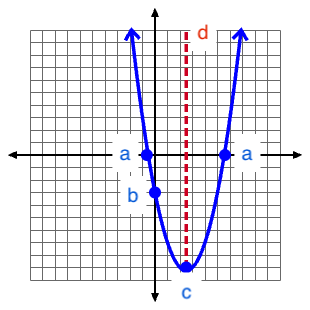
Q2. Match the letters on the graph to their appropriate labels: axis of symmetry, solutions/roots/zeroes, y-intercept, vertex.
Background
Topic: Quadratic Graph Features
This question tests your ability to identify key features of a quadratic graph, such as the axis of symmetry, roots, y-intercept, and vertex.
Key Terms
Axis of Symmetry: The vertical line that divides the parabola into two mirror images.
Solutions/Roots/Zeroes: The points where the graph crosses the x-axis.
Y-intercept: The point where the graph crosses the y-axis.
Vertex: The lowest or highest point on the parabola.
Step-by-Step Guidance
Examine the graph and locate the points labeled a, b, c, and d.
Identify which label corresponds to each letter based on their position:
Look for the points where the graph crosses the x-axis (roots), y-axis (y-intercept), the turning point (vertex), and the dashed vertical line (axis of symmetry).
Assign each label to the correct letter, but stop before stating the final matches.
Try solving on your own before revealing the answer!
Final Answer:
a: solutions/roots/zeroes
b: y-intercept
c: vertex
d: axis of symmetry
Each letter corresponds to a key feature of the quadratic graph as described above.
Q3. Identify if each quadratic has a minimum or maximum.
Background
Topic: Quadratic Function Properties
This question tests your ability to determine whether a quadratic function opens upward (minimum) or downward (maximum) based on the leading coefficient.
Key Terms
Minimum: The lowest point of the parabola (vertex) when .
Maximum: The highest point of the parabola (vertex) when .
Step-by-Step Guidance
For each quadratic, identify the leading coefficient ().
If , the parabola opens upward and has a minimum.
If , the parabola opens downward and has a maximum.
Apply this reasoning to each function, but stop before stating the final classification for each.
Try solving on your own before revealing the answer!
Final Answer:
: Minimum
: Maximum
: Maximum
: Minimum
The sign of the leading coefficient determines whether the quadratic has a minimum or maximum.
Q4. Rewrite in vertex form and state the vertex as an ordered pair.
Background
Topic: Completing the Square
This question tests your ability to convert a quadratic from general form to vertex form by completing the square.
Key Formula
Vertex Form:
Completing the Square:
Step-by-Step Guidance
Start with .
Group the and terms: .
Find the value to complete the square: Take half of , square it, and add/subtract as needed.
Rewrite the function in the form , but stop before stating the final vertex form and vertex.
Try solving on your own before revealing the answer!
Final Answer:
Vertex form:
Vertex:
Completing the square allows us to rewrite the function and identify the vertex.
Q5. Rewrite in vertex form and state the vertex as an ordered pair.
Background
Topic: Completing the Square with a Leading Coefficient
This question tests your ability to convert a quadratic with a leading coefficient other than 1 into vertex form.
Key Formula
Vertex Form:
Completing the Square: Factor from and terms before completing the square.
Step-by-Step Guidance
Start with .
Factor out $2x^2x.
Complete the square inside the parentheses: Take half of $4$, square it, and adjust the constant term accordingly.
Rewrite the function in vertex form, but stop before stating the final vertex form and vertex.
Try solving on your own before revealing the answer!
Final Answer:
Vertex form:
Vertex:
Factoring and completing the square allows us to rewrite the function and identify the vertex.
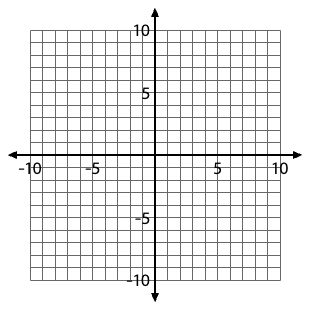
Q6. Rewrite in vertex form, sketch the function, and state the requested properties: vertex, axis of symmetry, solutions, domain, range.
Background
Topic: Quadratic Function Analysis
This question tests your ability to convert a quadratic to vertex form, graph it, and identify key properties.
Key Formula
Vertex Form:
Axis of Symmetry:
Solutions: Set and solve for
Domain: All real numbers ()
Range: Depends on the vertex and direction of opening
Step-by-Step Guidance
Start with .
Complete the square to rewrite in vertex form.
Identify the vertex from the vertex form.
Determine the axis of symmetry using .
Set and solve for to find the solutions.
State the domain and describe how to find the range, but stop before stating the final values.
Try solving on your own before revealing the answer!
Final Answer:
Vertex form:
Vertex:
Axis of symmetry:
Solutions: and
Domain:
Range:
The graph is a parabola opening upward with vertex at .
Q7. Find the solutions (roots/zeroes) of .
Background
Topic: Solving Quadratic Equations
This question tests your ability to find the roots of a quadratic equation by factoring or using the quadratic formula.
Key Formula
Quadratic Formula:
Factoring:
Step-by-Step Guidance
Set to find the roots: .
Try to factor the quadratic or use the quadratic formula.
Identify two numbers that multiply to and add to .
Write the factors and solve for , but stop before stating the final solutions.
Try solving on your own before revealing the answer!
Final Answer:
Solutions: and
Factoring gives , so the roots are and .
Q8. Find the solutions (roots/zeroes) of .
Background
Topic: Solving Quadratic Equations
This question tests your ability to find the roots of a quadratic equation, which may be real or complex.
Key Formula
Quadratic Formula:
Step-by-Step Guidance
Set to find the roots: .
Identify , , .
Calculate the discriminant: .
Plug values into the quadratic formula, but stop before stating the final solutions.
Try solving on your own before revealing the answer!
Final Answer:
Solutions: and
The discriminant is negative, so the roots are complex numbers.
Q9. A baseball player throws a rock upward from a 112-foot cliff at 96 ft/s. The height is . Answer the following:
Background
Topic: Quadratic Applications – Projectile Motion
This question tests your ability to analyze a quadratic function modeling projectile motion, including finding maximum height and time to hit the ground.
Key Formula
Vertex: for maximum/minimum
Maximum height: Plug into
Time to hit the ocean: Set and solve for
Step-by-Step Guidance
For maximum height, use with , .
Plug this value into to find the maximum height.
To find when the rock hits the ocean, set and solve for using the quadratic formula.
Be sure to include units in your answers, but stop before stating the final values.
Try solving on your own before revealing the answer!
Final Answer:
a. The rock reaches its maximum height at seconds.
b. The maximum height is $256$ feet above the ocean.
c. The rock hits the ocean at seconds.
These values are found using the vertex formula and solving the quadratic equation for time.
Q10. You have 200 feet of fencing. What should the length (L) and width (W) of a rectangular fence be to maximize the area?
Background
Topic: Optimization with Quadratics
This question tests your ability to use quadratic functions to solve optimization problems, specifically maximizing area given a fixed perimeter.
Key Formula
Perimeter:
Area:
Express in terms of and substitute into the area formula.
Step-by-Step Guidance
Start with the perimeter equation: .
Solve for in terms of : .
Substitute into the area formula: .
Write the area as a quadratic function of and find the value of that maximizes using the vertex formula, but stop before stating the final values.
Try solving on your own before revealing the answer!
Final Answer:
The area is maximized when feet and feet.
The maximum area is a square, square feet.
