 Indietro
Radian Measure and the Unit Circle: Precalculus Study Notes
Guida di studio - Note intelligenti
 Appunti personalizzati basati sui tuoi materiali, ampliati con definizioni chiave, esempi e contesto.
Chapter 3: Radian Measure and the Unit Circle
3.1 Radian Measure
Understanding radian measure is fundamental to trigonometry and calculus. This section introduces the concept of radians, conversions between degrees and radians, and the evaluation of trigonometric functions for angles measured in radians.
Radian Measure
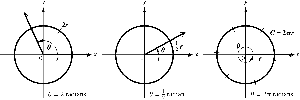
Radian: An angle with its vertex at the center of a circle that intercepts an arc equal in length to the radius of the circle has a measure of 1 radian.
General Formula: If a central angle θ (in radians) intercepts an arc of length s on a circle of radius r, then the radian measure is given by:
Radians are a dimensionless measure, as the units of length cancel out.
The circumference of a circle is , so a full revolution is radians.
Conversions between Degrees and Radians
To convert degrees to radians, multiply by .
To convert radians to degrees, multiply by .
Example 1: Convert 45° to radians:
Example 2: Convert radians to degrees:
Agreement on Angle Measurement Units
If no unit is specified, angles are assumed to be in radians.
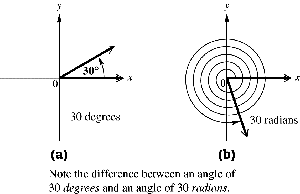
Be careful: 30° and 30 radians are very different angles.
Equivalent Angle Measures
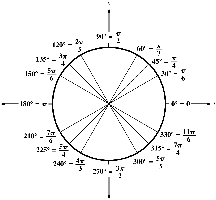
Common angles and their equivalents in degrees and radians are essential for trigonometry. Learn the following equivalences:
Degrees | Radians (Exact) | Radians (Approximate) |
|---|---|---|
0° | 0 | 0 |
30° | 0.52 | |
45° | 0.79 | |
60° | 1.05 | |
90° | 1.57 | |
180° | 3.14 | |
270° | 4.71 | |
360° | 6.28 |
Trigonometric Function Values of Angles in Radians
Trigonometric functions (sine, cosine, tangent, etc.) can be evaluated for angles in radians.
Calculators must be set to radian mode when working with radian measures.
Example:
3.2 Applications of Radian Measure
Radians are used to solve real-world problems involving circles, such as finding arc lengths and areas of sectors.
Arc Length on a Circle
The length of an arc intercepted by a central angle (in radians) on a circle of radius is:
Important: must be in radians for this formula.
Example: Find the arc length for a circle of radius 18.20 cm and central angle radians: cm
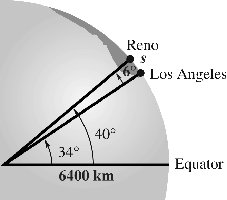
Application: Distance Between Two Cities
Latitude difference gives the central angle at Earth's center.
Distance , where km and is the latitude difference in radians.
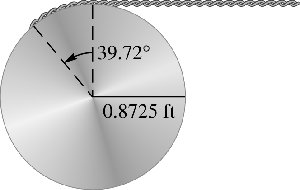
Application: Rope Wound Around a Drum
Arc length formula can determine how much rope is wound for a given rotation angle.
Example: For a drum of radius 0.8725 ft rotated through 39.72°:
Convert 39.72° to radians: radians
Arc length: ft
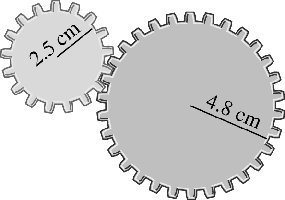
Application: Rotating Gears
When two gears are meshed, the arc length swept by each is equal at the point of contact.
If the smaller gear (radius ) rotates through angle , the larger gear (radius ) rotates through such that .
Solve for as .
Area of a Sector of a Circle
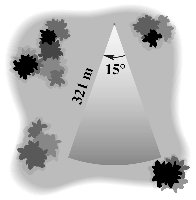
A sector is the region bounded by two radii and the intercepted arc.
The area of a sector with radius and central angle (in radians) is:
Important: must be in radians.
Example: For a sector with m and radians: m2
3.3 The Unit Circle and Circular Functions
The unit circle is a powerful tool for understanding trigonometric functions and their properties. Circular functions are defined for all real numbers using the unit circle.
The Unit Circle
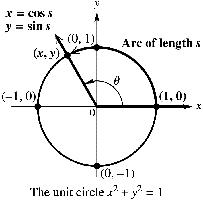
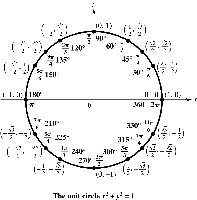
The unit circle is centered at the origin with radius 1.
For any real number , the coordinates on the unit circle correspond to .
The equation of the unit circle is:
Circular Functions
Sine and Cosine: For a real number , and are the and coordinates, respectively, of the point on the unit circle at arc length from .
Tangent:
The unit circle is symmetric about the -axis, -axis, and the origin.
Domains of the Circular Functions
Sine and Cosine: Defined for all real numbers.
Tangent and Secant: Undefined where (odd multiples of ).
Cotangent and Cosecant: Undefined where (integer multiples of ).
Evaluating Circular Functions
Use the unit circle to find exact values for common angles.
Reference angles and symmetry properties help evaluate functions for any real number.
Example: ,
Summary Table: Common Angles on the Unit Circle
Angle (Degrees) | Angle (Radians) | |||
|---|---|---|---|---|
0° | 0 | 0 | 1 | 0 |
30° | ||||
45° | 1 | |||
60° | ||||
90° | 1 | 0 | undefined |
Reflect: Radian vs. Degree Measure
Degree measure divides a circle into 360 equal parts.
Radian measure is based on the arc length relative to the radius, making it natural for calculus and trigonometry.
