 Indietro
Right Triangle Trigonometry and Applications
Guida di studio - Note intelligenti
 Appunti personalizzati basati sui tuoi materiali, ampliati con definizioni chiave, esempi e contesto.
Chapter 7: Applications of Trigonometric Functions
Section 7.1: Right Triangle Trigonometry; Applications
This section introduces the use of trigonometric functions in the context of right triangles and explores their applications in solving real-world and geometric problems. The relationships between angles and side lengths in right triangles are foundational for understanding trigonometry.
Right Triangle Trigonometry
Trigonometric functions can be defined using the sides of a right triangle. A right triangle is a triangle with one angle equal to 90 degrees. The side opposite the right angle is called the hypotenuse, and the other two sides are called the legs.
Pythagorean Theorem: The sides of a right triangle are related by , where is the hypotenuse.
By placing a right triangle in the Cartesian plane, the triangle's sides can be related to the coordinates of a point on a circle of radius .
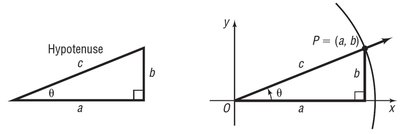
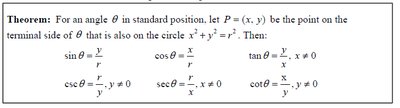
Trigonometric Functions in Terms of a Circle
For an angle in standard position, let be the point on the terminal side of that is also on the circle . The trigonometric functions are defined as:
Trigonometric Functions in Terms of Triangle Sides
Given a right triangle with angle , adjacent side , opposite side , and hypotenuse :
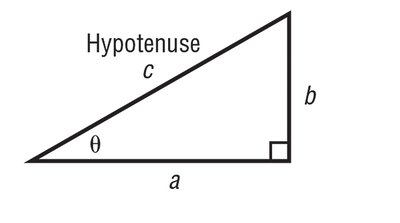
A common mnemonic to remember these relationships is SOH-CAH-TOA:
Sine = Opposite / Hypotenuse
Cosine = Adjacent / Hypotenuse
Tangent = Opposite / Adjacent
Example: Finding Trigonometric Values from a Right Triangle
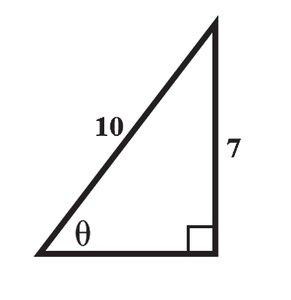
Given a right triangle with sides 7 and 10 (hypotenuse), find the six trigonometric functions for angle .
First, find the missing side using the Pythagorean Theorem: .
Then, use the definitions above to find each function.
Complementary Angles and Trigonometric Ratios
In a right triangle, the two non-right angles are complementary (sum to 90°). The sine of one angle equals the cosine of its complement, and vice versa. This leads to the following relationships:
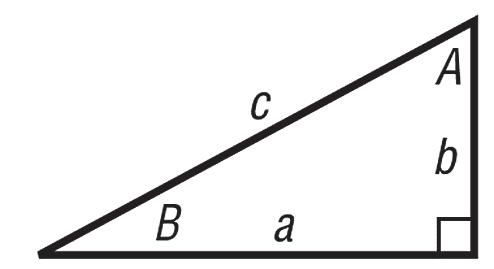
These relationships are called cofunction identities because the functions of complementary angles are equal.
Example: Complementary Angle Theorem
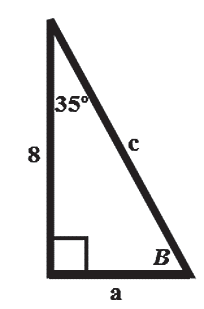
Given a right triangle with one angle of 35° and the side opposite is 8, use the complementary angle theorem to find the trigonometric ratios for both acute angles.
Solving Right Triangles
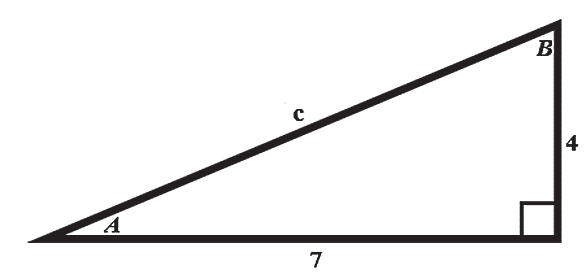
To solve a right triangle means to find all side lengths and angle measures. This is done using the Pythagorean Theorem, trigonometric ratios, and the fact that the two acute angles are complementary.
Given two sides, use the Pythagorean Theorem to find the third.
Given one side and one acute angle, use trigonometric functions to find the other sides.
Remember: the side opposite the smallest angle is the shortest, and the side opposite the largest angle (the right angle) is the hypotenuse.
Applications of Right Triangle Trigonometry
Finding the Width of a River
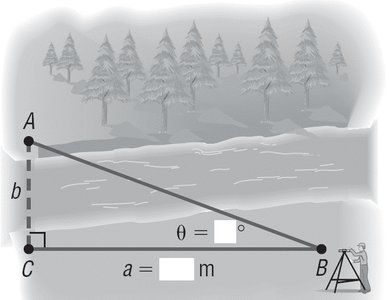
Surveyors use right triangle trigonometry to measure distances indirectly. For example, to find the width of a river, a surveyor measures a baseline and an angle, then uses trigonometric ratios to solve for the unknown width.
Angle of Elevation and Depression
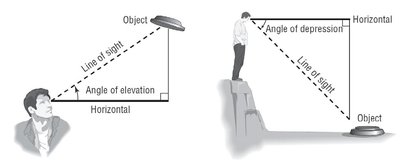
The angle of elevation is the angle above horizontal from the observer's eye to an object. The angle of depression is the angle below horizontal from the observer to an object. These concepts are used to solve problems involving heights and distances.
Example: To find the height of a tree, measure the distance from the tree and the angle of elevation to the top. Use to solve for the height.
If the measuring instrument is above ground level, add its height to the calculated value.
Bearings in Navigation and Surveying
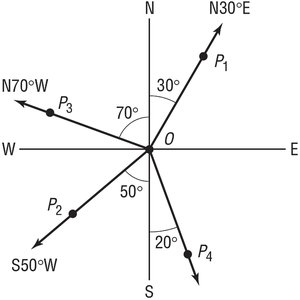
Bearing is a way to describe direction using angles measured from north or south toward east or west. For example, N30°E means 30° east of north. Bearings are used in navigation and surveying to specify directions.
To convert a bearing to a standard angle, measure clockwise from north.
Bearings always use an acute angle (less than 90°) and specify the reference direction first (N or S), then the angle, then the direction toward (E or W).
Summary Table: Trigonometric Functions in Right Triangles
Function | Definition |
|---|---|
sin θ | Opposite / Hypotenuse |
cos θ | Adjacent / Hypotenuse |
tan θ | Opposite / Adjacent |
csc θ | Hypotenuse / Opposite |
sec θ | Hypotenuse / Adjacent |
cot θ | Adjacent / Opposite |
Additional info: The notes above include expanded academic context and examples to ensure completeness and clarity for Precalculus students.
