 Indietro
Study Guide: Graphs and Transformations of Functions in Precalculus
Guida di studio - Note intelligenti
 Appunti personalizzati basati sui tuoi materiali, ampliati con definizioni chiave, esempi e contesto.
Graphs and Transformations of Functions
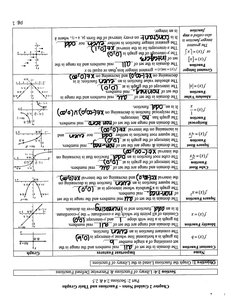
Basic Function Types and Their Graphs
This section introduces the fundamental types of functions commonly encountered in Precalculus, including their algebraic forms, graphical representations, and key properties. Understanding these basic functions is essential for analyzing more complex functions and their transformations.
Linear Function: Graph is a straight line passing through the origin with slope 1.
Quadratic Function: Graph is a parabola opening upwards, vertex at the origin.
Cubic Function: Graph passes through the origin, symmetric about the origin.
Square Root Function: Graph starts at the origin and increases slowly.
Absolute Value Function: Graph is a 'V' shape, vertex at the origin.
Reciprocal Function: Graph has two branches, one in each quadrant, with vertical and horizontal asymptotes.
Greatest Integer Function: Graph is a step function.
Exponential Function: Graph increases rapidly for .
Logarithmic Function: Graph increases slowly, undefined for .
Example: The graph of is a parabola with vertex at (0,0) and opens upward.
Piecewise Functions and Their Graphs
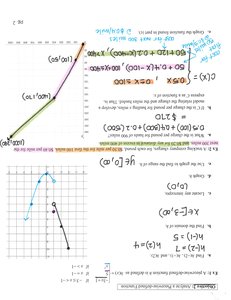
Piecewise functions are defined by different expressions for different intervals of the domain. Their graphs often consist of segments or portions of different basic functions.
Definition: A piecewise function is written as:
Graphing: Plot each segment according to its rule and domain interval.
Continuity: Check for jumps or holes at the boundaries between intervals.
Example:
Evaluating Piecewise Functions
To evaluate a piecewise function at a given value, determine which interval the input belongs to and use the corresponding expression.
Step 1: Identify the interval for the input value.
Step 2: Substitute the input into the appropriate expression.
Step 3: Simplify to find the output.
Example: For , and .
Transformations of Functions
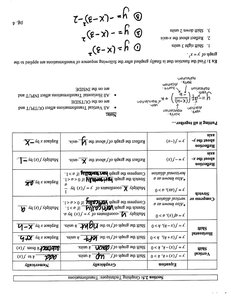
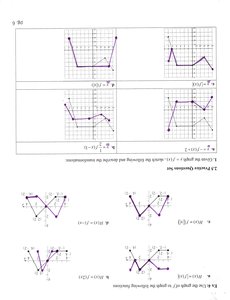
Transformations change the appearance of a function's graph. Common transformations include translations, reflections, stretches, and compressions. Understanding these helps in predicting and sketching the graph of modified functions.
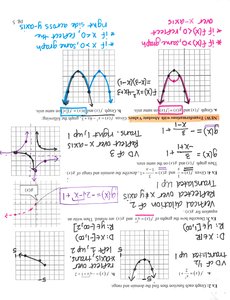
Vertical Translation: shifts the graph up by units.
Horizontal Translation: shifts the graph right by units.
Reflection: reflects the graph across the x-axis; reflects across the y-axis.
Vertical Stretch/Compression: stretches if , compresses if .
Horizontal Stretch/Compression: compresses if , stretches if .
Example: The graph of shifted up 3 units is .
Graphing Quadratic and Absolute Value Functions
Quadratic and absolute value functions are frequently transformed and analyzed in Precalculus. Their graphs are affected by changes in coefficients and constants.
Quadratic Function: Vertex:
Absolute Value Function: Vertex at (0,0), opens upward.
Transformations: Shifts, stretches, and reflections modify the position and shape of the graph.
Example: shifts the graph right by 2 units.
Graphing Piecewise Functions: Practice and Examples
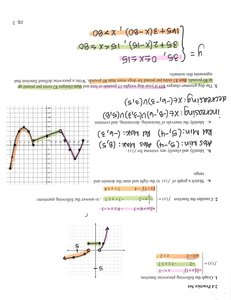
This section provides practice in graphing piecewise functions, emphasizing the importance of correctly plotting each segment and identifying discontinuities.
Step 1: Identify the intervals and corresponding expressions.
Step 2: Plot each segment on the same axes.
Step 3: Mark open or closed endpoints as appropriate.
Step 4: Check for jumps or holes at interval boundaries.
Example: Graph by plotting each segment and marking the transition at .
Additional info: The notes cover topics from Precalculus Chapter 1 and 2, focusing on graphs, functions, and their transformations, which are foundational for later chapters.
