 Indietro
3-01: Study Guide: Quadratic and Polynomial Functions in Precalculus
Guida di studio - Note intelligenti
 Appunti personalizzati basati sui tuoi materiali, ampliati con definizioni chiave, esempi e contesto.
Polynomial and Quadratic Functions
Polynomial Functions
Polynomial functions are a fundamental class of functions in algebra and precalculus. A polynomial function of degree n is defined as:
Definition: , where and all coefficients are real numbers.
Degree: The highest power of x in the function.
Leading Coefficient: The coefficient of the term with the highest degree.
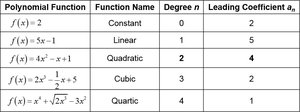
Classification: Polynomials are classified by degree: constant (0), linear (1), quadratic (2), cubic (3), quartic (4), etc.
Polynomial Function | Function Name | Degree n | Leading Coefficient an |
|---|---|---|---|
Constant | 0 | 2 | |
Linear | 1 | 5 | |
Quadratic | 2 | 4 | |
Cubic | 3 | 2 | |
Quartic | 4 | 1 |
Quadratic Functions
A quadratic function is a specific type of polynomial function of degree 2. Its general form is:
Definition: , where .
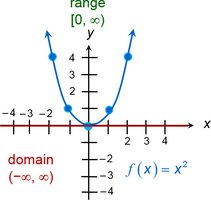
Simplest Quadratic: is the basic quadratic function.
Domain:
Range: for
Parabolas and Their Properties
The graph of a quadratic function is called a parabola. Parabolas have several important properties:
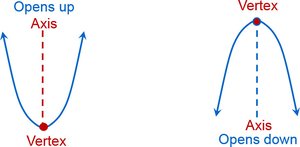
Axis of Symmetry: The vertical line that divides the parabola into two symmetric halves.
Vertex: The point where the axis of symmetry intersects the parabola; it is the maximum or minimum point.
Opening Direction: Parabolas open upward if and downward if .
Graphing Quadratic Functions
Graphing Techniques
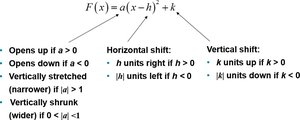
Quadratic functions can be graphed using transformations and by completing the square. The vertex form is especially useful:
Vertex Form:
Vertex:
Axis of Symmetry:
Transformations:
Opens up if , down if
Vertical stretch/shrink depending on
Horizontal shift by units
Vertical shift by units
Example: Graphing Quadratic Functions
Graphing by plotting points and identifying the vertex and axis of symmetry:
Vertex:
Axis of Symmetry:
Domain:
Range:
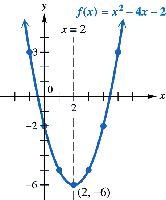
Completing the Square
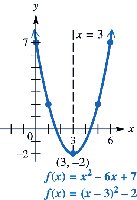
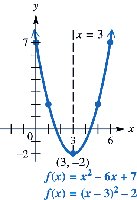
Completing the square is a method used to rewrite a quadratic function in vertex form, which makes graphing and analysis easier.
Process: Rewrite as by completing the square.
Vertex: The resulting gives the vertex.
Intervals of Increase/Decrease: The function decreases to the vertex and increases after.
Graphing When a ≠ 1
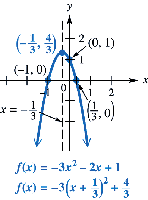
When the leading coefficient , factor from the quadratic terms before completing the square. This affects the width and direction of the parabola.
Example:
Vertex:
Intercepts: Find y-intercept by evaluating ; x-intercepts by solving .

Vertex Formula and Quadratic Models
Vertex Formula
The vertex of a parabola given by can be found using:
Axis of Symmetry:
Vertex:
Quadratic Models in Applications
Quadratic functions are used to model real-world phenomena, such as projectile motion and population growth.
Projectile Motion: models the height of an object projected upward.
Maximum Height: Occurs at the vertex.
Interval Analysis: Quadratic inequalities can determine intervals where the function exceeds a certain value.
Time to Hit Ground: Solve for using the quadratic formula.
Quadratic Regression and Data Modeling
Modeling Data with Quadratic Functions
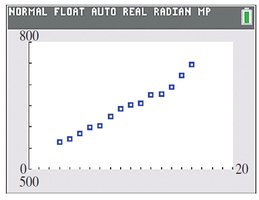
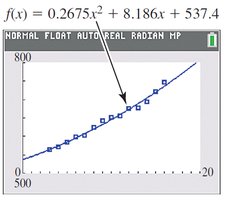
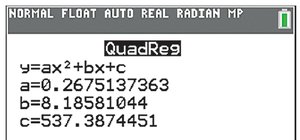
Quadratic regression is used to fit a quadratic model to real-world data, such as hospital outpatient visits over time.
Scatter Diagram: Visual representation of data points.
Quadratic Regression: Finds the best-fit quadratic equation .
Prediction: Use the model to estimate values for future years.
Solving Quadratic Equations
Quadratic Formula and X-Intercepts
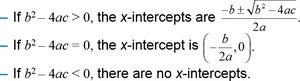
The quadratic formula is used to find the x-intercepts (roots) of a quadratic function:
Quadratic Formula:
Discriminant: determines the nature of the roots:
If , two real roots
If , one real root
If , no real roots
Summary Table: Properties of Quadratic Functions
Property | Description |
|---|---|
General Form | |
Vertex Form | |
Vertex | or |
Axis of Symmetry | or |
Opening Direction | Up if , down if |
Domain | |
Range | Depends on and |
Additional info: Academic context was added to clarify the process of completing the square, the use of quadratic regression, and the application of quadratic models in projectile motion and data prediction.
