 Indietro
3-02: Study Notes: Synthetic Division, Remainder Theorem, and Potential Zeros of Polynomial Functions
Guida di studio - Note intelligenti
 Appunti personalizzati basati sui tuoi materiali, ampliati con definizioni chiave, esempi e contesto.
Polynomial and Rational Functions
Synthetic Division
Synthetic division is a streamlined method for dividing a polynomial by a binomial of the form x − k. It is especially useful for polynomials with real or complex coefficients and simplifies the process by focusing only on the coefficients.
Definition: Synthetic division is a shortcut for the traditional long division of polynomials, applicable when the divisor is linear (degree 1).
Setup: Write the coefficients of the polynomial, using 0 for any missing terms.
Process: Multiply and add coefficients according to the synthetic division algorithm.
Result: The bottom row gives the coefficients of the quotient and the remainder.
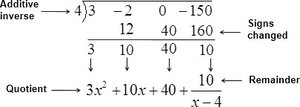
Example: Dividing 3x3 - 2x2 + 0x - 150 by x + 4 using synthetic division:
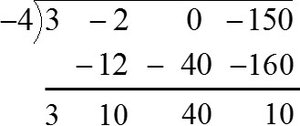
To simplify arithmetic, subtraction can be replaced by addition, and the divisor's sign is changed to its additive inverse:
Caution: Always use 0 for missing coefficients to avoid errors.
Division Algorithm for Polynomials
The division algorithm states that for polynomials f(x) and g(x) (with g(x) of lesser degree), there exist unique polynomials q(x) (quotient) and r(x) (remainder) such that:
Either or the degree of is less than the degree of .
Example: Synthetic Division Step-by-Step
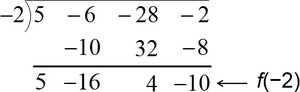
Dividing 5x3 - 6x2 - 28x - 2 by x + 2:
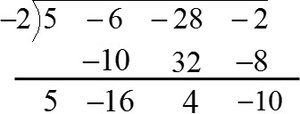
Bring down the first coefficient.
Multiply by the divisor's root and add to the next coefficient.
Continue until all coefficients are processed.
The last value is the remainder.
Special Case of the Division Algorithm
For any polynomial f(x) and any complex number k, there exists a unique polynomial q(x) and number r such that:
This form is essential for the remainder theorem.
Remainder Theorem
The remainder theorem states that when a polynomial f(x) is divided by x − k, the remainder is f(k).
Application: To find f(k), perform synthetic division with x − k as the divisor. The remainder is f(k).
Example: Dividing 5x3 - 6x2 - 28x - 2 by x + 2 gives remainder −10, so f(−2) = −10.
Tip: Use parentheses around substituted values to avoid errors.
Example: Using the Remainder Theorem
To find f(−2) for 5x3 - 6x2 - 28x - 2:
Example: Applying the Remainder Theorem
To find f(−3) for x4 + 3x3 - 4x2 - 5x:
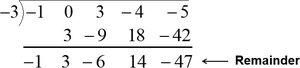
By this result, f(−3) = −47.
Testing Potential Zeros of Polynomial Functions
A zero of a polynomial function f(x) is a number k such that f(k) = 0. Real zeros correspond to x-intercepts of the graph.
Use synthetic division to find f(k).
If the remainder is 0, k is a zero of f(x).
If the remainder is not 0, k is not a zero.
Example: Deciding Whether a Number is a Zero
For f(x) and proposed zero k:
If remainder is 0, k is a zero and an x-intercept.
If remainder is not 0, k is not a zero.
Example with Complex Numbers
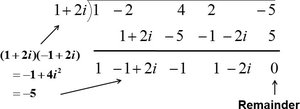
To determine if 1 + 2i is a zero:
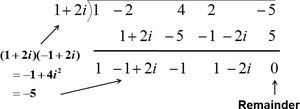
Since the remainder is 0, 1 + 2i is a zero of the polynomial, but not a real zero (no x-intercept).
Summary Table: Synthetic Division Steps
Step | Description |
|---|---|
Write coefficients | List all coefficients, using 0 for missing terms |
Set up divisor | Use the root k from x − k |
Bring down first coefficient | Start the process |
Multiply and add | Multiply by k, add to next coefficient |
Continue | Repeat until all coefficients are processed |
Interpret result | Bottom row gives quotient and remainder |
Additional info: Synthetic division is a fundamental tool in Precalculus for efficiently dividing polynomials, finding remainders, and testing potential zeros, including complex roots.
