 Indietro
Triangles and Their Properties in Precalculus
Guida di studio - Note intelligenti
 Appunti personalizzati basati sui tuoi materiali, ampliati con definizioni chiave, esempi e contesto.
Triangles: Classification and Properties
Classifying Triangles
Triangles are fundamental geometric shapes with three sides and three angles. The sum of the interior angles of any triangle is always radians (180°). Triangles can be classified by their angles or by their side lengths.
By Angles:
Acute Triangle: All three angles are less than 90° (or radians).
Obtuse Triangle: One angle is greater than 90° (or radians).
Right Triangle: One angle is exactly 90° (or radians). The side opposite the right angle is called the hypotenuse, and the other two sides are called legs.
By Sides:
Scalene Triangle: No sides are congruent; all sides have different lengths.
Isosceles Triangle: At least two sides are congruent. The angles opposite the congruent sides are also congruent.
Equilateral Triangle: All three sides are congruent, and all angles are equal (each angle is 60° or radians).
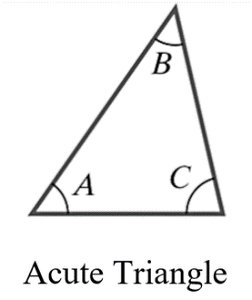
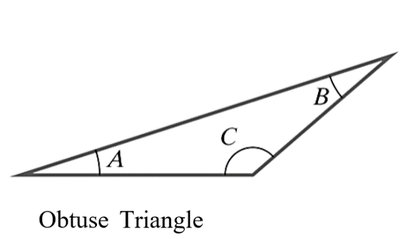
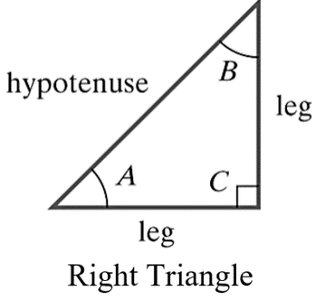
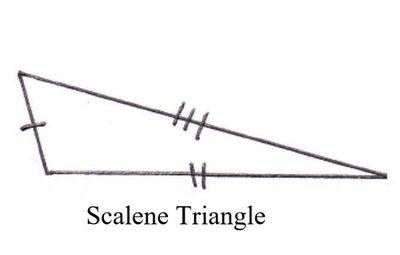
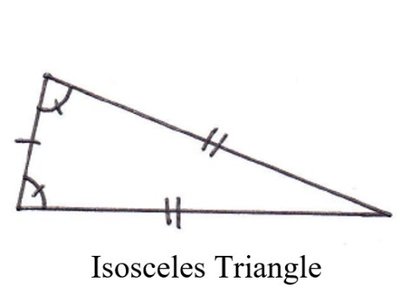
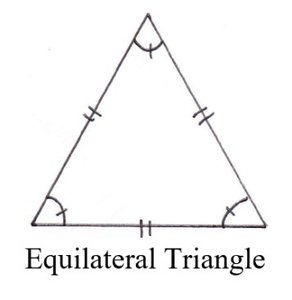
Example: A triangle with angles 60°, 60°, and 60° is an equilateral triangle. A triangle with angles 30°, 60°, and 90° is a right triangle.
The Pythagorean Theorem
Relationship in Right Triangles
The Pythagorean Theorem describes a unique relationship among the sides of a right triangle. It states that the sum of the squares of the lengths of the legs equals the square of the length of the hypotenuse. This relationship only holds for right triangles.
Formula: where a and b are the lengths of the legs, and c is the length of the hypotenuse.
Pythagorean Triples: Sets of three positive integers that satisfy the Pythagorean Theorem, such as (3, 4, 5), (5, 12, 13), and (8, 15, 17). Multiples of these sets are also Pythagorean triples (e.g., 6, 8, 10).
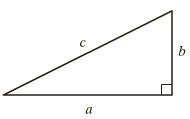
Example: For a right triangle with legs of length 5 and 12, the hypotenuse is .
Similar Triangles
Definition and Properties
Similar triangles have the same shape but not necessarily the same size. This means their corresponding angles are equal, and the lengths of their corresponding sides are proportional.
Corresponding Angles: All corresponding angles are congruent.
Proportional Sides: The ratio of the lengths of any two corresponding sides is the same for both triangles.
Proportionality Constant (k): If two triangles are similar, then , where are sides of the larger triangle, are sides of the smaller triangle, and .
Example: If triangle ABC is similar to triangle XYZ, and the sides of ABC are twice as long as those of XYZ, then .
Special Right Triangles
45°-45°-90° Triangle
This is an isosceles right triangle where the two acute angles are each 45° ( radians). The legs are congruent, and the hypotenuse is times the length of a leg.
Side Lengths: If each leg has length , then the hypotenuse has length .
Example: If the legs are 1 unit each, the hypotenuse is units.
30°-60°-90° Triangle
This triangle has angles of 30° ( radians), 60° ( radians), and 90° ( radians). It can be formed by bisecting an equilateral triangle. The side lengths are always in the ratio 1 : : 2.
Side Lengths: If the shortest leg (opposite 30°) is , the hypotenuse is , and the other leg (opposite 60°) is .
Example: If the shortest leg is 1 unit, the hypotenuse is 2 units, and the other leg is units.
