 Indietro
Trigonometric Functions of Any Angle
Guida di studio - Note intelligenti
 Appunti personalizzati basati sui tuoi materiali, ampliati con definizioni chiave, esempi e contesto.
Trigonometric Functions of Any Angle
Definitions of Trigonometric Functions of Any Angle
Trigonometric functions can be defined for any angle, not just acute angles in right triangles. For an angle θ in standard position, with its terminal side passing through the point P = (x, y) and distance r = \sqrt{x^2 + y^2} from the origin, the six trigonometric functions are defined as:
Sine:
Cosine:
Tangent: , x ≠ 0
Cosecant: , y ≠ 0
Secant: , x ≠ 0
Cotangent: , y ≠ 0
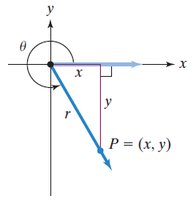
Example: If the terminal side of θ passes through (3, 4), then , so , , , etc.
Trigonometric Functions of Quadrantal Angles
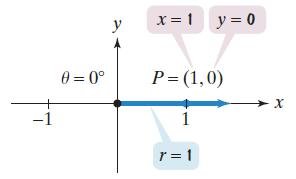
Quadrantal angles are angles whose terminal sides lie on the x- or y-axis (e.g., 0°, 90°, 180°, 270°, or their radian equivalents). The trigonometric functions for these angles can be evaluated by considering the coordinates of the point where the terminal side intersects the unit circle.
At θ = 0° (or 0 radians), the point is (1, 0), so , , .
At θ = 90° (or radians), the point is (0, 1), so , , is undefined.
Similar reasoning applies for 180°, 270°, and 360°.
The Signs of the Trigonometric Functions
The sign of a trigonometric function depends on the quadrant in which the terminal side of the angle lies:
Quadrant I: All trigonometric functions are positive.
Quadrant II: Only sine and cosecant are positive.
Quadrant III: Only tangent and cotangent are positive.
Quadrant IV: Only cosine and secant are positive.
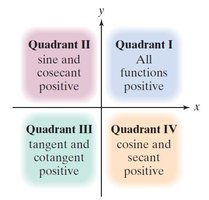
Example: If θ is in Quadrant III, then is negative, is negative, but is positive.
Reference Angles
A reference angle is the acute angle formed by the terminal side of θ and the x-axis. Reference angles are always positive and less than 90° (or radians). They are used to evaluate trigonometric functions for any angle by relating them to the corresponding acute angle in the first quadrant.
For θ in Quadrant I: Reference angle = θ
For θ in Quadrant II: Reference angle = 180° – θ (or )
For θ in Quadrant III: Reference angle = θ – 180° (or )
For θ in Quadrant IV: Reference angle = 360° – θ (or )
Example: The reference angle for 210° is 210° – 180° = 30°.
Using Reference Angles to Evaluate Trigonometric Functions
To evaluate a trigonometric function for any angle:
Find the reference angle for θ.
Evaluate the trigonometric function for the reference angle.
Determine the correct sign based on the quadrant in which θ lies.
Example: To find :
Reference angle = 180° – 150° = 30°
150° is in Quadrant II, where sine is positive, so
Procedure Summary:
Identify the quadrant of θ.
Find the reference angle.
Evaluate the function for the reference angle.
Apply the correct sign.
Additional info: For angles greater than 360° (or ) or less than –360° (or –$2\pi$), subtract or add multiples of 360° (or $2\pi$) to find a coterminal angle between 0° and 360° (or 0 and $2\pi$), then proceed as above.
