 Indietro
Trigonometric Functions of Any Angle and Reference Angles
Guida di studio - Note intelligenti
 Appunti personalizzati basati sui tuoi materiali, ampliati con definizioni chiave, esempi e contesto.
Trigonometric Functions of Any Angle
Definitions and Fundamental Concepts
Trigonometric functions can be defined for any angle, not just acute angles in right triangles. For an angle θ in standard position, with a point P(x, y) on its terminal side and r = \sqrt{x^2 + y^2}, the six trigonometric functions are defined as follows:
sin θ = \frac{y}{r}
cos θ = \frac{x}{r}
tan θ = \frac{y}{x}
csc θ = \frac{r}{y}
sec θ = \frac{r}{x}
cot θ = \frac{x}{y}
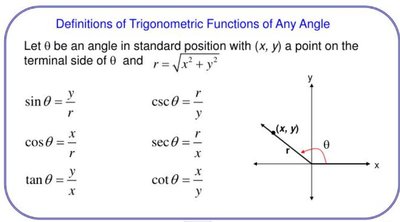
These definitions allow us to evaluate trigonometric functions for any angle, including those whose terminal sides lie in different quadrants.
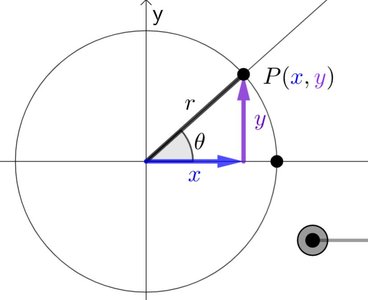
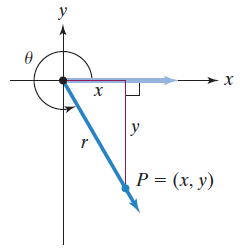
Evaluating Trigonometric Functions for a Given Point
Given a point P(x, y) on the terminal side of θ, you can find all six trigonometric functions by first calculating r and then applying the definitions above.
Example: Let P = (1, –3). Find x, y, r, and each trigonometric function of θ.
x = 1, y = –3
r = \sqrt{1^2 + (-3)^2} = \sqrt{1 + 9} = \sqrt{10}
sin θ = \frac{-3}{\sqrt{10}}
cos θ = \frac{1}{\sqrt{10}}
tan θ = \frac{-3}{1} = -3
csc θ = \frac{\sqrt{10}}{-3}
sec θ = \frac{\sqrt{10}}{1} = \sqrt{10}
cot θ = \frac{1}{-3} = -\frac{1}{3}
Trigonometric Functions of Quadrantal Angles
Definition and Evaluation
Quadrantal angles are angles whose terminal sides lie on the x- or y-axis (0°, 90°, 180°, 270°, etc.). The values of trigonometric functions at these angles can be found by considering the coordinates of the corresponding points on the unit circle.
At θ = 0° (0 radians): P = (1, 0)
cos 0° = 1
csc 0° is undefined (since y = 0)
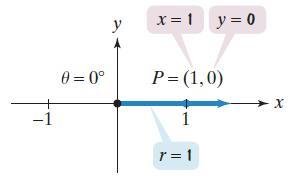
At θ = 90° (\frac{\pi}{2} radians): P = (0, 1)
cos 90° = 0
csc 90° = 1
At θ = 180° (\pi radians): P = (–1, 0)
cos 180° = –1
csc 180° is undefined (since y = 0)
At θ = 270° (\frac{3\pi}{2} radians): P = (0, –1)
cos 270° = 0
csc 270° = –1
Signs of Trigonometric Functions in Each Quadrant
Understanding Signs by Quadrant
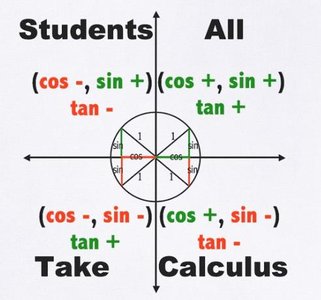
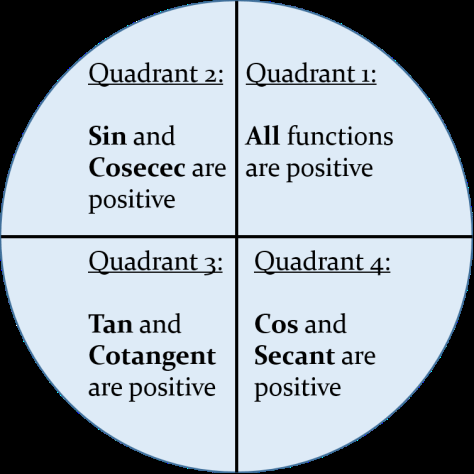
The sign of a trigonometric function depends on the quadrant in which the terminal side of the angle lies. The mnemonic "All Students Take Calculus" helps remember which functions are positive in each quadrant:
Quadrant I: All functions are positive
Quadrant II: Sine and cosecant are positive
Quadrant III: Tangent and cotangent are positive
Quadrant IV: Cosine and secant are positive
Determining the Quadrant from Function Signs
Given the signs of sine, cosine, or tangent, you can determine the quadrant in which the angle lies:
If sin θ < 0 and cos θ > 0, θ is in Quadrant IV.
If sin θ > 0 and cos θ < 0, θ is in Quadrant II.
If tan θ < 0 and cos θ > 0, θ is in Quadrant IV.
If sin θ > 0 and tan θ > 0, θ is in Quadrant I.
If sin θ < 0 and cos θ < 0, θ is in Quadrant III.
Reference Angles
Definition and Properties
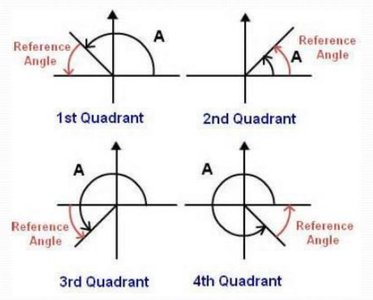
A reference angle is the acute angle formed between the terminal side of a given angle and the x-axis. Reference angles are always positive and are used to simplify the evaluation of trigonometric functions for any angle.
Finding Reference Angles
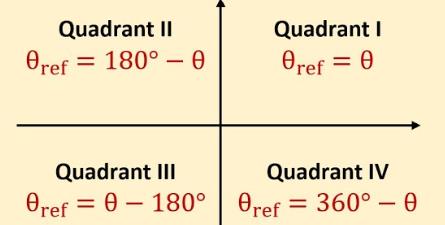
The reference angle θ' for an angle θ depends on the quadrant:
Quadrant | Reference Angle Formula |
|---|---|
I | θ' = θ |
II | θ' = 180° – θ |
III | θ' = θ – 180° |
IV | θ' = 360° – θ |
Example: Find the reference angle for θ = 210°.
θ is in Quadrant III, so θ' = 210° – 180° = 30°.
Example: θ = –240°
Add 360°: –240° + 360° = 120°, which is in Quadrant II. θ' = 180° – 120° = 60°.
Example: θ = \frac{7\pi}{4}
θ is in Quadrant IV, so θ' = 2\pi – \frac{7\pi}{4} = \frac{8\pi}{4} – \frac{7\pi}{4} = \frac{\pi}{4}.
Reference Angles for Angles Greater Than 360° or Less Than –360°
For angles outside the range [0°, 360°], first find a coterminal angle by adding or subtracting multiples of 360° (or 2π radians) until the angle is within one full rotation. Then, use the quadrant rules above to find the reference angle.
Example: θ = 665°
665° – 360° = 305°, which is in Quadrant IV. θ' = 360° – 305° = 55°.
Example: θ = \frac{15\pi}{4}
\frac{15\pi}{4} – 2\pi = \frac{15\pi}{4} – \frac{8\pi}{4} = \frac{7\pi}{4}, which is in Quadrant IV. θ' = 2\pi – \frac{7\pi}{4} = \frac{\pi}{4}.
Using Reference Angles to Evaluate Trigonometric Functions
The value of a trigonometric function for any angle θ is the same as the value for its reference angle θ', except possibly for the sign, which is determined by the quadrant in which θ lies.
Procedure:
Find the reference angle θ'.
Evaluate the trigonometric function for θ'.
Assign the correct sign based on the quadrant of θ.
Example: Find sin 300°.
Reference angle: 360° – 300° = 60°. sin 60° = \frac{\sqrt{3}}{2}. 300° is in Quadrant IV, where sine is negative, so sin 300° = –\frac{\sqrt{3}}{2}.
Example: Find tan \frac{5\pi}{4}.
Reference angle: \frac{5\pi}{4} – \pi = \frac{\pi}{4}. tan \frac{\pi}{4} = 1. \frac{5\pi}{4} is in Quadrant III, where tangent is positive, so tan \frac{5\pi}{4} = 1.
