Indietro
Vertical Shifts of Functions: Domain and Range
Guida di studio - Note intelligenti
 Appunti personalizzati basati sui tuoi materiali, ampliati con definizioni chiave, esempi e contesto.
Vertical Shifts of Functions
Understanding Vertical Shifts
Vertical shifts are transformations that move the graph of a function up or down without affecting its shape. These shifts only impact the range of the function, not the domain.
Vertical Shift Up: If a positive real number k is added to the output of a function f(x), the graph of the new function f(x) + k is shifted vertically up by k units.
Vertical Shift Down: If a positive real number k is subtracted from the output of a function f(x), the graph of the new function f(x) - k is shifted vertically down by k units.
Example: Vertical Shift Down
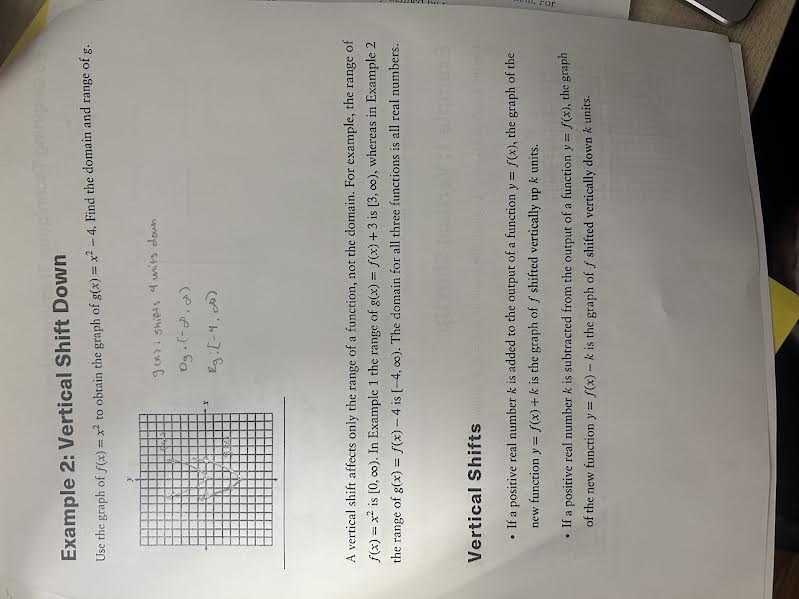
Consider the function f(x) = x2. The graph of g(x) = x2 - 4 is obtained by shifting the graph of f(x) downward by 4 units.
Domain of f(x):
Range of f(x):
Domain of g(x):
Range of g(x):
Explanation: The domain remains unchanged because the transformation does not affect the input values. The range is shifted down by 4 units, so the minimum value of g(x) is -4 instead of 0.
General Formula for Vertical Shifts
For f(x) + k: Range is shifted up by k units.
For f(x) - k: Range is shifted down by k units.
Example: If f(x) = x2, then:
f(x) + 3: Range is
f(x) - 4: Range is