 Indietro
Principles of Accounting: Long-Term Liabilities, Bonds, and Time Value of Money
Guida di studio - Note intelligenti
 Appunti personalizzati basati sui tuoi materiali, ampliati con definizioni chiave, esempi e contesto.
Long-Term Liabilities
Definition and Types
Long-term liabilities are obligations that a company expects to pay after one year or more. They are crucial for understanding a company's financial structure and include several key types:
Notes Payable: Written promises to pay a certain amount of money at a future date.
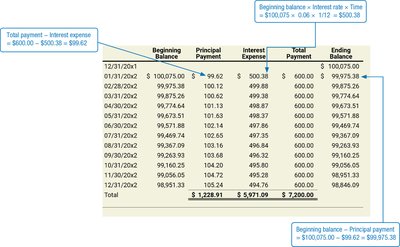
Mortgage Payable: Loans secured by real estate property.
Bonds Payable: Debt securities issued to investors, typically with fixed interest payments.
Examples and Applications
- **Example:** A company may issue a 10-year note payable for $20,000, agreeing to pay interest and principal over the term. - **Application:** Mortgages are used to finance buildings, while bonds are used for large-scale capital needs. 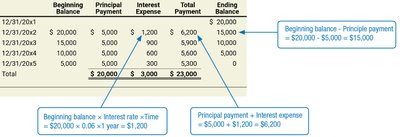
Bonds Payable
Bond Terminology
Bonds are a common form of long-term debt. Key terms include:
Face Value: The amount the issuer agrees to pay at maturity.
Stated Interest Rate: The rate used to calculate periodic interest payments.
Market Interest Rate: The rate investors demand for similar risk bonds.
Issue Price: The price at which bonds are sold, which may be at face value, a discount, or a premium.
Bond Pricing
The relationship between the stated and market interest rates determines the bond's issue price:
Stated Rate | Market Rate | Issue Price |
|---|---|---|
9% | 9% | Face value |
9% | 10% | Discount |
9% | 8% | Premium |

Bond Payment Schedules
Bonds typically pay interest semiannually. The payment schedule includes regular interest payments and repayment of principal at maturity. 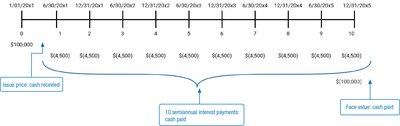


Accounting for Bonds
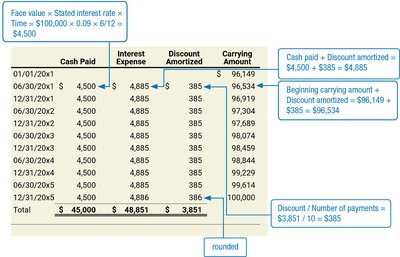
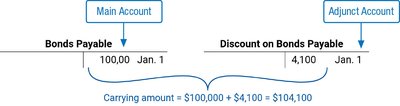
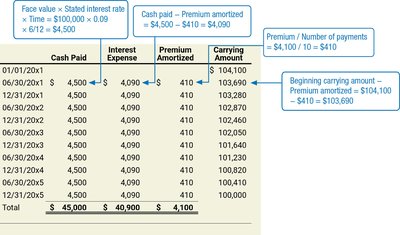
- **Discount on Bonds Payable:** When bonds are issued below face value, the difference is recorded as a discount and amortized over the bond's life. - **Premium on Bonds Payable:** When bonds are issued above face value, the excess is recorded as a premium and amortized. - **Carrying Value:** The net amount of bonds payable after adjusting for discount or premium. 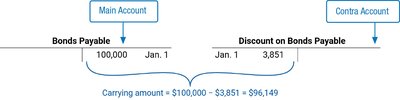
Time Value of Money
Concept Overview
The time value of money is a fundamental principle in accounting and finance, stating that a dollar today is worth more than a dollar in the future due to its earning potential.
Present Value (PV): The current worth of a future sum of money.
Future Value (FV): The value of a current sum at a future date, given a specific interest rate.

Key Formulas
- **Present Value Formula:** - **Future Value Formula:** - **Ordinary Annuity Present Value:** - **Ordinary Annuity Future Value:**
Applications in Accounting
- **Bond Pricing:** The issue price of a bond is the present value of its future cash flows (interest payments and principal). - **Loan Amortization:** Calculating the present value of loan payments helps determine the amount borrowed. 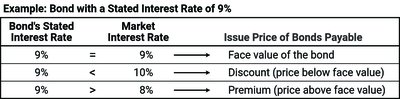
Amortization of Discounts and Premiums
Straight-Line Method
The straight-line method spreads the discount or premium evenly over the bond's life.
Discount Amortization:
Premium Amortization:

Effective-Interest Method
This method calculates amortization based on the carrying value and market rate, resulting in varying amounts each period.
Retirement of Bonds
Bond Retirement at Maturity
At maturity, the issuer repays the face value to bondholders.
Journal Entry: Debit Bonds Payable, Credit Cash.
Early Retirement
Bonds may be retired before maturity, often resulting in a gain or loss depending on the carrying value and market price paid.
Financial Leverage
Definition and Importance
Financial leverage refers to the use of debt to increase the potential return to equity holders. It is measured by the debt-to-equity ratio:
Debt-to-Equity Ratio:
Summary Table: Long-Term Liabilities on the Balance Sheet
Type | Example | Balance Sheet Presentation |
|---|---|---|
Notes Payable | Bank loan | Long-term liabilities |
Mortgage Payable | Building loan | Long-term liabilities |
Bonds Payable | Corporate bonds | Long-term liabilities (net of discount/premium) |
Key Takeaways
Long-term liabilities are essential for financing and investing activities.
Bonds can be issued at face value, discount, or premium depending on market conditions.
The time value of money is central to bond pricing and loan amortization.
Amortization of discounts and premiums affects interest expense and carrying value.
Financial leverage impacts risk and return for shareholders.
