 Indietro
Biological Psychology: Structure and Function of the Nervous System
Guida di studio - Note intelligenti
 Appunti personalizzati basati sui tuoi materiali, ampliati con definizioni chiave, esempi e contesto.
Biological Psychology
The Nervous System: Overview
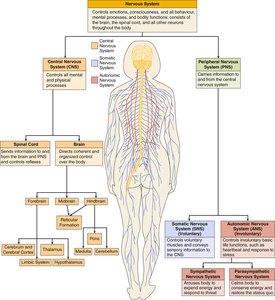
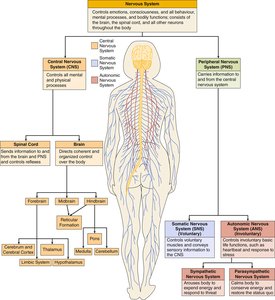
The nervous system is the primary control center for emotions, consciousness, behavior, and bodily functions. It consists of the brain, spinal cord, and a network of nerves that extend throughout the body. The nervous system is divided into two main parts: the Central Nervous System (CNS) and the Peripheral Nervous System (PNS).
Central Nervous System (CNS): Includes the brain and spinal cord. Responsible for processing information and controlling most mental and physical processes.
Peripheral Nervous System (PNS): Composed of nerves that branch out from the CNS to the rest of the body. It transmits information to and from the CNS.
Central Nervous System (CNS)
The CNS is the core of the nervous system, responsible for integrating sensory information and responding accordingly. It consists of:
Brain: The main organ for processing information, controlling thoughts, emotions, and movements.
Spinal Cord: Connects the brain to the PNS and controls reflexes.
The brain is further divided into regions:
Forebrain: Includes the cerebral cortex, thalamus, hypothalamus, and limbic system. Responsible for higher-order functions like reasoning, emotions, and memory.
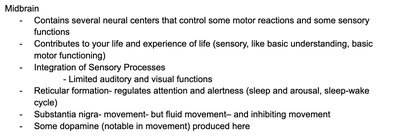
Midbrain: Contains neural centers for motor reactions and sensory functions. Integrates sensory processes and regulates attention and alertness via the reticular formation. The substantia nigra is involved in movement and dopamine production.
Hindbrain: Includes the cerebellum, pons, and medulla. Controls basic life functions such as breathing, heart rate, and motor coordination.
Midbrain: Structure and Function
The midbrain is a small but crucial part of the brainstem, involved in motor control, sensory processing, and regulation of alertness.
Motor and Sensory Centers: Controls some motor reactions and sensory functions.
Integration of Sensory Processes: Limited auditory and visual functions.
Reticular Formation: Regulates attention, alertness, sleep, and arousal (sleep-wake cycle).
Substantia Nigra: Involved in movement, fluid motor control, and inhibition of movement. Produces dopamine, which is essential for movement regulation.
Example: Damage to the substantia nigra is associated with Parkinson's disease, which affects movement.
Peripheral Nervous System (PNS)
The PNS connects the CNS to limbs and organs. It is divided into:
Somatic Nervous System: Controls voluntary movements and transmits sensory information.
Autonomic Nervous System (ANS): Regulates involuntary functions (e.g., heart rate, digestion). The ANS is further divided into the sympathetic (activates fight-or-flight response) and parasympathetic (promotes rest and digestion) systems.
Neurons: Structure and Types
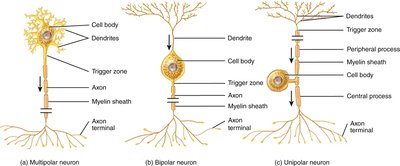
Neurons are the basic units of the nervous system, responsible for transmitting information throughout the body. They have specialized structures for receiving and sending signals.
Cell Body: Contains the nucleus and metabolic machinery.
Dendrites: Receive signals from other neurons.
Axon: Transmits electrical impulses away from the cell body.
Myelin Sheath: Insulates the axon, speeding up signal transmission.
Axon Terminal: Releases neurotransmitters to communicate with other neurons.
Types of neurons:
Multipolar Neuron: Has multiple dendrites and one axon; common in the CNS.
Bipolar Neuron: Has one dendrite and one axon; found in sensory organs.
Unipolar Neuron: Has a single process that splits into two branches; often found in the PNS.
Summary Table: Nervous System Divisions
Division | Main Function | Key Structures |
|---|---|---|
Central Nervous System (CNS) | Processing and integration of information | Brain, Spinal Cord |
Peripheral Nervous System (PNS) | Transmission of information to/from CNS | Nerves, Somatic and Autonomic Systems |
Somatic Nervous System | Voluntary movement | Motor and sensory nerves |
Autonomic Nervous System (ANS) | Involuntary functions | Sympathetic and Parasympathetic branches |
Key Terms and Concepts
Neuron: Basic cell of the nervous system.
Dopamine: Neurotransmitter involved in movement and reward.
Reticular Formation: Network regulating alertness and sleep.
Substantia Nigra: Midbrain structure producing dopamine.
Additional info: The notes expand on the midbrain's functions and provide context for the nervous system's structure and neuron types, making the guide self-contained for introductory psychology students.
