 Indietro
Bronfenbrenner’s Ecological Systems Theory and Psychology Participant Pool
Guida di studio - Note intelligenti
 Appunti personalizzati basati sui tuoi materiali, ampliati con definizioni chiave, esempi e contesto.
Bronfenbrenner’s Ecological Systems Theory
Introduction to Ecological Systems Theory
Bronfenbrenner’s Ecological Systems Theory is a foundational concept in developmental psychology, emphasizing how a child’s development is influenced by multiple layers of environmental factors. This model helps explain the complex interplay between individual, social, and cultural influences on human growth.
Key Point 1: The theory identifies several systems that interact to shape development, ranging from immediate surroundings to broader societal influences.
Key Point 2: Bronfenbrenner’s work challenged traditional views by highlighting the importance of context and policy in child development.
Example: The Head Start programme, co-founded by Bronfenbrenner, provides early learning opportunities to children from disadvantaged backgrounds, illustrating the impact of policy and community on development.
Systems in Bronfenbrenner’s Model
The ecological model consists of several nested systems, each representing a different level of influence:
Macrosystem: The broadest level, encompassing cultural values, customs, and laws.
Exosystem: External environments that indirectly affect the individual, such as parents’ workplaces or community services. Additional info: Exosystem is not explicitly listed in the notes but is part of Bronfenbrenner's original model.
Mesosystem: Interconnections between microsystems, such as relationships between family and school.
Microsystem: Immediate environments, including family, school, and peers.
Individual: The child or person at the center of the model, whose development is shaped by all surrounding systems.
Each system interacts dynamically, influencing the individual’s development through direct and indirect pathways.
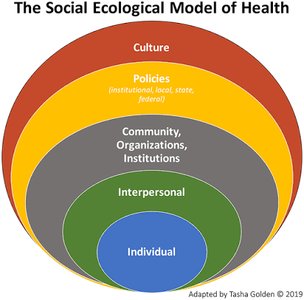
Application: Social Ecological Model of Health
The Social Ecological Model of Health, adapted from Bronfenbrenner’s theory, illustrates how health outcomes are shaped by multiple layers:
Culture: Overarching beliefs and practices that influence all other systems.
Policies: Institutional, local, state, and federal regulations that affect health and development.
Community, Organizations, Institutions: Social structures that provide support and resources.
Interpersonal: Relationships with family, friends, and peers.
Individual: Personal characteristics and behaviors.
This model is used to understand how interventions at different levels can improve health and well-being.
Psychology Participant Pool (SONA)
Introduction to Research Participation
Psychology courses often require students to participate in research studies, contributing to the scientific process and gaining firsthand experience in psychological research.
Key Point 1: Students must enroll in the correct psychology course and provide identifying information (full name, NSID, course, professor).
Key Point 2: Participation is tracked by credits, with 30 minutes of study per credit (e.g., 1.5 hours for 3 credits).
Example: Students screenshot debrief forms as proof of participation.
Importance of Critical Thinking in Psychology
With rapid changes in technology and globalization, access to information has increased, but so has the prevalence of misinformation. Psychology students must develop critical thinking skills to evaluate sources and avoid the negative effects of misinformation, such as anxiety and loss of sleep.
Key Point 1: Critical thinking is essential for distinguishing scientific facts from false information.
Key Point 2: Misinformation can undermine the scientific integrity of psychology and impact mental health.
Additional info: The notes emphasize the importance of culture and policy in shaping psychological science, aligning with the themes of Ch. 1 (Introducing Psychological Science) and Ch. 10 (Lifespan Development).
